
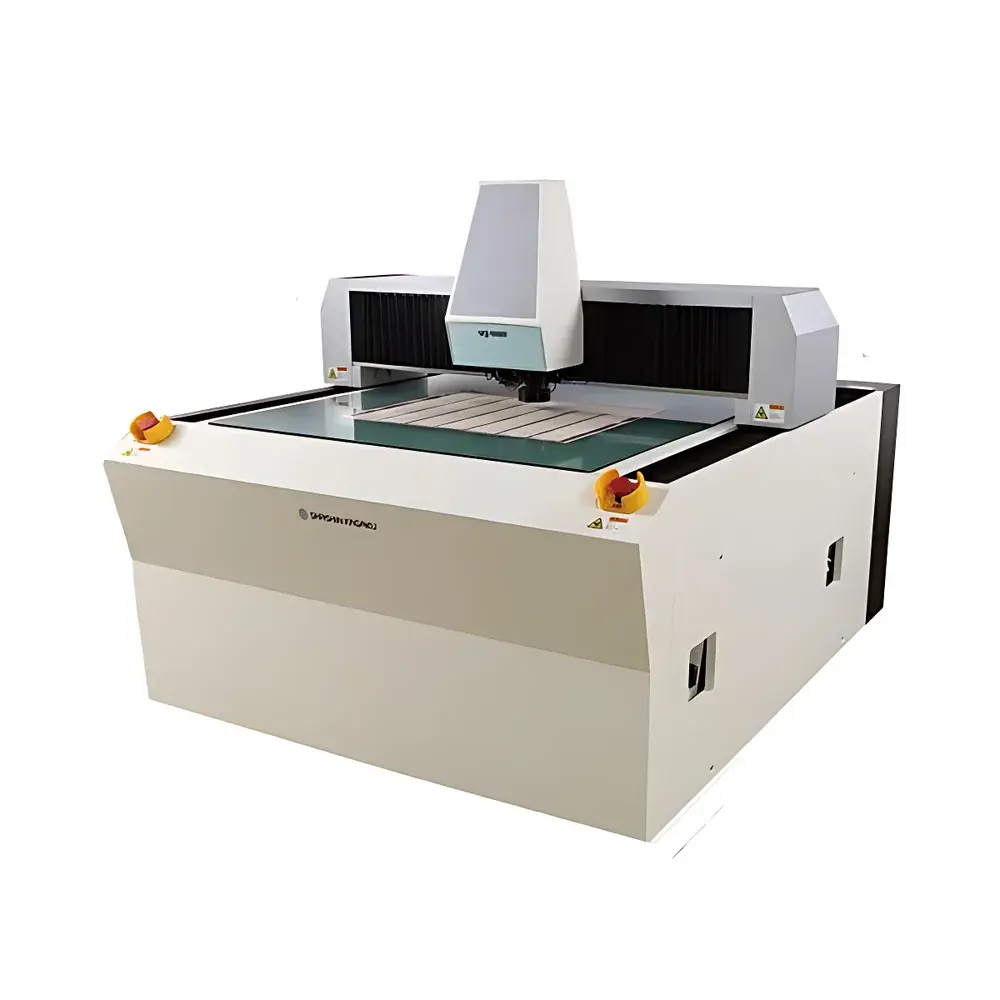
SHASHIN KAGAKU SQ-9000 Precision Automated Long-Dimension Measuring System
| Brand | SHASHIN KAGAKU |
|---|---|
| Origin | Japan |
| Manufacturer Type | Authorized Distributor |
| Product Origin | Imported |
| Model | SQ-9000 |
| Pricing | Upon Request |
| Effective Measurement Range (X×Y×Z) | 700 × 900 × 60 mm |
| Maximum Workpiece Dimensions (X×Y×Z) | 1000 × 1250 × 60 mm |
| Maximum Workpiece Thickness | 60 mm |
| Minimum Readout Unit | 0.1 µm |
| XY Measurement Accuracy | U₁ = (3 + L/250) µm, U₂ = (4 + L/230) µm |
| Z-Axis Measurement Accuracy | (1.5 + 4L/1000) µm |
Overview
The SHASHIN KAGAKU SQ-9000 is a high-precision automated long-dimension measuring system engineered for metrological-grade dimensional inspection of large-format industrial components. Unlike conventional coordinate measuring machines (CMMs) or optical comparators, the SQ-9000 integrates advanced machine vision architecture with mechanically stabilized gantry motion control to deliver traceable, repeatable measurements across extended X–Y planes—up to 1000 mm × 1250 mm in footprint—while maintaining sub-micron resolution in all three axes. Its core measurement principle combines telecentric imaging optics, high-resolution monochrome CMOS sensors, and deterministic stage positioning to realize non-contact, full-field 2D profile capture and calibrated Z-axis height mapping. Designed specifically for applications demanding geometric fidelity over large areas—such as printed circuit board (PCB) panel inspection, flat-panel display (FPD) mask verification, precision sheet metal fabrication, and semiconductor substrate handling—the SQ-9000 meets the stringent repeatability and uncertainty requirements of ISO 10360-2 (CMM acceptance testing) and JIS B 7441 (optical measuring instruments). The system’s mechanical base is constructed from thermally stable granite with precision-ground linear guides, minimizing drift and ensuring long-term stability under controlled laboratory or cleanroom environments.
Key Features
- Granite-based rigid gantry structure with dual-axis motorized stage (X/Y) and motorized Z-axis focus drive for high-stability positioning
- Telecentric illumination and lens system optimized for low-distortion, parallax-free imaging across full field-of-view
- High-sensitivity monochrome CMOS sensor (≥5 MP effective resolution) with programmable exposure and gain control
- Sub-pixel edge detection algorithm supporting real-time contour extraction and geometric feature fitting (lines, circles, arcs, slots)
- Calibration-certified accuracy per ISO 15530-3: U₁ = (3 + L/250) µm and U₂ = (4 + L/230) µm in XY; (1.5 + 4L/1000) µm in Z, where L is measured length in mm
- 0.1 µm minimum readout resolution with bidirectional encoder feedback on all axes
- Integrated environmental compensation module (temperature, air pressure) for uncertainty reduction in variable lab conditions
Sample Compatibility & Compliance
The SQ-9000 accommodates flat or gently contoured workpieces up to 1250 mm in width, 1000 mm in length, and 60 mm in thickness—including PCB panels, photomasks, thin-film solar substrates, stamped metal sheets, and ceramic wafers. Its open-top design enables rapid loading/unloading via manual or automated conveyor interface. All measurement data comply with ISO/IEC 17025 documentation standards when operated within validated procedures. The system supports GLP/GMP-aligned audit trails, user access control levels, and electronic signature capability—fully compatible with FDA 21 CFR Part 11 requirements when configured with optional validation package. It adheres to CE marking directives (EMC Directive 2014/30/EU, Machinery Directive 2006/42/EC) and conforms to JIS B 7441 Class I specifications for optical measuring instruments.
Software & Data Management
The SQ-9000 operates with SHASHIN KAGAKU’s proprietary MetroVision™ software suite—a Windows-based platform supporting both guided operator workflows and script-driven batch automation. Core modules include geometric dimensioning and tolerancing (GD&T) analysis per ASME Y14.5 and ISO 1101, statistical process control (SPC) charting, multi-point trend monitoring, and export to industry-standard formats (IGES, STEP AP214, CSV, PDF report templates). Raw image archives, calibration logs, and measurement history are stored in an encrypted SQLite database with configurable retention policies. Optional integration with enterprise MES/QMS systems is available via RESTful API or OPC UA interface. Software validation documentation (IQ/OQ/PQ protocols) and electronic record integrity controls meet ISO 13485 and ICH Q9 requirements for regulated manufacturing environments.
Applications
- Dimensional verification of large-area printed circuit boards (PCBs), including solder mask alignment, via placement, and copper trace width/spacing
- Photomask and reticle inspection for semiconductor lithography tool qualification
- Flatness and warpage assessment of glass substrates used in OLED/LCD manufacturing
- Geometric tolerance evaluation of automotive stampings and chassis components
- Quality gate inspection for additive manufacturing build plates and large-format polymer parts
- Calibration artifact verification for secondary standards laboratories
FAQ
What is the maximum allowable surface roughness for reliable edge detection?
The system achieves robust edge localization on surfaces with Ra ≤ 3.2 µm; for higher roughness, optional structured light projection mode can be enabled to enhance Z-profile fidelity.
Can the SQ-9000 measure features with undercut geometry?
No—it is optimized for top-down optical profiling of nominally planar or low-curvature surfaces; side-wall or recessed feature measurement requires complementary tactile probing or CT scanning.
Is NIST-traceable calibration included with delivery?
Yes—a full factory calibration certificate (traceable to NMIJ/AIST) is provided, along with a set of certified reference artifacts for periodic in-house verification.
Does the system support multi-sensor fusion (e.g., adding a laser displacement sensor)?
Yes—two auxiliary sensor ports are available for synchronized integration of analog or digital external probes, subject to firmware revision v3.2 or later.
What maintenance schedule is recommended for long-term accuracy retention?
Annual recalibration and biannual optical path alignment verification are advised; daily warm-up (30 min) and weekly stage lubrication per OEM guidelines ensure optimal performance.



