
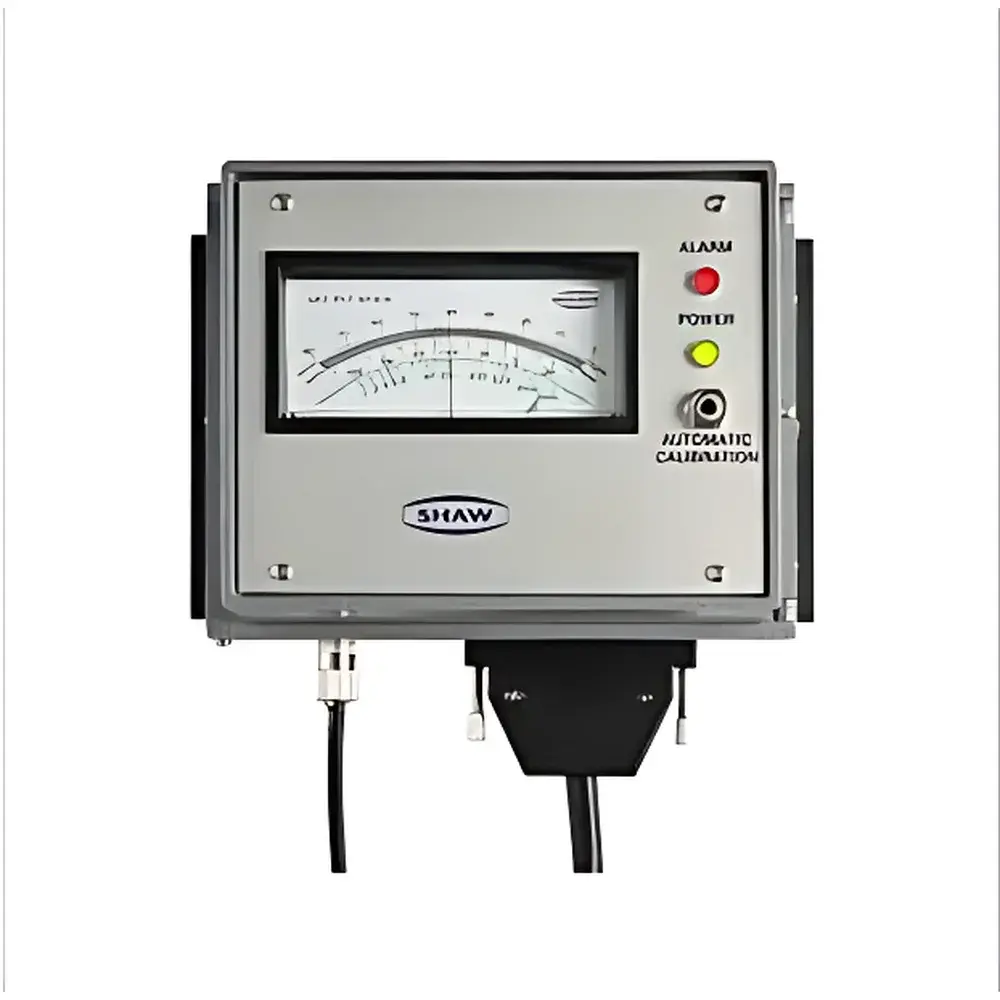
Shaw SDA-P Online Dew Point Meter
| Brand | Shaw |
|---|---|
| Origin | United Kingdom |
| Model | SDA-P |
| Type | Online Dew Point Meter |
| Principle | Chilled Mirror (Electrochemical Sensor Variant) |
| Operating Temperature | -20 °C to +50 °C |
| Accuracy | ±3 °C |
| Repeatability | ±3 °C |
| Measuring Range | -100 °C to 0 °C |
| Display | 3½-digit backlit LCD |
| Output | 4–20 mA analog signal, dual relay alarms (240 V AC @ 3 A) |
| Power Supply | 220 V AC, 50 Hz |
| Installation | Panel mount (cutout: 135 mm × 66 mm × 175 mm depth) |
| Sample Pressure | 1–30 psi (up to 200 bar sensor-rated) |
| Sample Flow Rate | 1–5 L/min (recommended: 1 L/min) |
| Gas Connection | 1/4" or 1/8" compression fittings |
| Intrinsic Safety | Sensor certified intrinsically safe |
| Calibration | Automatic 1-minute ambient air zero calibration |
| Compliance | ISO 9002 quality management system |
Overview
The Shaw SDA-P Online Dew Point Meter is a high-reliability, industrial-grade dew point analyzer engineered for continuous, real-time moisture monitoring in compressed air, process gases, and drying systems. Unlike capacitive or aluminum oxide sensors subject to drift and contamination, the SDA-P employs a robust electrochemical sensing principle—specifically optimized for stable performance across low-humidity environments where trace moisture control is critical. Its measurement range of –100 °C to 0 °C dew point enables precise verification of dryness in applications such as pharmaceutical nitrogen blanketing, semiconductor purge gas lines, and natural gas transmission pipelines. Designed for permanent installation, the SDA-P integrates seamlessly into PLC-controlled environments via standardized 4–20 mA output and supports dual relay alarm outputs for automated process interlocks. The instrument’s compact panel-mount chassis (135 mm × 66 mm × 175 mm depth) accommodates space-constrained control cabinets while maintaining full operational integrity under ambient temperatures from –20 °C to +50 °C.
Key Features
- Electrochemical dew point sensing technology with inherent stability in sub-ppm moisture regimes
- Full-scale accuracy of ±3 °C and repeatability of ±3 °C—validated per ISO 8573-1 Annex B methodology for compressed air quality certification
- Automatic ambient air zero calibration routine completed within 60 seconds, eliminating manual span adjustment during routine operation
- Backlit 3½-digit digital display for clear local readout under low-light industrial conditions
- Configurable high/low dew point alarm thresholds with dry-contact relay outputs rated at 240 V AC / 3 A
- Intrinsically safe sensor head compatible with hazardous area Zone 1/2 installations when paired with approved galvanic isolators or Zener barriers
- Extended cable capability: sensor-to-transmitter distance up to 1000 meters without signal degradation
- Gas inlet compatibility with standard 1/4″ or 1/8″ Swagelok-style compression fittings for rapid integration into existing pneumatic manifolds
Sample Compatibility & Compliance
The SDA-P is validated for use with non-corrosive, non-condensing gases including compressed air, nitrogen, argon, hydrogen, natural gas, and synthetic instrument air. It is not suitable for chlorine, ammonia, or highly reactive halogenated compounds due to electrochemical sensor limitations. Sample pressure tolerance spans 1–30 psi (0.07–2.1 bar), with optional high-pressure sensor variants rated to 200 bar for upstream pipeline monitoring. Flow rate is optimized at 1 L/min; deviations beyond 1–5 L/min may affect thermal equilibrium response time but do not compromise steady-state accuracy. The device complies with ISO 9002-certified manufacturing protocols and supports audit-ready documentation for GLP and GMP-regulated environments. While not inherently 21 CFR Part 11 compliant, its analog output architecture permits integration with validated SCADA or DCS platforms that provide electronic signature and audit trail functionality.
Software & Data Management
The SDA-P operates as a standalone field instrument without embedded firmware or network connectivity. All configuration—including alarm setpoints, display units (°C or °F), and output scaling—is performed via front-panel push-button interface. Analog 4–20 mA output is linearly proportional to dew point temperature across the selected range and may be logged directly by PLCs, data acquisition systems, or centralized HMI dashboards. For facilities requiring long-term trend analysis, the analog signal can be digitized using third-party DAQ hardware supporting Modbus RTU or Ethernet/IP gateways. No proprietary software or driver installation is required. Calibration history is maintained manually per facility SOPs; no internal memory or timestamped event logging is implemented—consistent with ISA-84.00.01 SIL-rated instrumentation design philosophy emphasizing determinism over feature bloat.
Applications
- Continuous monitoring of dryer outlet streams in heatless and refrigerated compressed air systems
- Verification of moisture compliance in ISO 8573-1 Class 1–4 compressed air networks for pharmaceutical cleanrooms
- Hydrogen purity assurance in fuel cell feed gas conditioning skids
- Trace moisture detection in LNG dehydration units prior to cryogenic storage
- Process gas validation in semiconductor fab nitrogen purging loops (target: <1 ppmv H₂O)
- Quality gate inspection for desiccant-filled packaging lines handling hygroscopic active pharmaceutical ingredients (APIs)
FAQ
What is the recommended sample flow rate for optimal SDA-P performance?
The manufacturer specifies 1 L/min as the nominal flow rate for thermal stabilization and fastest response time; operation between 1–5 L/min remains within specification.
Can the SDA-P be used in explosive atmospheres?
Yes—the sensor element is intrinsically safe (Ex ia IIC T4 Ga); full system certification requires pairing with an approved safety barrier per IEC 60079-11.
Does the SDA-P require periodic recalibration with certified reference gas?
No—automatic ambient air zero calibration eliminates routine span checks; however, annual verification against NIST-traceable chilled mirror reference is recommended for ISO/IEC 17025-accredited labs.
Is the 4–20 mA output isolated?
Yes—the analog output is fully galvanically isolated from power supply and relay circuits to prevent ground loop interference.
What maintenance intervals are specified for the electrochemical sensor?
Sensor service life exceeds 24 months under typical industrial conditions; replacement is indicated only upon observed drift exceeding ±5 °C or failure to auto-zero within 90 seconds.
Related Products





