
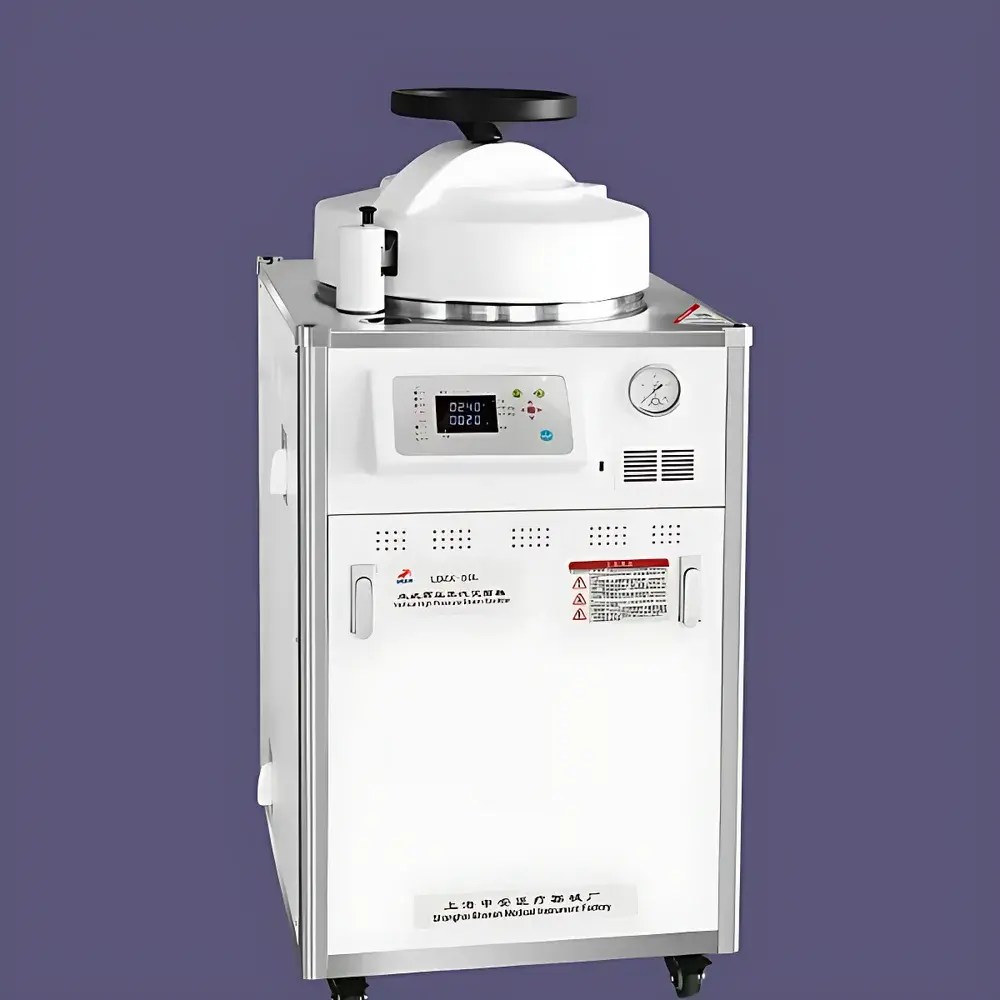
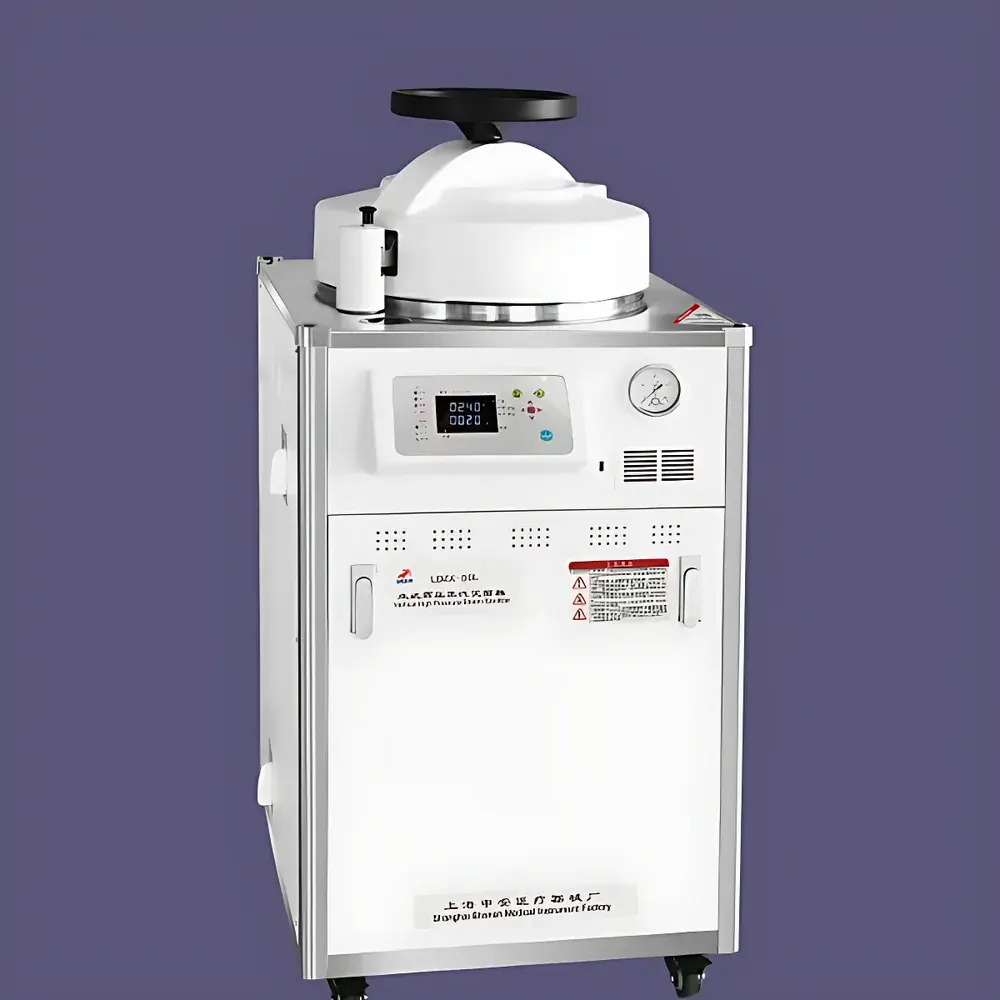
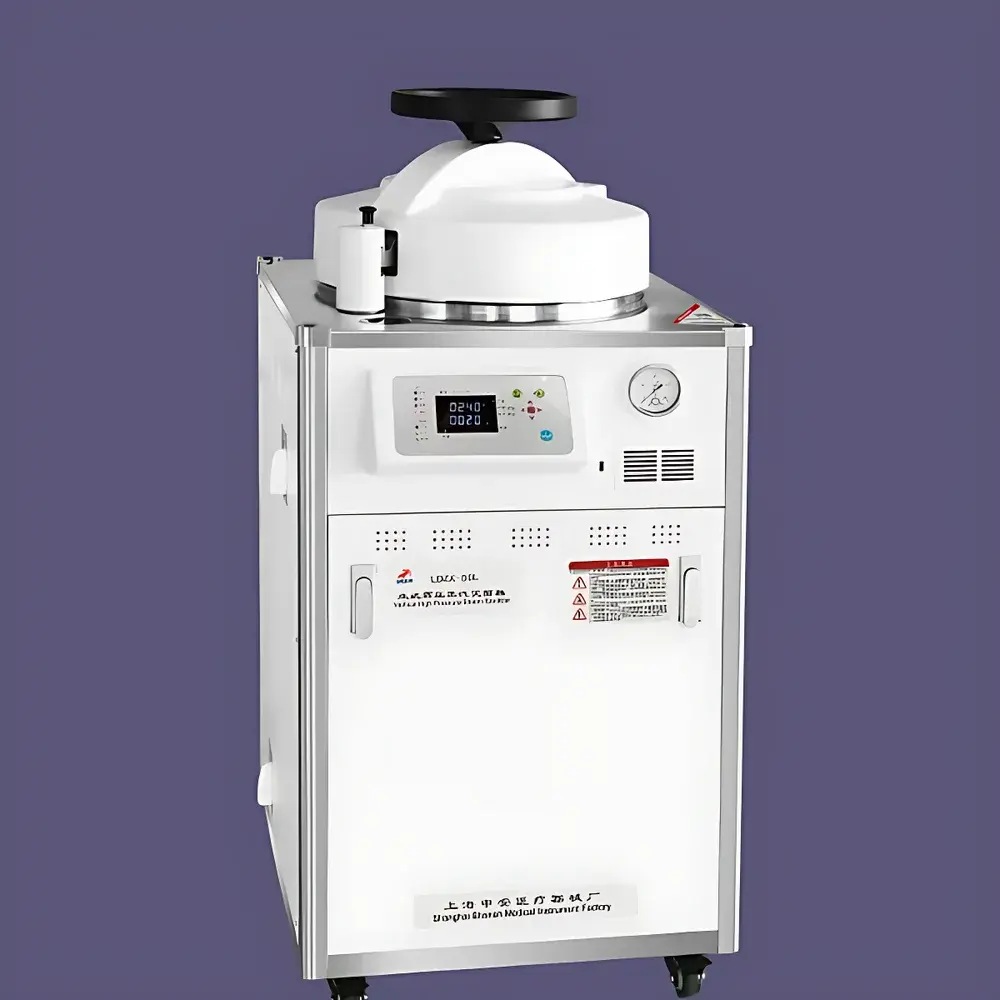
Shen’an LDZX-50L Vertical Steam Autoclave
| Brand | Shen'an / She Medical Devices |
|---|---|
| Origin | Shanghai, China |
| Model | LDZX-50L |
| Instrument Type | Vertical Autoclave |
| Max Temperature | 128 °C |
| Max Pressure | 0.165 MPa |
| Chamber Dimensions | Ø350 × 550 mm |
| Chamber Volume | 50 L (nominal) |
| External Dimensions | 810 × 670 × 1260 mm |
| Inner Chamber Wall Thickness | ≥2 mm |
| Design Service Life | ≥10 years |
| Safety Certifications | GB/T 150–2011 (Pressure Vessels), Special Equipment Manufacturing License (R1 Class) |
| Cooling | Integrated forced-air cooling fan |
| Control Interface | LCD display with microprocessor-based cycle management |
| Optional | Thermal printer (real-time date/temperature/time/pressure), USB data export (U-disk), Validation port |
Overview
The Shen’an LDZX-50L Vertical Steam Autoclave is a CE-compliant, pressure-vessel-certified sterilization system engineered for routine and validated microbiological decontamination in academic laboratories, clinical diagnostics facilities, pharmaceutical QC labs, and biotechnology research environments. It operates on the principle of saturated steam under controlled pressure and temperature—leveraging the well-established thermodynamic relationship between steam pressure and saturation temperature to achieve microbial lethality (e.g., ≥6-log reduction of Geobacillus stearothermophilus spores at 121 °C for 15 min or equivalent F0 ≥12). Designed and manufactured in accordance with China’s GB/T 150.1–2011 standard for stationary pressure vessels (R1 class), the unit integrates dual mechanical–electrical safety interlocks, redundant overpressure protection, and fail-safe dry-run prevention—ensuring compliance with ISO 17665-1:2017 (Sterilization of health care products — Moist heat) and foundational GLP/GMP operational expectations.
Key Features
- Robust stainless-steel 304 chamber (wall thickness ≥2 mm) with self-sealing elastomeric gasket and handwheel-operated lateral displacement lid mechanism—enabling safe, repeatable sealing without torque tools.
- Microprocessor-controlled cycle logic with dynamic LCD interface displaying real-time temperature, pressure, elapsed time, and phase status (pre-vacuum, heating, sterilization, exhaust, cooling).
- One-touch preset program selection for common load types: solid instruments, wrapped items, liquids, and agar media—each with configurable hold times and ramp profiles.
- Integrated forced-air cooling system reduces post-cycle chamber temperature from 121 °C to <50 °C in ≤25 minutes, minimizing operator wait time and condensation risk in liquid loads.
- Pre-warming and melt function enables precise thermal conditioning of culture media (e.g., agar dissolution at 95–105 °C), preventing thermal shock and ensuring homogeneity prior to dispensing.
- Programmable start delay (up to 24 hours) supports unattended operation during off-shift hours while maintaining thermal stability through insulated chamber design.
- Dual independent safety systems: mechanical pressure-lock interlock (physically prevents lid opening above 0.02 MPa) + electronic overpressure cutoff (triggers at 0.165 MPa ±0.005 MPa) with audible/visual alarm.
- Auto air purge sequence removes non-condensable gases before sterilization phase—critical for achieving uniform steam penetration and eliminating cold spots.
- Comprehensive fault diagnostics: continuous monitoring of water level, door seal integrity, temperature sensor drift, and heater continuity—with error codes displayed and logged.
- Movable base with locking casters (Ø100 mm TPU wheels) facilitates repositioning within shared lab spaces without requiring floor anchoring.
Sample Compatibility & Compliance
The LDZX-50L accommodates standard laboratory loads up to 50 L nominal volume—including stainless-steel instrument trays, wrapped surgical kits, glassware, PET/PP containers, and aqueous solutions (with vented caps). Its chamber geometry (Ø350 × 550 mm) permits vertical stacking of 1-L Erlenmeyer flasks or 500-mL bottles. All internal wetted surfaces are electropolished 304 stainless steel, compliant with USP material compatibility requirements for sterilized pharmaceutical contact surfaces. The autoclave meets mandatory regulatory prerequisites for Class B (EN 13060:2021) equivalency in non-hospital settings and supports IQ/OQ/PQ validation protocols via its dedicated calibration port and traceable temperature/pressure logging capability.
Software & Data Management
While the base controller operates via embedded firmware (no external PC dependency), optional modules enable full data traceability: a thermal line printer provides hard-copy records of cycle parameters (date/time, setpoints, actuals, alarms) per FDA 21 CFR Part 11 Annex A recommendations; a USB 2.0 interface allows direct export of CSV-formatted cycle logs (including timestamps, sensor readings, and event flags) to removable U-disk storage. All data fields are write-protected during active cycles, and timestamping is synchronized to internal RTC with battery backup. Audit trail functionality includes user-initiated actions (e.g., program selection, manual abort), system-generated events (e.g., pressure deviation >±0.01 MPa), and calibration history—supporting GLP documentation workflows.
Applications
- Routine sterilization of reusable glassware, metal instruments, and polymer labware in teaching and research laboratories.
- Media preparation and sterilization for microbiology, cell culture, and molecular biology workflows—especially where agar-based or nutrient-rich formulations require precise thermal control.
- Decontamination of biohazardous waste (BSL-2 compatible loads) prior to autoclave validation or off-site disposal.
- Pre-sterilization of packaging components and process aids in small-scale GMP pilot production environments.
- Validation support for sterilization process development, including D-value determination studies and F0 mapping using calibrated thermocouples inserted via the validation port.
FAQ
Does the LDZX-50L comply with international sterilization standards such as ISO 17665?
Yes—the autoclave’s pressure vessel design, temperature uniformity profile, and cycle reproducibility meet the fundamental physical and procedural requirements outlined in ISO 17665-1:2017 for moist-heat sterilization processes.
Can the unit be integrated into a laboratory LIMS or centralized monitoring system?
Not natively—but raw cycle data exported via USB can be imported into third-party LIMS platforms for archival and trending analysis. Custom RS-232 or Ethernet interfaces are not supported in this model.
Is the stainless-steel chamber passivated and corrosion-tested per ASTM A967?
Chamber material conforms to GB/T 20878–2007 (equivalent to ASTM A240/A240M for 304 SS), and surface finish meets Ra ≤0.8 µm after electropolishing—standard for autoclave-grade components. Passivation per ASTM A967 is recommended post-installation and documented in the user manual.
What is the maximum allowable fill volume for liquid loads to prevent boil-over?
For aqueous solutions, maximum fill level is 75% of container capacity. Total liquid volume per cycle must not exceed 35 L to maintain adequate steam space and ensure effective air removal.
How frequently does the safety valve require recalibration or replacement?
Per GB/T 12243–2021, the mechanical relief valve must undergo functional verification every 6 months and full recalibration annually by an accredited metrology lab—records of which are required for GLP audits.
Related Products



