
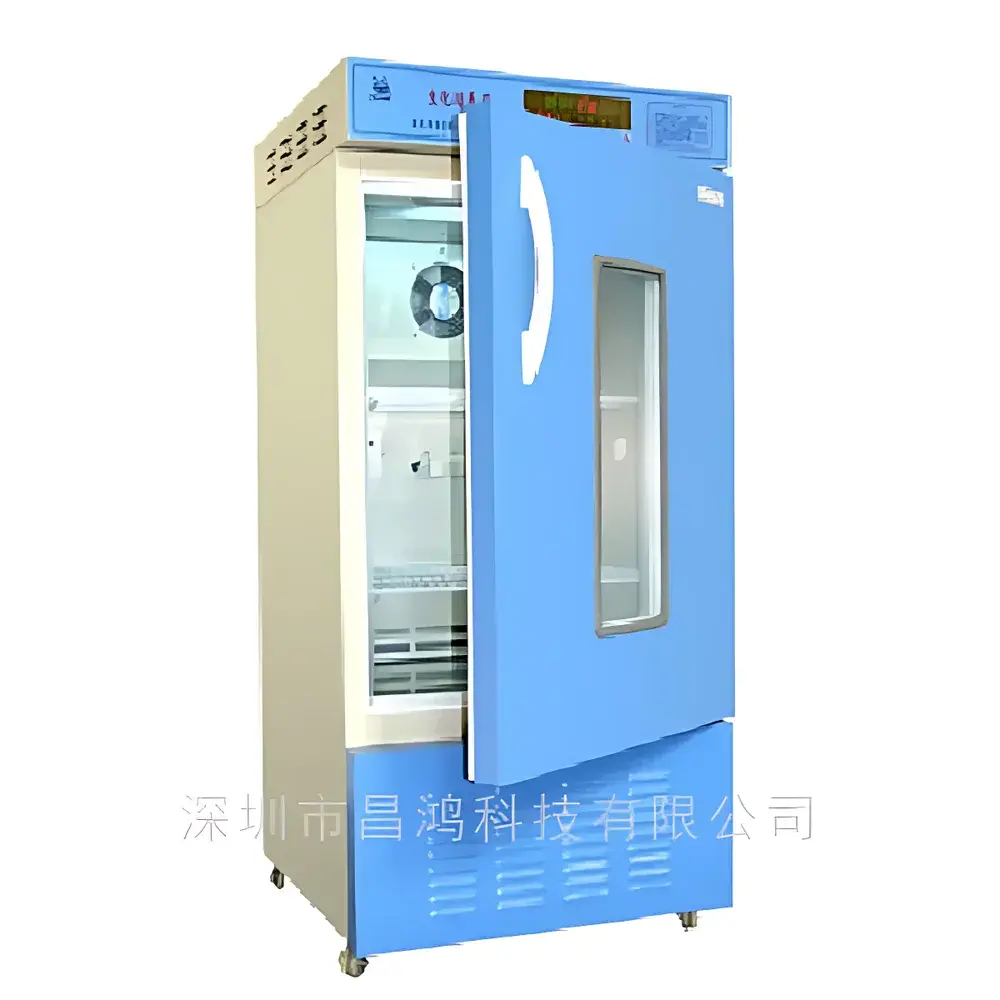
Shenchanghong BOD Biochemical Incubator 150L
| Brand | Shenchanghong |
|---|---|
| Origin | Guangdong, China |
| Manufacturer Type | Direct Manufacturer |
| Country of Origin | China |
| Model | 150L |
| Quotation | Upon Request |
| Capacity | 150 L |
| Temperature Control Range | 5–65 °C |
| Temperature Resolution | 0.1 °C |
| Temperature Fluctuation | ±0.3 °C |
| Temperature Uniformity | ±0.8 °C |
| Refrigerant | R134a |
| Power Consumption | 179 W |
| Supply Voltage | 220 VAC, 50 Hz |
| Inner Chamber Dimensions (W×D×H) | 45 × 43 × 53 cm |
| Outer Dimensions (W×D×H) | 52 × 52 × 110 cm |
| Insulation | Integral Polyurethane Foam |
| Interior Material | Brushed Stainless Steel |
| Exterior Finish | Powder-Coated Cold-Rolled Steel |
| Control System | Microprocessor-Based PID Controller with Timer |
| Air Circulation | SMOOTH Whole-Chamber Air Distribution System |
| Safety Features | Dual Independent Over-Temperature Protection (±4 °C deviation alarm + fixed 70 °C upper cutoff) |
| Interface Options | RS485 port and printer interface |
| Monitoring Port | Ø30 mm access port on left side |
| Display | LED with real-time clock and programmable timer (0–9999 min) |
Overview
The Shenchanghong BOD Biochemical Incubator 150L is a precision-engineered environmental chamber designed specifically for biochemical oxygen demand (BOD) testing and long-term microbial, algal, and cellular culture under tightly controlled thermal conditions. Based on the fundamental principle of maintaining stable aerobic incubation environments at defined temperatures—typically 20 °C per ASTM D5210 and ISO 5815-1—the unit supports standardized BOD5 assays critical for wastewater treatment monitoring, regulatory compliance, and environmental impact assessment. Its dual-mode heating and refrigeration system enables operation across a broad physiological range (5–65 °C), accommodating not only BOD protocols but also general microbiological cultivation, seed germination studies, enzyme activity assays, and stability testing of biological reagents. Constructed with an integral polyurethane foam-insulated cabinet and corrosion-resistant brushed stainless steel interior, the incubator ensures minimal thermal drift and high reproducibility—key requirements for GLP-compliant laboratories conducting routine water quality analysis.
Key Features
- Microprocessor-based PID temperature controller with 0.1 °C resolution and ±0.3 °C fluctuation tolerance—optimized for BOD5 standardization.
- SMOOTH whole-chamber air distribution system ensuring ±0.8 °C uniformity across the 150 L working volume, validated per ISO 15270 for incubator performance verification.
- Dual independent over-temperature protection: primary deviation alarm (±4 °C from setpoint) and secondary hardwired cutoff at 70 °C—meeting IEC 61010-1 safety requirements for laboratory equipment.
- Eco-conscious refrigeration using R134a, a zero-ozone-depletion-potential (ODP) refrigerant compliant with EU F-Gas Regulation (EU) No 517/2014.
- RS485 serial interface and dedicated printer port support external data logging and integration into centralized lab information management systems (LIMS).
- Front-access Ø30 mm test port enables real-time probe insertion without compromising chamber integrity or thermal stability.
- Built-in BOD-rated power outlet (IEC 60320 C13) located inside the chamber for direct connection of dissolved oxygen meters or stirrers during closed-system BOD assays.
- Self-diagnostic firmware with alphanumeric fault-code display simplifies troubleshooting and reduces downtime in high-throughput QC labs.
Sample Compatibility & Compliance
The 150L chamber accommodates standard BOD bottles (300 mL glass or plastic), Petri dishes, multi-well plates, Erlenmeyer flasks, and tissue culture vessels up to 1 L. Adjustable stainless steel shelving (three-tier, height-adjustable in 25 mm increments) allows flexible configuration for heterogeneous sample loads. The unit conforms to essential regulatory frameworks governing water quality laboratories: it supports adherence to EPA Method 405.1, ASTM D5210-92 (reapproved 2021), ISO 5815-1:2019, and China’s HJ 505-2009 standard for BOD determination. Its construction materials—food-grade stainless steel interior and non-toxic polyurethane insulation—meet USP Class VI biocompatibility criteria for indirect contact with biological samples.
Software & Data Management
While the incubator operates as a standalone instrument via its embedded microcontroller, its RS485 interface enables seamless communication with third-party data acquisition software (e.g., LabVIEW, MATLAB, or custom SCADA platforms) using Modbus RTU protocol. Time-stamped temperature logs—including setpoint, actual reading, and alarm events—can be exported for audit trails required under FDA 21 CFR Part 11 (when paired with compliant software and user access controls). The integrated timer function (0–9999 minutes) supports unattended operation for standard 5-day BOD cycles and extended incubation protocols, with LED-displayed elapsed time synchronized to internal real-time clock (RTC) calibrated to ±2 seconds/month.
Applications
- BOD5 and BODu measurement in municipal and industrial wastewater effluents per ISO 5815 and APHA Standard Methods 5210B.
- Cultivation of heterotrophic bacteria (e.g., Pseudomonas aeruginosa, Escherichia coli) and nitrifying consortia for kinetic studies and biodegradability screening.
- Algal growth experiments (e.g., Chlorella vulgaris) under controlled photoperiod-independent thermal regimes.
- Stability testing of enzymatic reagents, nutrient media, and preserved water quality reference standards.
- Seed germination and plant tissue culture pre-incubation where precise thermoregulation supersedes light control requirements.
- Validation of membrane filtration methods requiring consistent incubation of mFC agar plates at 44.5 °C (for fecal coliform enumeration).
FAQ
Does this incubator meet ASTM D5210 requirements for BOD5 testing?
Yes—the temperature stability (±0.3 °C fluctuation), uniformity (±0.8 °C), and operational range (5–65 °C) fully satisfy the thermal performance criteria specified in ASTM D5210-92(2021).
Can the RS485 interface be used for remote calibration verification?
Yes—when connected to a validated data logger or LIMS, the interface transmits real-time temperature values and system status codes, enabling periodic calibration traceability per ISO/IEC 17025 Clause 7.7.
Is the interior lighting suitable for photobiological applications?
No—this model provides no internal illumination; it is optimized for dark-cycle BOD and thermal-only microbiological assays. For photo-incubation, consider our parallel photobioreactor series.
What maintenance is required for long-term reliability?
Annual inspection of condenser coil cleanliness, refrigerant pressure verification, and validation of temperature sensor accuracy against NIST-traceable references are recommended per manufacturer guidelines.
How does the dual-limit safety system interact with GLP documentation?
Each over-temperature event triggers a timestamped log entry and audible alarm, supporting objective evidence generation for GLP audit trails under OECD Principles of Good Laboratory Practice.
Related Products







