
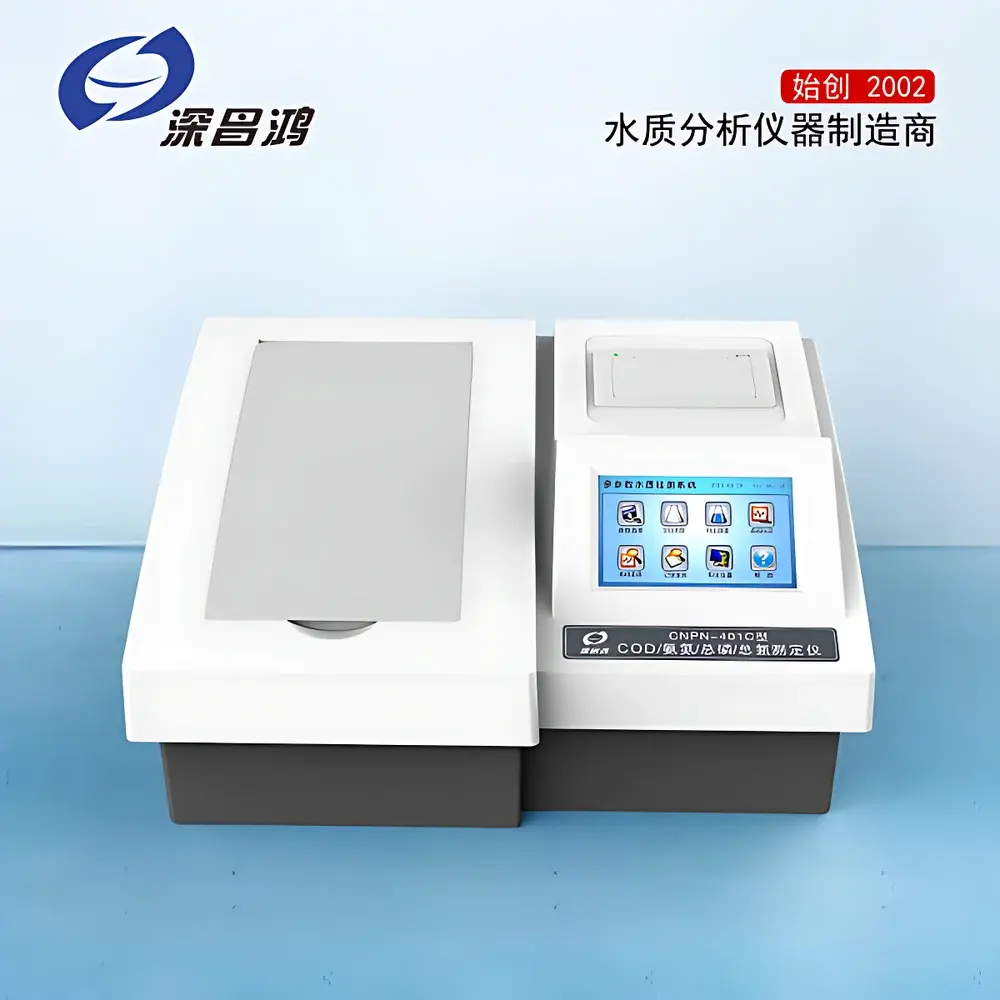
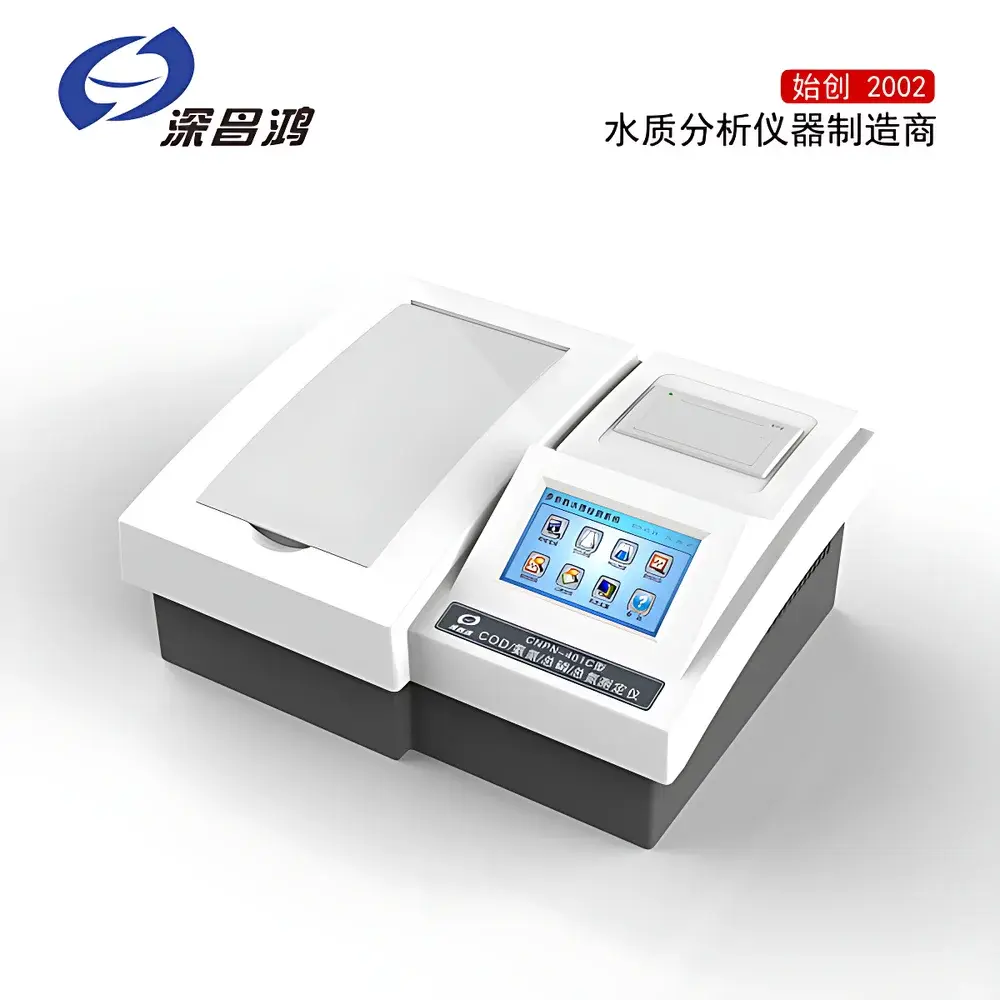
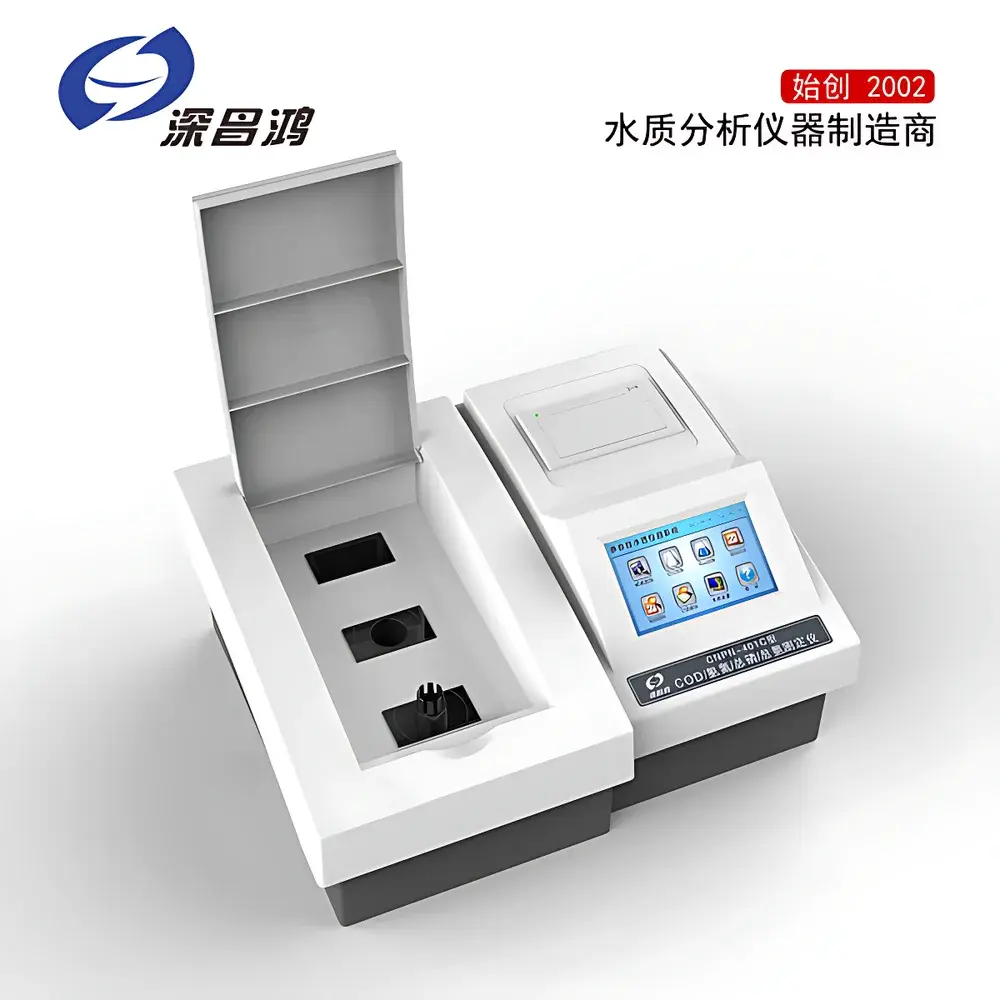
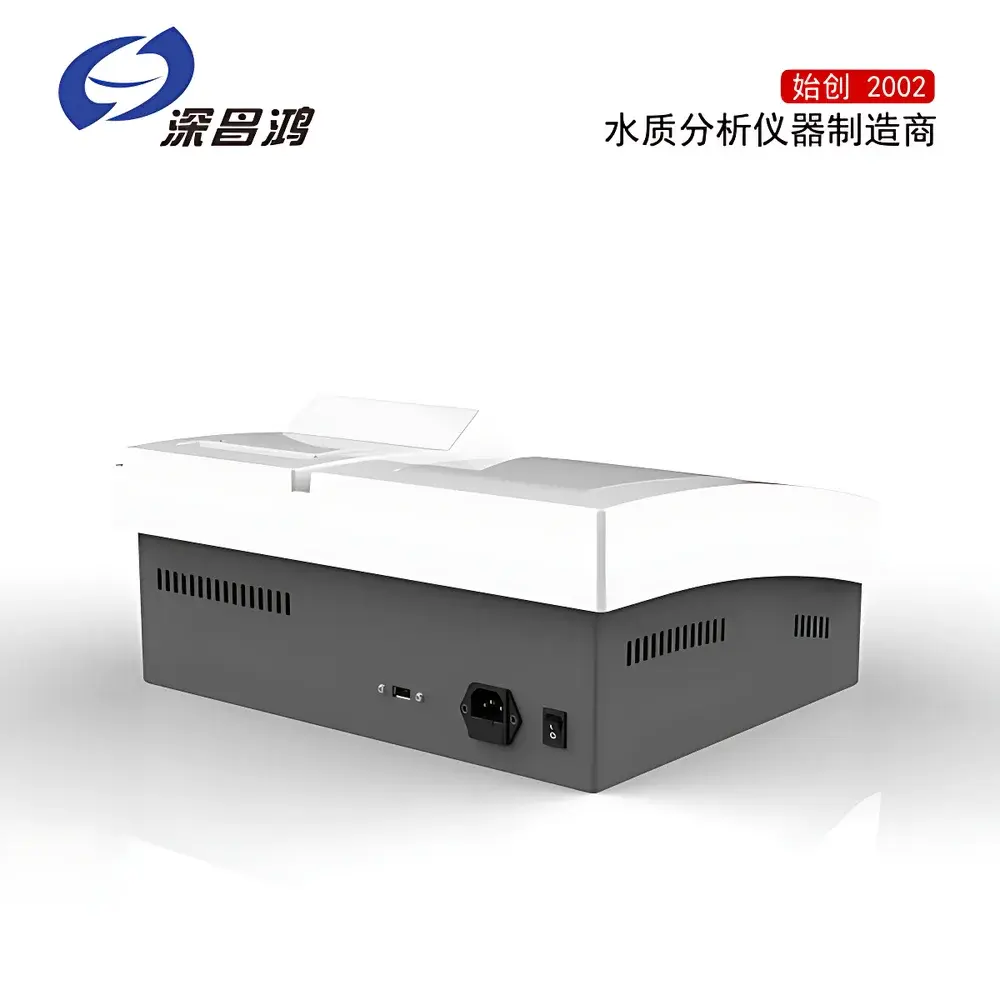
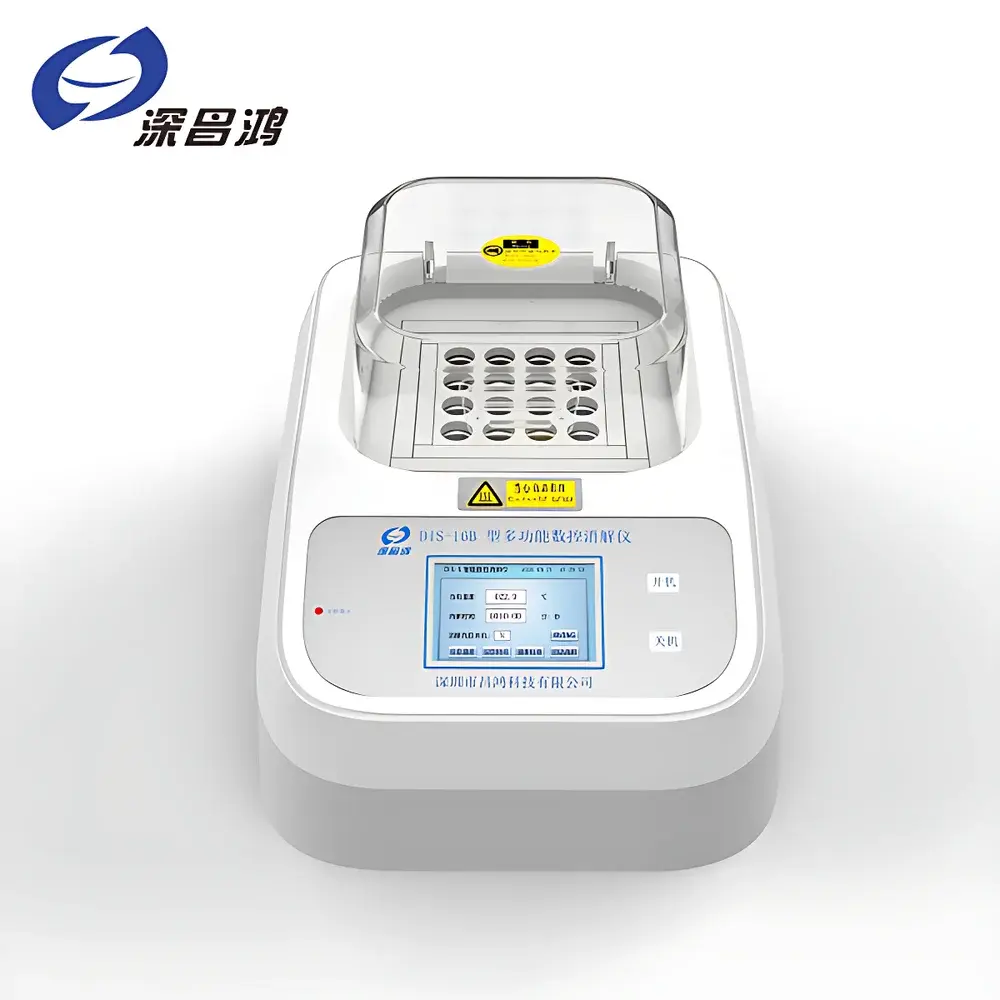
Shenchanghong CNPN-401C Multi-Parameter Water Quality Analyzer
| Brand | Shenchanghong |
|---|---|
| Origin | Shenzhen, China |
| Manufacturer Type | Direct Manufacturer |
| Product Origin | Domestic (China) |
| Model | CNPN-401C |
| Instrument Type | Laboratory Water Quality Analyzer |
| Detection Parameters | COD, Ammonia-Nitrogen, Total Phosphorus, Total Nitrogen |
| Measurement Principle | COD – Rapid Digestion Optical Method |
| Optical System | High-brightness, long-life imported cold light source |
| Display | 5-inch color touchscreen with bilingual (Chinese/English) UI |
| Data Storage | 100 calibration curves, 1,000 test records |
| Connectivity | USB interface for PC data transfer and reporting |
| Digestion Capacity | 16 samples per batch (optional 20/25/36) |
| Digestion Temp. Range | Ambient to 200 °C (PID-controlled) |
| Temperature Accuracy | ≤±1.0 °C |
| Optical Stability | ≤0.002 A / 20 min |
| Repeatability | ≤±3% |
| Measurement Ranges | COD 5–2000 mg/L (extendable to 20,000 mg/L) |
| Accuracy | COD ≤±5% |
| Chloride Interference Tolerance (COD) | ≤2000 mg/L |
| Digestion Conditions | COD – 165 °C, 20 min |
| Dimensions (Analyzer) | 400 × 310 × 158 mm |
| (Digestor) | 260 × 355 × 135 mm |
| Weight (Analyzer) | 4 kg |
| (Digestor) | 5.5 kg |
Overview
The Shenchanghong CNPN-401C Multi-Parameter Water Quality Analyzer is a benchtop laboratory instrument engineered for precise, simultaneous quantification of four critical water quality parameters: Chemical Oxygen Demand (COD), Ammonia-Nitrogen (NH₃-N), Total Phosphorus (TP), and Total Nitrogen (TN). It implements standardized spectrophotometric methodologies compliant with widely adopted environmental testing protocols—including HJ/T 399–2007 (COD), HJ 535–2009 (NH₃-N), GB 11893–89 (TP), and HJ 636–2012 (TN). The system employs a dual-unit architecture: a dedicated optical analyzer and an independent temperature-controlled digestion block. This physical separation ensures thermal isolation from the photometric measurement path, thereby preserving baseline stability and minimizing drift during extended operation. The analyzer utilizes an imported high-intensity cold light source with narrow spectral bandwidth and low thermal output, contributing to long-term photometric reproducibility (<0.002 A drift over 20 minutes) and reduced lamp replacement frequency.
Key Features
- Modular design with physically separated analyzer and digestion units to eliminate thermal cross-interference and enhance optical system integrity.
- PID-controlled digital heating module in the digestion unit enables precise, programmable temperature regulation (ambient to 200 °C) with accuracy ≤±1.0 °C and adjustable timing (1–999 minutes).
- 5-inch full-color capacitive touchscreen interface supporting real-time bilingual (English/Chinese) operation, intuitive icon-driven navigation, and context-sensitive prompts.
- Integrated one-step digestion-and-measurement workflow: pre-calibrated reagent kits and matched digestion/cuvette tubes eliminate tube transfer errors and reduce analyst handling time.
- Robust data management architecture featuring non-volatile memory for up to 100 user-defined calibration curves and 1,000 timestamped measurement records with sample ID, operator ID, and method metadata.
- USB 2.0 port enables direct export of raw data, calibration logs, and QC reports to Windows-based PCs; compatible with standard spreadsheet and LIMS import formats.
- One-touch system recovery function restores factory calibration settings and default configurations without requiring service intervention.
- Flexible digestion capacity: standard 16-position block with optional upgrade paths to 20-, 25-, or 36-position configurations for high-throughput laboratories.
Sample Compatibility & Compliance
The CNPN-401C is validated for use with surface water, groundwater, domestic wastewater, industrial effluents, and treated discharge samples. Its analytical methods align with national Chinese environmental standards (HJ and GB series) and are technically equivalent to internationally recognized procedures—e.g., APHA Standard Methods 5220 D (COD), 4500-NH₃ B (ammonia), 4500-P E (orthophosphate after digestion), and 4500-NO₃⁻ F (total nitrogen via persulfate oxidation). While not certified under ISO/IEC 17025 or EPA approval schemes, the instrument’s documented repeatability (≤±3%), accuracy tolerances, and traceable calibration routines support internal QA/QC programs, GLP-aligned workflows, and regulatory self-monitoring requirements. The system supports audit-ready documentation when paired with external LIMS or electronic lab notebook (ELN) platforms.
Software & Data Management
The embedded firmware provides secure, password-protected access levels for operator, supervisor, and administrator roles. All measurements are automatically timestamped and tagged with method ID, lot number of reagents used, digestion temperature/duration, and operator code. Data export via USB generates CSV-formatted files containing absorbance values at specified wavelengths (e.g., 620 nm for COD, 420 nm for NH₃-N, 700 nm for TP, and 220/275 nm dual-wavelength for TN), raw concentration outputs, and QC flags. The included data acquisition software (Windows-compatible) allows curve fitting (linear, polynomial), statistical summary (mean, SD, CV%), report generation with customizable headers/footers, and direct printing to network or local printers. No cloud connectivity or remote access is implemented—ensuring full data sovereignty and compliance with on-premise IT security policies.
Applications
This analyzer serves routine monitoring needs across municipal water treatment plants, environmental protection agencies, third-party testing laboratories, and industrial process control environments. Typical use cases include: daily influent/effluent compliance screening against discharge limits (e.g., GB 8978–1996); source water characterization for drinking water facilities; nutrient loading assessment in watershed management studies; pretreatment verification in electroplating or food processing wastewater streams; and educational laboratory instruction in environmental chemistry and analytical science curricula. Its multi-parameter capability reduces cross-instrument variability and accelerates turnaround time compared to sequential single-analyte assays.
FAQ
Is the CNPN-401C compliant with US EPA or ISO methods?
The instrument implements methodologies aligned with Chinese national standards (HJ/GB). While not EPA-certified, its COD, NH₃-N, TP, and TN procedures are technically comparable to APHA Standard Methods 5220 D, 4500-NH₃ B, 4500-P E, and 4500-NO₃⁻ F, respectively.
Can I customize calibration curves beyond the built-in 100 slots?
No—storage is fixed at 100 curves. However, users may archive older curves externally via USB export and reload them as needed.
What maintenance is required for long-term optical stability?
Routine cleaning of the cuvette chamber and optical windows with lint-free, alcohol-dampened swabs every 200 measurements is recommended. Lamp replacement is typically required only after ≥10,000 hours of cumulative operation.
Does the system support 21 CFR Part 11 compliance?
No. The CNPN-401C does not include electronic signatures, audit trails, or role-based electronic record controls required for FDA-regulated GxP environments.
Are digestion tubes reusable?
The supplied quartz-glass digestion/cuvette tubes are designed for single-use per analysis to prevent cross-contamination and ensure consistent light path geometry. Reuse is not recommended.







