
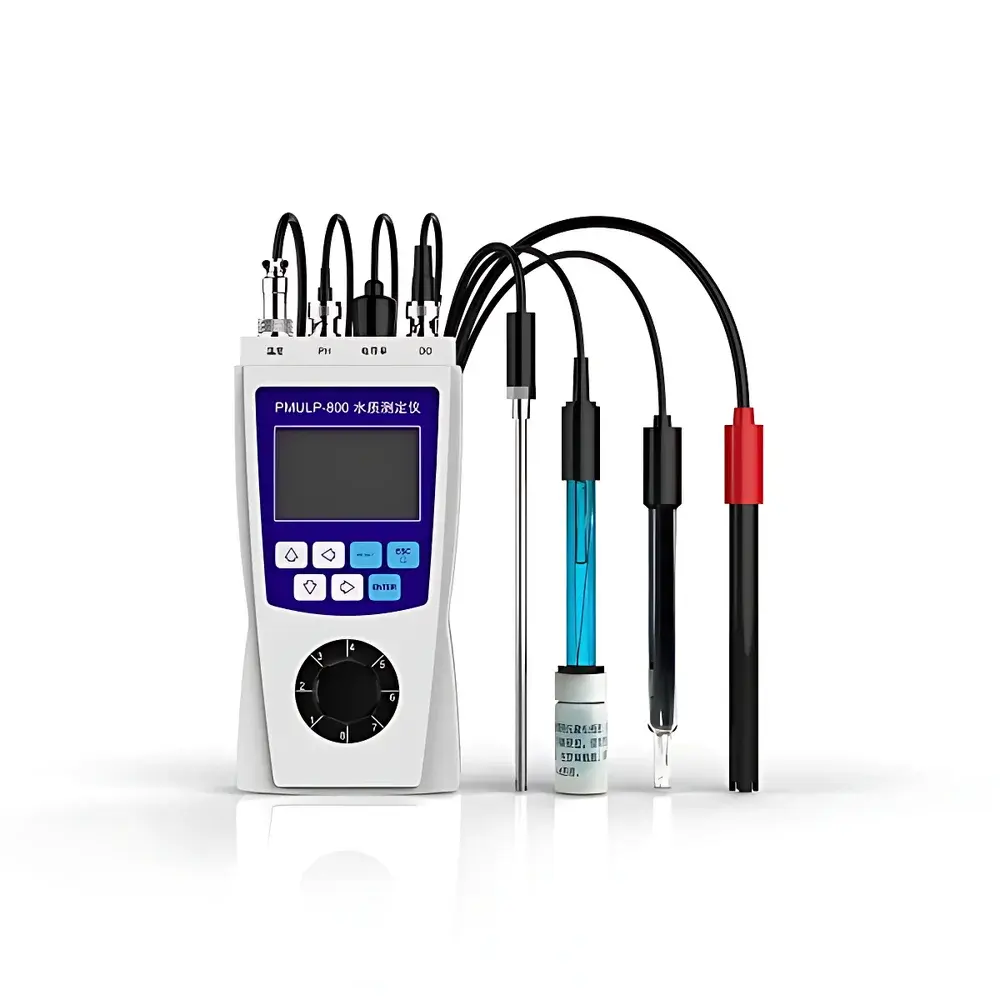
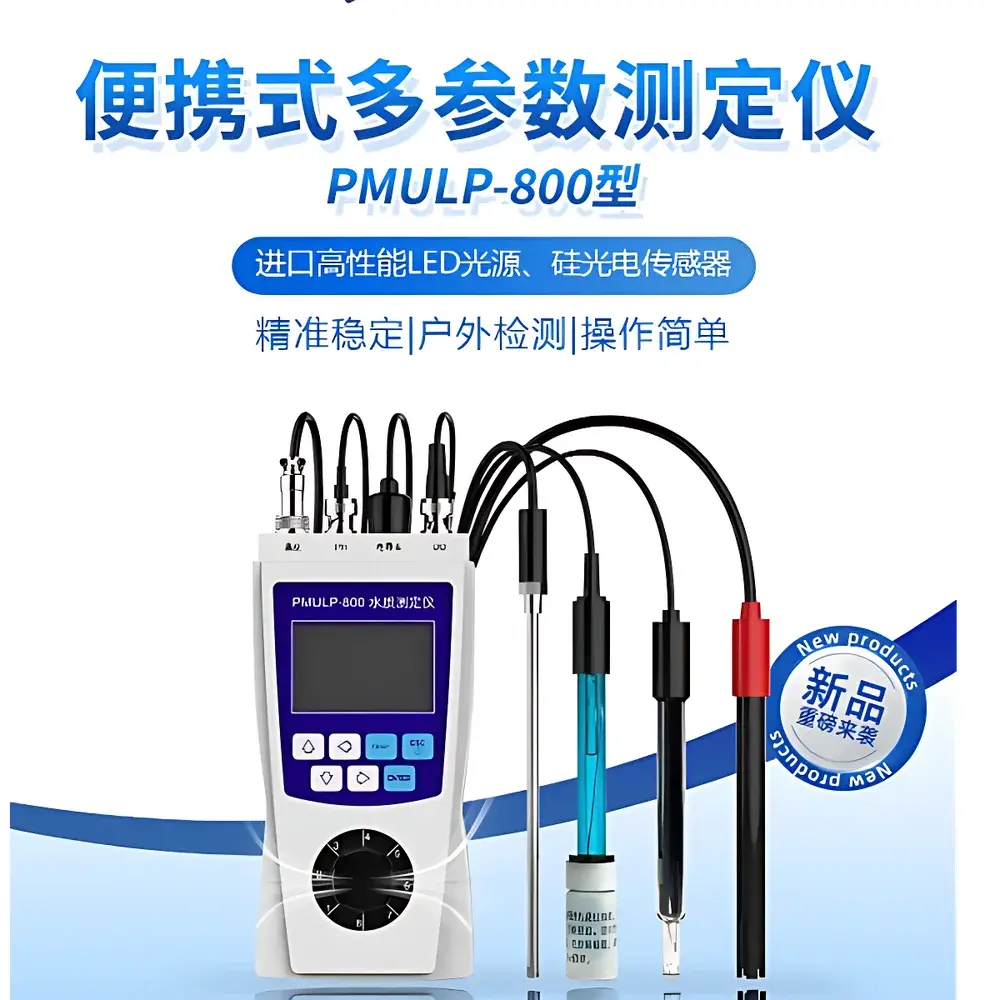
Shenchanghong PMULP-800 Portable Multi-Parameter Water Quality Analyzer
| Brand | Shenchanghong |
|---|---|
| Origin | Guangdong, China |
| Manufacturer Type | Direct Manufacturer |
| Country of Origin | China |
| Model | PMULP-800 |
| Instrument Type | Portable |
| Temperature Range | 0–100 °C |
| pH Range | 0.00–14.00 |
| Dissolved Oxygen (DO) Range | 0–20.0 mg/L |
| Conductivity Range | 0.00 µS/cm – 199.9 mS/cm |
| Turbidity Range | 0–400 NTU |
| Optical Wavelengths | 420, 440, 470, 520, 540, 560, 610, 630, 660, 680, 700 nm (user-selectable within range) |
| Absorbance Accuracy | ≤±5% FS |
| Repeatability | ≤3% RSD |
| Absorbance Drift | <0.002 A in 20 min |
| Dimensions (Main Unit) | 92 × 185 × 50 mm |
| Weight (Main Unit) | ~0.4 kg |
| Total Kit Weight (incl. case & accessories) | ~1.5 kg |
| Power Supply | Rechargeable Li-ion battery, 7.4 V / 1500 mAh |
| Operating Environment | 5–40 °C, ≤85% RH, low-vibration, non-direct-sunlight |
Overview
The Shenchanghong PMULP-800 is a field-deployable, multi-parameter water quality analyzer engineered for rapid, on-site assessment of physicochemical and optical water quality indicators. It integrates dual measurement modalities—electrochemical sensing (pH, ORP, conductivity, temperature, and dissolved oxygen via polarographic or fluorescence-based electrodes) and spectrophotometric analysis (via fixed-wavelength LED optics)—within a single compact chassis. The instrument operates on the principle of absorbance-based quantification (Beer–Lambert law) for colorimetric parameters—including nitrate, phosphate, ammonia, residual chlorine, heavy metals (e.g., Cr⁶⁺, Cu²⁺, Fe²⁺/³⁺), and inorganic anions—and employs standardized electrode kinetics for electrochemical endpoints. Designed for regulatory screening and routine monitoring, the PMULP-800 supports method flexibility across drinking water, surface water, wastewater effluent, and aquaculture applications—complying with foundational principles outlined in ISO 5667 (water sampling), ISO 7027 (turbidity), and EPA Method 365.3 (phosphate), while enabling user-defined calibration protocols aligned with local regulatory frameworks.
Key Features
- Modular sensor architecture: Supports simultaneous or sequential deployment of up to eight electrochemical probes and optical modules, with hot-swappable electrode interfaces (pH/ORP share one port; DO, conductivity, and temperature use dedicated ports)
- Programmable optical engine: Eleven discrete LED wavelengths (420–700 nm) allow configuration for over 70 analytes; wavelength selection is software-controlled and traceable per measurement sequence
- Field-optimized hardware: IP67-rated main unit housing; integrated rechargeable Li-ion battery (7.4 V / 1500 mAh) provides ≥12 hours of continuous operation; low-power design (10 W max) enables extended off-grid deployment
- Calibration traceability: On-device calibration log stores date, operator ID, standard lot number, and deviation values; supports two-point pH calibration, KCl-standardized conductivity verification, and air-saturated DO zero/span checks
- Ruggedized transport system: Includes shock-absorbing portable case (384 × 300 × 120 mm), calibrated 25-mm diameter glass cuvettes, three dedicated turbidity tubes (Formazin-equivalent), dual-position tube rack, and precision adjustable-volume pipette (100–1000 µL)
Sample Compatibility & Compliance
The PMULP-800 accepts liquid samples from natural waters, treated effluents, and potable supplies without pre-filtration for most parameters (except turbidity, which requires particle-free aliquots). Electrode-based measurements are validated per ISO 11277 (soil suspension compatibility) and ASTM D1293 (pH of water); optical assays follow ISO 6223 (residual chlorine) and ISO 15704 (phosphorus). All factory-installed methods are documented per ISO/IEC 17025:2017 clause 7.2.2 (method validation), and firmware supports audit-ready data export compliant with GLP requirements. While not FDA 21 CFR Part 11-certified out-of-box, the system permits implementation of electronic signature workflows and full audit trails when paired with validated third-party LIMS integration.
Software & Data Management
The bundled PC software (Windows-compatible, supplied on USB drive) enables method setup, calibration curve generation (linear, quadratic, or polynomial), real-time graphing, and CSV/PDF report export. Each dataset includes embedded metadata: GPS coordinates (if connected via Bluetooth-enabled external module), ambient temperature/humidity (recorded at time of measurement), operator ID, and instrument serial number. Raw absorbance and mV readings are stored with timestamp resolution of 100 ms. Firmware updates are delivered via signed binary packages; version history and checksums are logged automatically. Data integrity is reinforced through cyclic redundancy check (CRC-32) on all stored records and optional password-protected user roles (Admin, Technician, Viewer).
Applications
- Drinking water safety verification: Residual chlorine, turbidity, pH, and conductivity monitoring at distribution points per WHO Guidelines for Drinking-water Quality (4th ed.)
- Surface water quality surveillance: Field screening for eutrophication indicators (nitrate, phosphate, ammonium) and dissolved oxygen saturation deficits in rivers and lakes
- Wastewater treatment plant (WWTP) process control: Rapid assessment of influent/effluent parameters including COD surrogates (via dichromate-based colorimetry), total chlorine, and redox potential
- Environmental impact assessments: Baseline and post-intervention sampling for heavy metal leaching (e.g., Pb, Cd, As) using APHA-approved colorimetric protocols
- Academic and training laboratories: Pedagogical platform for teaching analytical method validation, inter-method comparison (e.g., electrode vs. optical DO), and uncertainty budgeting per GUM (JCGM 100:2008)
FAQ
Can the PMULP-800 be used for regulatory reporting under national environmental standards?
Yes—when operated with certified reference materials and documented calibration procedures, its measurements meet the performance criteria of China’s HJ/T 91–2019 (surface water monitoring) and HJ/T 399–2007 (COD colorimetric method), as well as EU Directive 2000/60/EC Annex V requirements for field-screening tools.
Is electrode cross-sensitivity compensated in firmware?
The system applies built-in temperature compensation for pH and conductivity (per NIST SRM 1692), and salinity correction for DO readings; however, users must manually select appropriate electrode-specific algorithms during method setup.
How is spectral interference managed during multi-analyte testing?
Each optical method uses wavelength-specific bandpass filtering and blank subtraction routines; users are advised to run sequential measurements with reagent blanks when analyzing complex matrices (e.g., high-humic-content waters).
Does the device support third-party electrode brands?
Only electrodes with Shenchanghong’s proprietary pinout and communication protocol (SC-EPv2) are guaranteed functional; generic BNC or DIN connectors are not supported.
What is the recommended recalibration frequency for field use?
Electrodes should be verified daily before first use and after every 10 samples in variable matrices; optical modules require blank verification every 2 hours or after ambient temperature shifts >5 °C.
Related Products







