
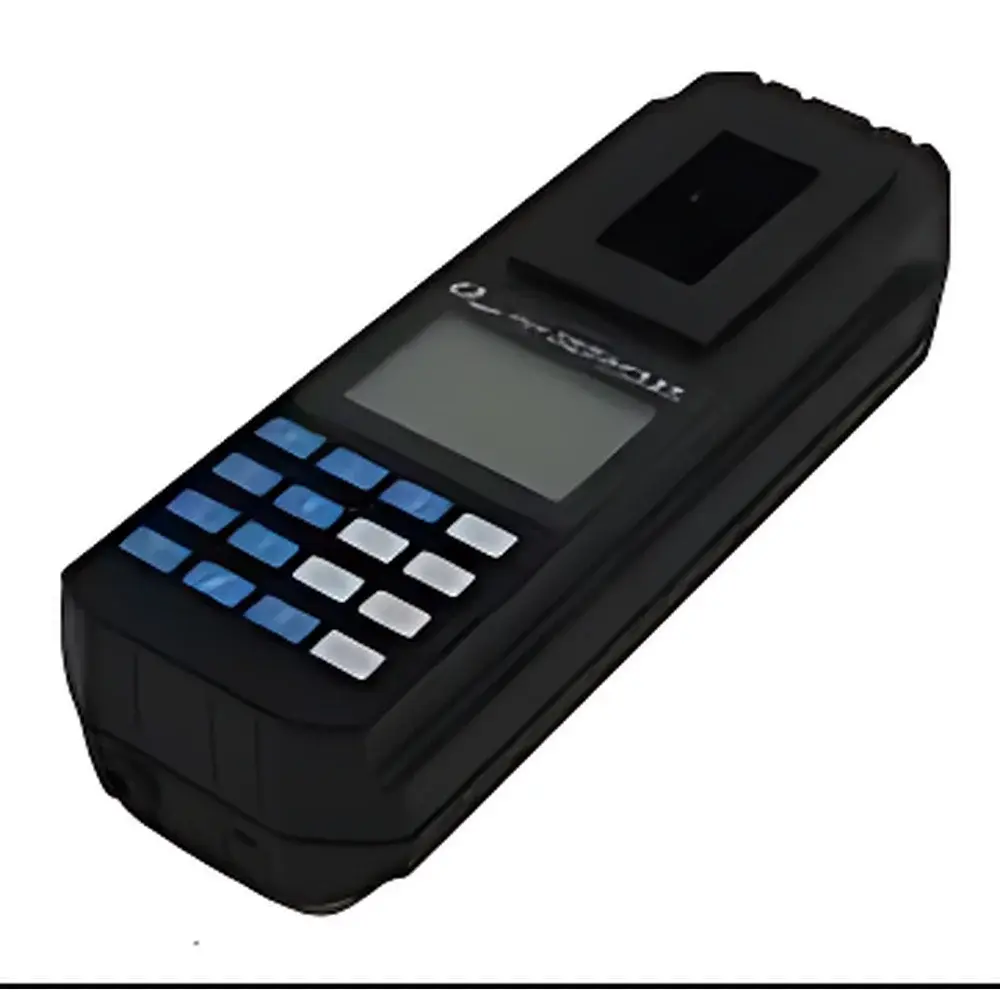
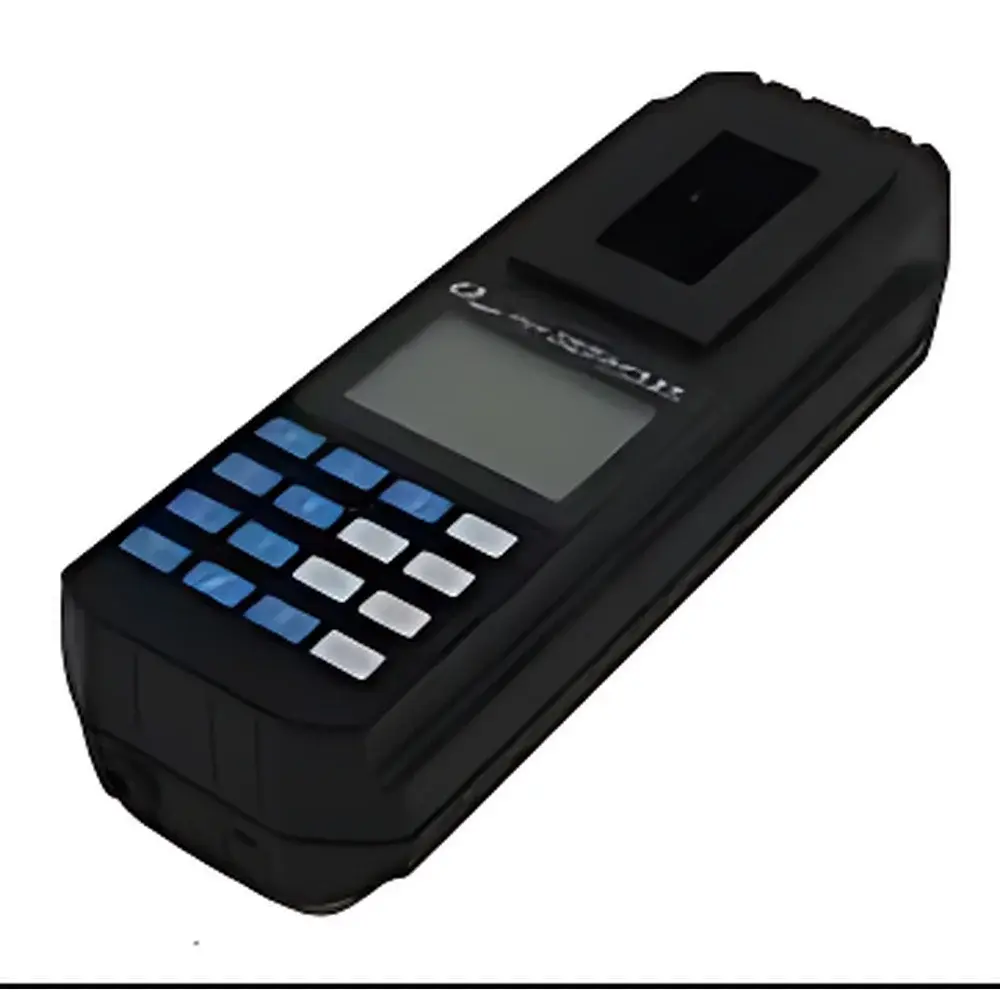
Shenchanghong PSS-200 Portable Suspended Solids Analyzer
| Brand | Shenchanghong |
|---|---|
| Origin | Guangdong, China |
| Manufacturer Type | OEM Manufacturer |
| Regional Classification | Domestic (China) |
| Model | PSS-200 |
| Instrument Type | Portable |
| Measurement Principle | Colorimetric Photometry (Turbidimetric Absorption at 850 nm) |
| Range | 0–1000 mg/L |
| Accuracy | ≤ ±2% FS |
| Repeatability | ≤ ±2% FS |
| Resolution | 0.01 mg/L |
| Power Supply | Rechargeable Lithium-ion Battery |
| Weight | 500 g |
| Dimensions | 80 × 230 × 55 mm |
| Optical System | Narrow-band Interference Filter + Imported Long-life LED Light Source |
| Data Storage | 20 Calibration Curves + 199 Measurement Records |
| Interface | USB 2.0 |
| Enclosure Rating | IP65 |
| Housing Material | Molded ABS Polymer |
| Data Protection | Auto-Save with Power-Fail Backup |
Overview
The Shenchanghong PSS-200 Portable Suspended Solids Analyzer is a field-deployable photometric instrument engineered for rapid, on-site quantification of total suspended solids (TSS) in aqueous samples. It operates on the principle of turbidimetric absorption—measuring light attenuation at 850 nm through a standardized sample cell—where particle concentration correlates linearly with optical density under controlled dispersion conditions. Designed to meet routine monitoring requirements across decentralized environmental testing environments, the PSS-200 delivers laboratory-grade reproducibility without reliance on benchtop infrastructure. Its optical architecture employs a narrow-band interference filter and a high-stability, long-lifetime LED source to minimize spectral drift and thermal sensitivity—critical for consistent performance across ambient temperature fluctuations (10–40 °C). The device conforms to foundational methodological expectations outlined in ISO 7027 (water quality — determination of turbidity) and serves as a practical surrogate for gravimetric TSS analysis (per EPA Method 160.2 and ISO 11923) where immediate screening or trend tracking is prioritized over absolute mass-based validation.
Key Features
- Ultra-low-power 16-bit microcontroller architecture enabling ≥6 months of standby operation on a single lithium-ion charge
- Optical system featuring imported high-brightness LED source and precision narrow-band interference filters (FWHM ≤10 nm), ensuring minimal photometric drift and high inter-unit repeatability
- IP65-rated molded ABS housing providing full protection against dust ingress, water splashes, and incidental chemical exposure during field deployment
- Integrated data management with non-volatile memory supporting storage of up to 20 user-defined calibration curves and 199 timestamped measurement records
- USB 2.0 interface compliant with standard CDC/ACM class protocols for direct connection to Windows/macOS/Linux systems without proprietary drivers
- Automatic power-fail data retention—measurement values and calibration parameters persist unaltered after unexpected shutdown
- High-resolution display (128 × 64 pixel monochrome LCD) with backlight for low-light readability and intuitive menu navigation
Sample Compatibility & Compliance
The PSS-200 is validated for use with clarified, filtered, or raw surface water, wastewater effluent, stormwater runoff, and pretreated drinking water sources. Sample turbidity must remain within the instrument’s dynamic range (0–1000 mg/L TSS); highly viscous or strongly colored matrices may require dilution or filtration prior to analysis to avoid scattering artifacts. While not certified to GLP or ISO/IEC 17025 accreditation requirements out-of-the-box, the device supports audit-ready workflows: all stored calibrations retain date/time stamps, and measurement logs include operator ID fields (user-configurable via software). Its optical design aligns with the photometric assumptions underlying ASTM D3730 (Standard Test Method for Turbidity of Water) and provides traceable correlation to reference methods when calibrated against NIST-traceable formazin standards.
Software & Data Management
Data export is performed via native USB mass-storage emulation—no proprietary software installation required. Measurement files are saved in plain-text CSV format with UTF-8 encoding, containing columns for sample ID, date/time stamp, measured value (mg/L), calibration curve ID, and operator code. Optional firmware updates are distributed as signed binary packages compatible with standard DFU (Device Firmware Upgrade) protocol. For regulated environments, the PSS-200 supports manual entry of electronic signatures and configurable audit trails when integrated into LIMS platforms via its open serial command set (ASCII-based, documented in technical appendix).
Applications
- Routine TSS screening at municipal wastewater treatment plant influent, effluent, and sludge dewatering stages
- Field verification of sediment control measures on construction sites per EPA Construction General Permit (CGP) requirements
- Academic water quality field studies requiring lightweight, battery-operated instrumentation
- Emergency response monitoring following flood events or industrial spills
- Calibration cross-checking for online turbidity sensors in SCADA-integrated water networks
- Pre-screening prior to laboratory-based gravimetric TSS analysis (ISO 11923) to optimize sample selection and reduce lab turnaround time
FAQ
What is the recommended calibration frequency for the PSS-200?
Calibration should be verified daily before first use using two-point verification (zero and mid-range standard); full multi-point calibration is advised weekly or after sensor cleaning.
Can the PSS-200 measure samples containing algae or organic flocs?
Yes—provided particles remain stably suspended during measurement; vigorous vortex mixing immediately before loading is essential to minimize settling bias.
Is the instrument compliant with FDA 21 CFR Part 11 for electronic records?
No—the PSS-200 does not implement electronic signature enforcement or audit trail automation; however, exported CSV logs may be archived within Part 11-compliant LIMS systems.
Does the device require annual factory recalibration?
Not mandatory; users may perform full optical verification using supplied formazin standards and documented procedures in the service manual.
How is optical path length maintained across different sample volumes?
The cuvette chamber enforces fixed 10-mm path length via precision-machined alignment rails; only standardized 10-mm square glass or quartz cuvettes are supported.
Related Products







