
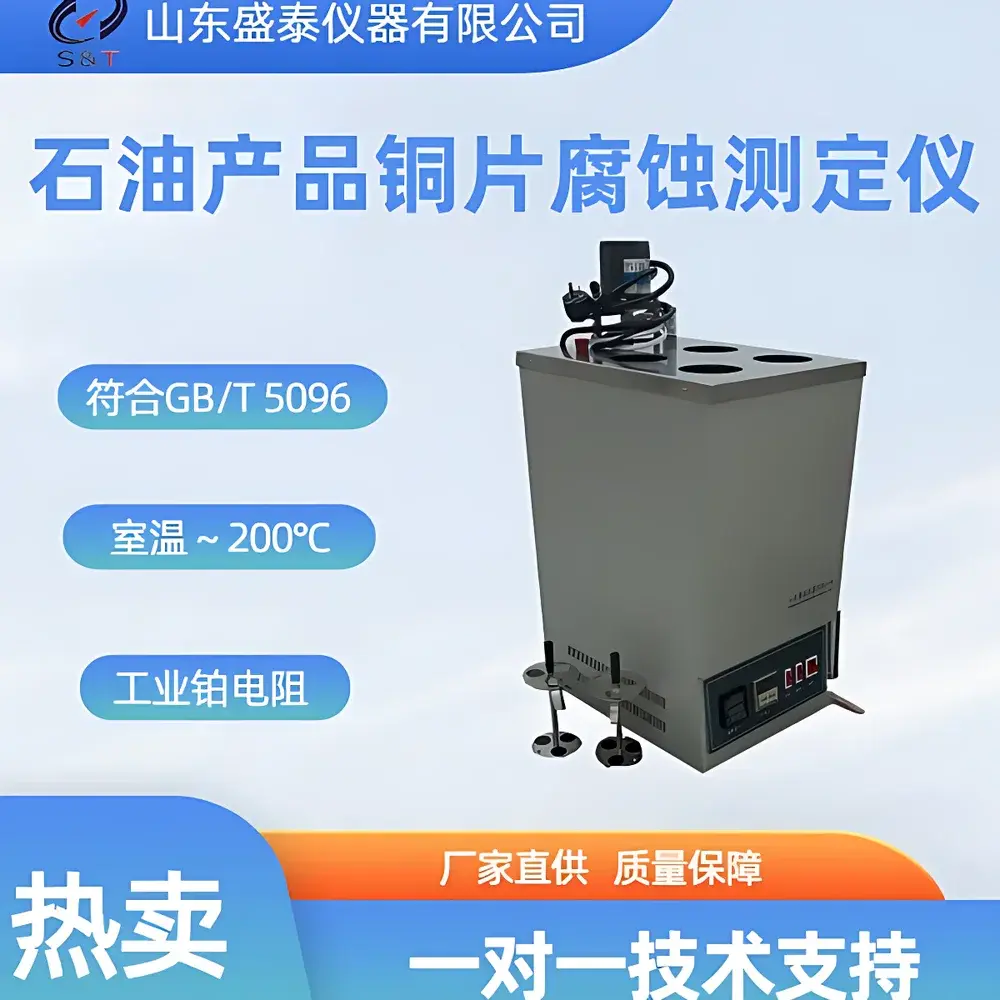
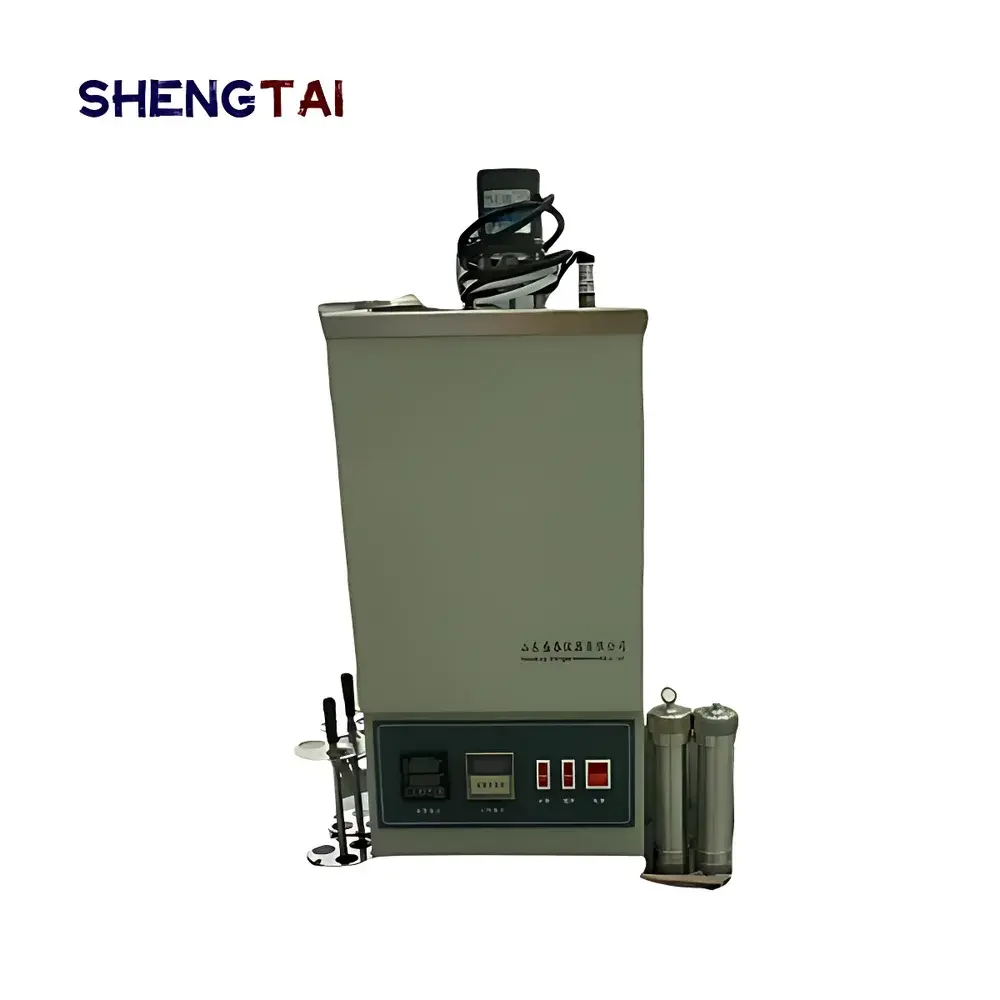
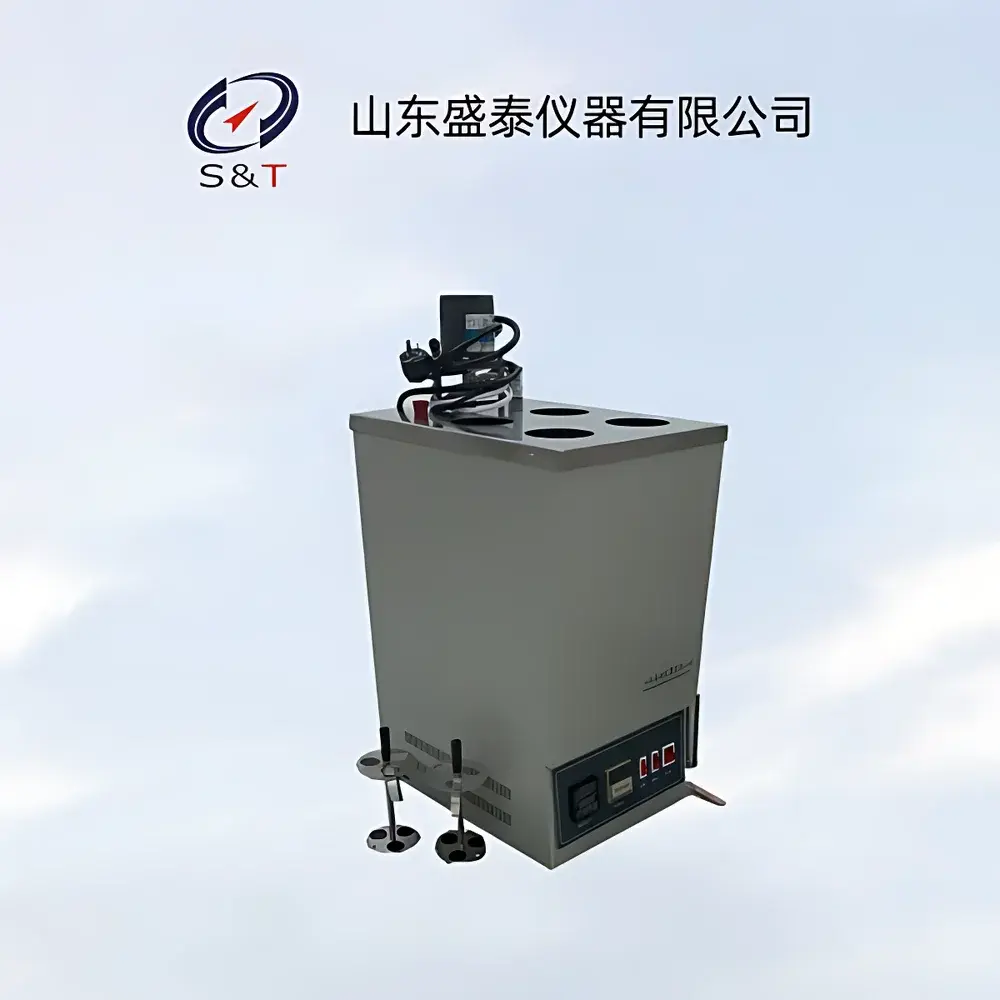
Shengtai Instruments SD 5096 Petroleum Product Copper Strip Corrosion Tester
| Brand | Shengtai Instruments |
|---|---|
| Origin | Shandong, China |
| Manufacturer Type | Manufacturer |
| Model | SD 5096 |
| Power Supply | 220 V ±10%, 50 Hz |
| Temperature Control Range | Ambient to 200 °C |
| Temperature Accuracy | ±0.1 °C |
| Temperature Sensor | Industrial Pt100 Platinum Resistance Thermometer |
| Heating Power | 2100 W |
| Timing Range | 0.01 s to 99 h 99 min |
| Display | LED digital for both temperature and time |
| Sample Capacity | 4 test positions |
| Compliance | GB/T 5096, ASTM D130, ASTM D3241, SH/T 0023 |
Overview
The Shengtai Instruments SD 5096 Petroleum Product Copper Strip Corrosion Tester is a precision-engineered laboratory instrument designed to evaluate the corrosive tendency of hydrocarbon-based fluids toward copper metal surfaces under standardized thermal exposure conditions. It operates on the fundamental principle of controlled immersion corrosion: a polished copper strip is immersed in a representative sample of petroleum product—such as aviation gasoline, jet fuel, diesel, kerosene, industrial solvents, or lubricating oils—and heated to a specified temperature (commonly 100 °C or 120 °C) for a defined duration (typically 3 hours). Following the exposure period, the strip is cleaned and visually assessed against an internationally recognized copper corrosion standard color chart to assign a corrosion rating from Class 1a (no discoloration) to Class 4 (severe darkening or pitting). This method is grounded in electrochemical surface interaction kinetics and provides a reproducible, qualitative–semi-quantitative index of active sulfur compounds, organic acids, peroxides, or other corrosive species present in refined fuels and lubricants.
Key Features
- Four independent test wells housed within a thermally uniform oil bath, enabling parallel evaluation of multiple samples under identical conditions.
- Digital PID temperature controller with Pt100 sensor feedback ensures stable thermal regulation across the full operating range (ambient to 200 °C) with ±0.1 °C accuracy—critical for inter-laboratory reproducibility.
- Integrated high-power (2100 W) heating system coupled with motor-driven mechanical stirring maintains homogeneous bath temperature distribution, minimizing thermal gradients that could compromise test validity.
- Precise digital timer with resolution down to 0.01 seconds supports flexible test durations—from short-term screening to extended stability assessments—and includes audible alarm notification upon completion.
- LED-display interface provides real-time, simultaneous readout of setpoint and actual bath temperature, as well as elapsed or remaining time—enhancing operator oversight and reducing manual recording errors.
- Comprehensive accessory kit includes ASTM/GB-compliant copper strips, glass test tubes, stainless steel test bombs, observation tube, and an imported U.S.-sourced copper corrosion color standard chart (aligned with ASTM D130-04 and GB/T 5096-91).
Sample Compatibility & Compliance
The SD 5096 is validated for use with a broad spectrum of petroleum-derived materials, including but not limited to: aviation turbine fuels (Jet A, Jet A-1), automotive and aviation gasoline, diesel fuels, kerosene fractions, naphtha solvents, and mineral-based lubricating oils. Its design strictly adheres to the procedural requirements and apparatus specifications outlined in GB/T 5096–2010 (equivalent to ISO 2160), ASTM D130–22, ASTM D3241–21 (for jet fuel silver strip testing), and SH/T 0023–2017. The instrument meets essential metrological criteria for GLP-compliant laboratories, supporting traceable temperature calibration and documented test execution. While not inherently 21 CFR Part 11 compliant, its digital logging interface (when paired with external PC-based data capture systems) facilitates audit-ready record retention when integrated into quality management frameworks aligned with ISO/IEC 17025.
Software & Data Management
The SD 5096 operates as a standalone hardware platform without embedded software or network connectivity. All operational parameters—including temperature setpoint, dwell time, and bath status—are configured and monitored via front-panel controls and LED displays. For laboratories requiring electronic data capture, optional RS232 or USB interfaces may be retrofitted to enable serial transmission of temperature/time logs to LIMS or Excel-based tracking templates. Raw output consists of operator-recorded visual ratings referenced against the supplied color chart; no automated image analysis or AI-assisted classification is included. Documentation workflows align with standard analytical practice: each test must be recorded manually in a bound lab notebook or electronic log with signature, date, sample ID, test conditions, observed rating, and analyst identification—fulfilling basic traceability requirements under ISO 17025 Clause 7.7.
Applications
This tester serves critical roles across refining QA/QC, fuel certification, lubricant formulation validation, and regulatory compliance verification. Refineries employ it to screen feedstocks and finished products for sulfur-induced corrosion potential prior to blending or shipment. Aviation maintenance facilities use it to verify jet fuel integrity before aircraft refueling—ensuring adherence to ASTM D1655 specifications. Lubricant manufacturers apply it during additive package development to assess compatibility between base oils and corrosion inhibitors. Independent testing labs deploy the SD 5096 in third-party certification programs for EN 590, ASTM D975, or GB 17930, where copper strip corrosion rating forms part of the pass/fail criteria. Its robust mechanical architecture and consistent thermal performance make it suitable for routine use in ISO 17025-accredited environments.
FAQ
What standards does the SD 5096 comply with?
It fully conforms to GB/T 5096–2010, ASTM D130–22, ASTM D3241–21, and SH/T 0023–2017 for copper and silver strip corrosion testing.
Can the instrument test non-petroleum samples such as biodiesel or bio-blends?
Yes—provided the sample remains stable at test temperatures and does not degrade the bath oil or corrode internal components; users should validate compatibility per ASTM D6751 or EN 14214 protocols.
Is calibration documentation provided with the unit?
Each unit ships with a factory calibration certificate for the Pt100 sensor and timer, traceable to national metrology institutes; annual recalibration is recommended.
What maintenance is required for long-term reliability?
Regular cleaning of the oil bath, inspection of heater elements and stirrer coupling, and periodic replacement of thermal oil (every 12–18 months under continuous use) are advised.
Are spare copper strips and color charts available as consumables?
Yes—Shengtai offers certified copper test strips (ASTM Grade 1, 99.9% Cu), polishing kits (steel wool, abrasive papers), and NIST-traceable color reference charts as recurring consumables.





