
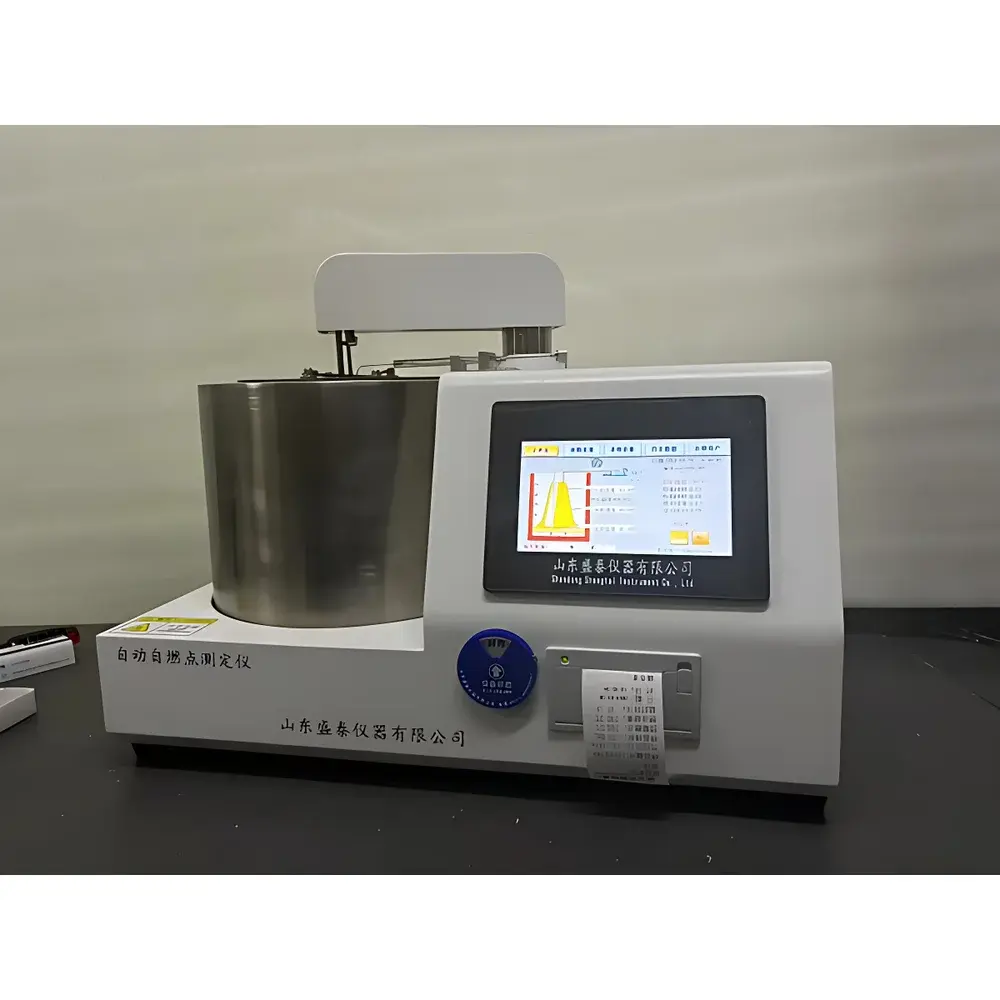
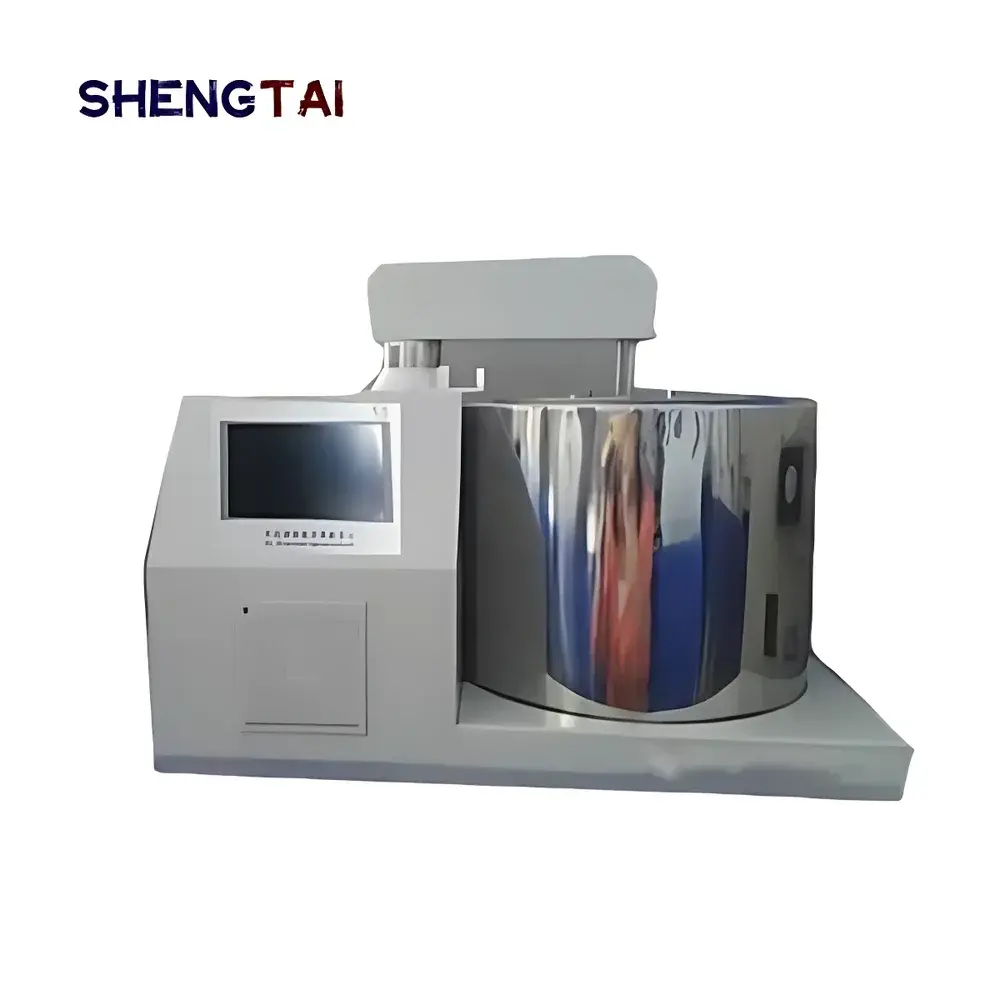
Shengtai Instruments SH706B Automatic Autoignition Temperature Tester for Flammable Liquids
| Brand | Shengtai Instruments |
|---|---|
| Origin | Shandong, China |
| Manufacturer Type | Manufacturer |
| Country of Origin | China |
| Model | SH706B |
| Price | Upon Request |
| Temperature Control Range | Ambient to 800 °C |
| Temperature Accuracy | ±1 °C |
| Timing Accuracy | 1 s |
| Sample Volume | 50 µL |
| Repeatability | ≤10 °C |
| Reproducibility | ≤20 °C |
| Compliance | DL/T 706–2017, SH/T 0642–1997, GB/T 21860–2008 |
| Display | Color LCD Touchscreen |
| Data Export | USB flash drive (CSV/Excel) |
| Power Supply | AC 220 V ±10%, 50 Hz ±2.5 Hz |
| Max. Power Consumption | <1500 W |
| Operating Environment | 5–35 °C, RH ≤85% |
| Dimensions (W×D×H) | 450×380×550 mm |
| Net Weight | 35 kg |
Overview
The Shengtai Instruments SH706B Automatic Autoignition Temperature Tester is a dedicated laboratory instrument engineered for the precise and repeatable determination of the autoignition temperature (AIT) of flammable liquids—particularly turbine oils, phosphate ester anti-wear hydraulic fluids, and other petroleum- and chemical-based liquids used in high-risk industrial environments. It operates on the principle of controlled thermal exposure in a calibrated furnace under standardized atmospheric oxygen conditions, where the sample is introduced at a defined volume (50 µL) into a preheated reaction chamber. Ignition is detected optically and/or thermally upon spontaneous combustion without external ignition source, in strict accordance with internationally aligned national standards including DL/T 706–2017 (China’s electric power industry standard), SH/T 0642–1997 (petroleum products), and GB/T 21860–2008 (chemical liquids). The system integrates microprocessor-based temperature profiling, real-time three-point thermal monitoring, and fully automated sequence control—from ambient ramping to final stabilization, sample introduction, event detection, and result reporting.
Key Features
- Triple-point temperature sensing (bottom center, mid-side, and top zones) ensures spatial uniformity and thermal stability across the reaction furnace cavity, minimizing gradient-induced measurement deviation.
- Automated inert gas exchange mechanism maintains consistent O2 concentration during thermal ramping and holding phases—critical for reproducible autoignition onset detection under ASTM-equivalent oxidative conditions.
- Programmable temperature ramping and isothermal hold functionality enables user-defined thermal protocols compliant with method-specific heating rates and dwell times per DL/T 706–2017 Annex A.
- Touch-enabled color LCD interface provides intuitive navigation, real-time temperature/time curve visualization, and immediate access to calibration logs and test history.
- Integrated thermal printer delivers hard-copy reports with date/time stamp, operator ID (if configured), sample ID, measured AIT value, and pass/fail status relative to specification limits.
- USB data export supports traceable CSV or Excel-formatted records—including raw temperature vs. time arrays, ignition event timestamps, and furnace zone differentials—for long-term archival and audit-ready documentation.
Sample Compatibility & Compliance
The SH706B is validated for use with Class I and II flammable liquids (flash point ≤93 °C), including but not limited to phosphate ester anti-wear fluids (e.g., Fyrquel®, Skydrol®), synthetic hydrocarbon blends, and refined distillates. Its design conforms to the physical geometry, thermal mass, and procedural requirements specified in DL/T 706–2017 (for power plant turbine oil qualification), SH/T 0642–1997 (for general petroleum products), and GB/T 21860–2008 (aligned with ISO 871:2006 principles for plastic and chemical materials). While not certified to UL 94 or ASTM E659 directly, its operational methodology satisfies the core experimental rigor required for hazard classification under GHS Annex 6 and CLP Regulation (EC) No 1272/2008 for autoignition assessment.
Software & Data Management
The embedded firmware supports GLP-compliant operation through mandatory electronic signature prompts prior to test initiation, automatic timestamping of all critical events (e.g., “temperature setpoint reached”, “sample dispensed”, “ignition confirmed”), and immutable storage of raw sensor outputs. Audit trails are retained in non-volatile memory and exported verbatim via USB. No proprietary software installation is required on host PCs; exported CSV files are natively readable in Excel, LabArchives, or LIMS platforms supporting ICH M7 and FDA 21 CFR Part 11–compatible metadata tagging (when paired with validated third-party document management systems).
Applications
- Quality assurance testing of phosphate ester hydraulic fluids in thermal power stations and aerospace ground support equipment.
- Material safety data sheet (MSDS/SDS) development and regulatory submission for new solvent formulations under REACH Annex VII.
- Comparative AIT screening during R&D of flame-retardant additives for lubricants and functional fluids.
- Periodic verification of fluid degradation in service-aged turbine oils—where rising AIT may indicate oxidation byproduct accumulation.
- Supporting fire risk assessments in process safety management (PSM) programs per OSHA 1910.119 and CCPS guidelines.
FAQ
What standards does the SH706B explicitly support?
DL/T 706–2017, SH/T 0642–1997, and GB/T 21860–2008. These cover electrical insulating oils, petroleum derivatives, and general liquid chemicals respectively.
Is the instrument suitable for viscous or high-boiling-point samples?
Yes—provided the sample remains stable below 800 °C and can be accurately metered at 50 µL volume. Pre-heating of syringes or use of heated transfer lines is recommended for viscosities >100 cSt.
Does the system meet FDA 21 CFR Part 11 requirements?
The hardware and firmware provide foundational controls (audit trail, electronic signatures, data immutability), but full Part 11 compliance requires site-specific validation and integration with a qualified electronic record system.
How is oxygen concentration maintained during testing?
Via an integrated programmable air exchange module that cycles ambient air through the furnace chamber at defined intervals, ensuring stoichiometric availability for reliable autoignition detection.
Can test parameters be modified beyond standard methods?
Yes—ramp rate, hold duration, and detection sensitivity thresholds are configurable within safe operational limits, enabling method development per internal SOPs or emerging regulatory drafts.





