
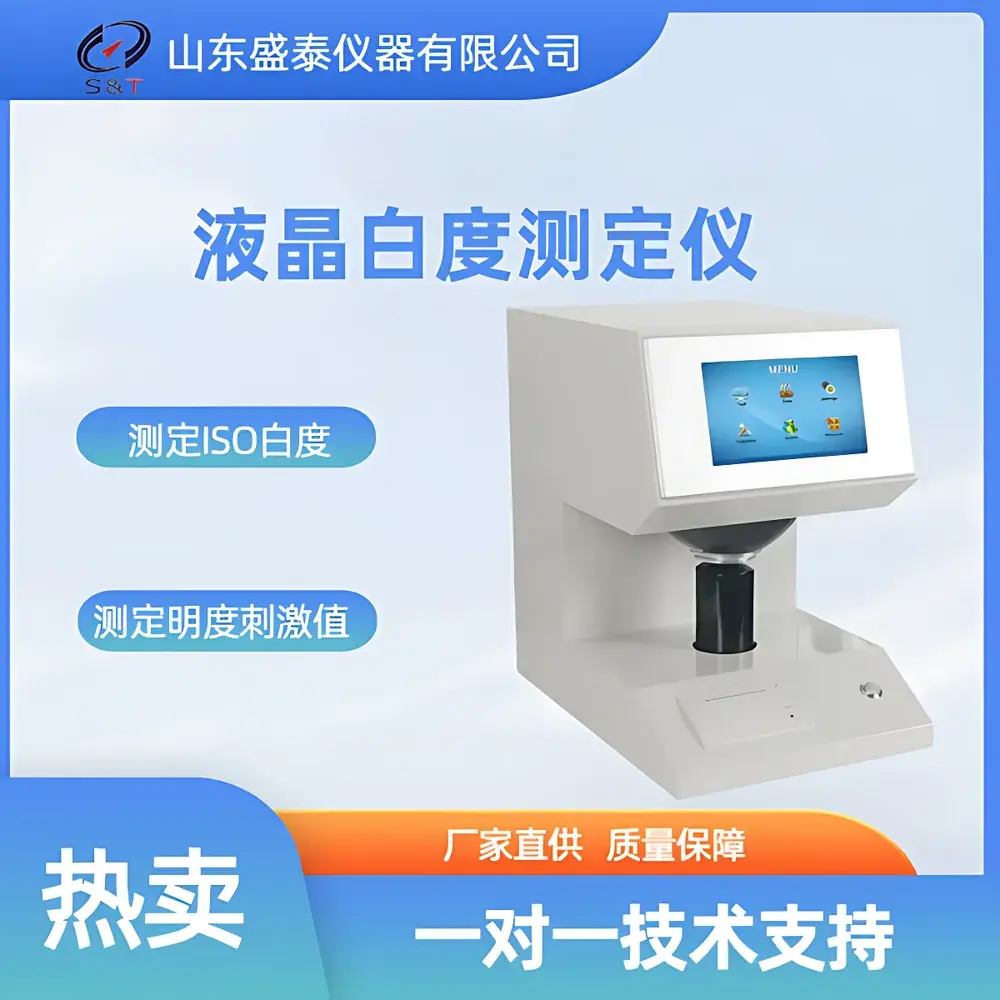
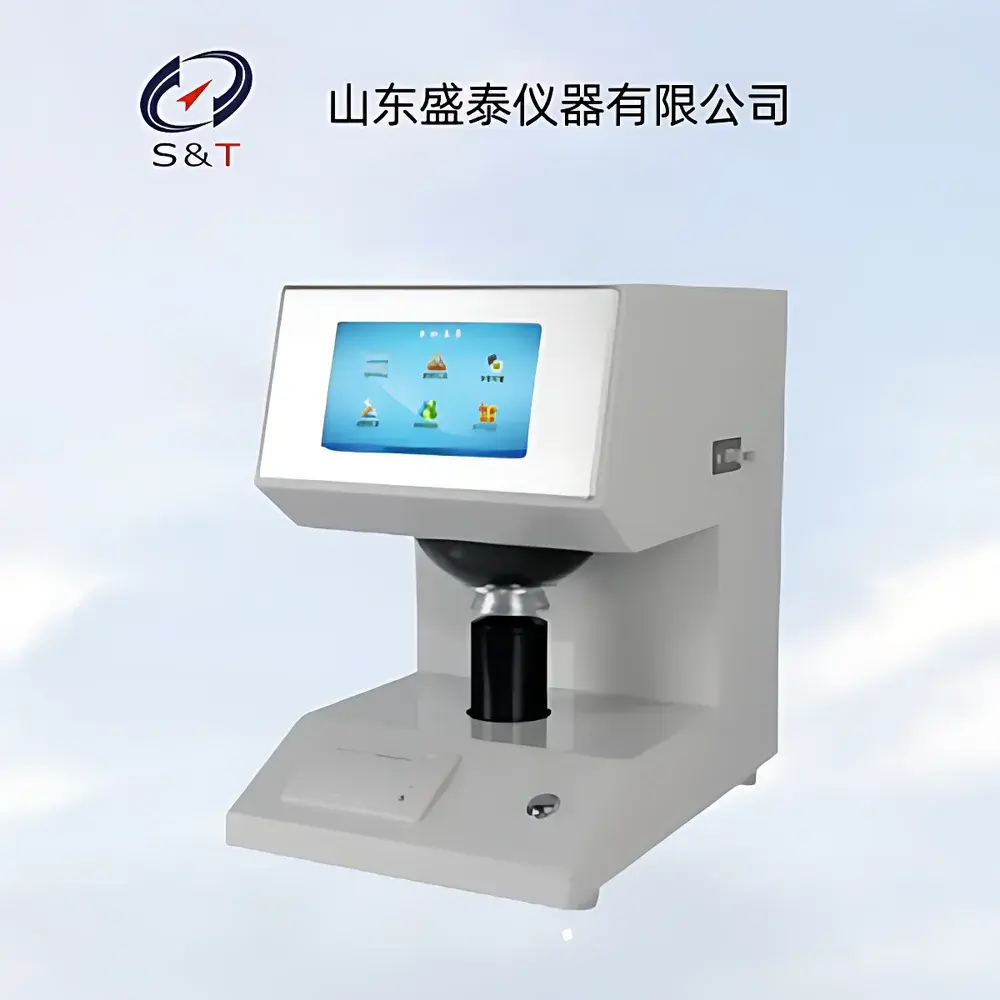
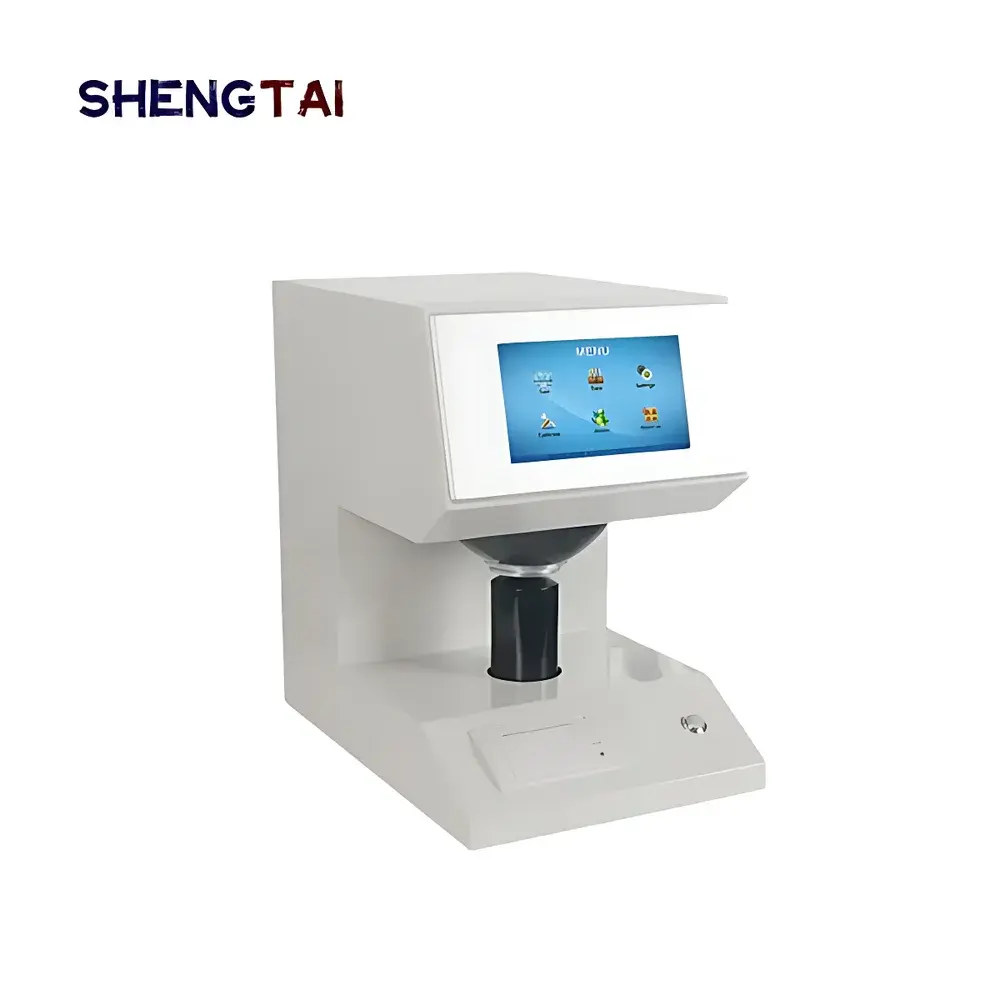
Shengtai Instruments ST001D Whiteness Meter for Flour and Starch
| Brand | Shengtai Instruments |
|---|---|
| Origin | Shandong, China |
| Manufacturer Type | Manufacturer |
| Model | ST001D |
| Illuminant | Simulated D65 |
| Geometry | Diffuse/0° (d/0) |
| Integrating Sphere Diameter | 150 mm |
| Measurement Aperture | 30 mm |
| Display | High-resolution LCD with Chinese UI |
| Connectivity | Ethernet (TCP/IP), USB (optional) |
| Power Supply | AC 220 V ±10%, 50 Hz |
| Zero Drift | ≤0.1 |
| Value Drift | ≤0.1 |
| Measurement Error | ≤0.5 |
| Repeatability Error | ≤0.1 |
| Specular Reflection Error | ≤0.1 |
| Sample Size | ≥Φ30 mm, thickness ≤40 mm |
| Dimensions | 360 × 264 × 400 mm |
| Net Weight | 20 kg |
| Compliance | GB/T 22427.6, GB/T 23774, GB/T 3978–2008, GB 7933, GB 7974, ISO 2470, GB 8940.2, GB 1840, GB 2913, GB 13025.2, GB 1543 |
Overview
The Shengtai Instruments ST001D Whiteness Meter is a precision optical measurement instrument engineered for quantitative evaluation of whiteness, brightness, and related optical properties in powdered and planar solid materials—particularly flour, starch, paper, ceramics, salts, plastics, and inorganic industrial powders. It operates on the principle of diffuse reflectance photometry under simulated CIE Standard Illuminant D65, conforming to the d/0° (diffuse illumination / 0° viewing) geometry specified in ISO 2470 and GB/T 3978–2008. The instrument integrates a 150 mm integrating sphere with a built-in light absorber to eliminate specular reflection artifacts, ensuring accurate measurement of total reflectance—including contributions from fluorescence in optically brightened samples. Its core function is the determination of ISO Brightness (R457), Hunter Whiteness (WH), and CIE Whiteness (WJ), alongside auxiliary parameters such as opacity, transparency, scattering coefficient, absorption coefficient, and ink absorbency—making it suitable for QC laboratories operating under GLP, GMP, or ISO/IEC 17025 frameworks.
Key Features
- Optical system calibrated to simulate CIE Standard Illuminant D65, enabling traceable comparison with international reference methods.
- d/0° geometry with 150 mm integrating sphere and 30 mm measurement port; includes non-reflective baffle and internal light absorber to suppress specular component interference.
- High-stability photodetector array coupled with low-drift analog circuitry: zero drift ≤0.1, value drift ≤0.1, repeatability error ≤0.1, and measurement error ≤0.5 (unitless whiteness index).
- Large-format backlit LCD display with native Chinese interface—guides users through calibration, sample placement, measurement, and statistical summary (mean, SD, min/max) without external software.
- Integrated thermal printer (imported print head) supports on-device hardcopy output; no ink, no ribbon, silent operation, and rapid print cycle.
- Dual power protection: non-volatile memory retains calibration coefficients and user settings after power interruption.
- Standard communication interfaces include Ethernet (TCP/IP) for networked lab data aggregation and USB port for direct PC connection (driver and basic acquisition software provided upon request).
Sample Compatibility & Compliance
The ST001D accommodates flat, opaque, or semi-transparent samples with minimum diameter ≥30 mm and thickness ≤40 mm. For powdered materials—including wheat flour, corn starch, potato starch, and tapioca—the included dedicated powder press ensures consistent packing density and surface uniformity prior to measurement. The instrument complies with over ten national and international standards, including GB/T 22427.6 (starch whiteness), GB/T 23774 (inorganic chemical products), ISO 2470 (paper ISO brightness), GB 7974 (paper whiteness), GB 1543 (paper opacity), and GB 2913 (plastics). These alignments support audit readiness for food-grade starch producers certified to ISO 22000 or BRCGS, pharmaceutical excipient manufacturers adhering to USP <788>, and salt refineries complying with GB 13025.2. While not FDA 21 CFR Part 11–validated out-of-the-box, the device’s deterministic measurement logic, audit-ready print logs, and secure configuration storage enable straightforward validation per laboratory SOPs.
Software & Data Management
The ST001D operates autonomously via embedded firmware—no host PC is required for routine measurements. All raw and processed data (whiteness indices, opacity %, scattering/absorption coefficients) are stored internally with timestamp and operator ID (if configured). Via Ethernet, instruments can be integrated into centralized LIMS or MES platforms using standard TCP/IP socket communication; data payloads follow ASCII-based delimited format compatible with Python, LabVIEW, or SQL ingestion pipelines. USB connectivity supports firmware updates and bulk export of measurement histories (CSV format). Optional PC software (Windows only) provides advanced statistical analysis, trend charting, SPC control limits, and PDF report generation compliant with internal QA documentation requirements. Calibration history, maintenance logs, and environmental condition tags (e.g., ambient temperature/humidity input) are manually annotatable within the software interface.
Applications
- Flour milling: Monitoring whiteness consistency across wheat varieties and milling grades per GB/T 5506 and AACC Method 27-10A.
- Starch production: Quantifying brightness loss during acid hydrolysis or enzymatic modification; validating compliance with GB 1840 for industrial cassava/potato starch.
- Paper & board manufacturing: Measuring ISO brightness (R457) and opacity per ISO 2470 and GB 7974 for grade certification.
- Ceramic glaze & enamel R&D: Evaluating TiO2-based opacifier efficiency via WJ and scattering coefficient trends.
- Chemical additives: Assessing whiteness stability of precipitated calcium carbonate, talc, or kaolin fillers under thermal or UV exposure.
- Pharmaceutical excipients: Supporting documentation of physical attribute consistency for lactose, microcrystalline cellulose, or starch-based diluents in registration dossiers.
FAQ
Does the ST001D support fluorescence compensation for optically brightened starch samples?
Yes. The instrument measures both base reflectance at 457 nm and total emission under D65-simulated excitation, enabling calculation of fluorescent whitening contribution per GB/T 22427.6 Annex B.
Can I validate this instrument against NIST-traceable standards?
The ST001D accepts certified ceramic white tiles (e.g., NIST SRM 2035–2037 equivalents) and black cavity standards. Calibration verification protocols are documented in the user manual per ISO/IEC 17025 Clause 6.5.
Is the thermal printer field-replaceable, and what is its expected lifetime?
The imported thermal print head is rated for ≥50 km of continuous printing; replacement kits—including print head, platen roller, and paper guides—are available directly from Shengtai Instruments with full technical documentation.
What environmental conditions are recommended for optimal performance?
Operate within 10–30 °C ambient temperature and ≤85% RH (non-condensing); avoid direct sunlight or strong ambient UV sources that may affect sensor stability.
How often should recalibration be performed in a regulated QC environment?
Daily verification using supplied white/black standards is recommended; full recalibration (per GB/T 3978–2008) is advised every 3 months or after mechanical shock, lamp replacement, or firmware update.




