
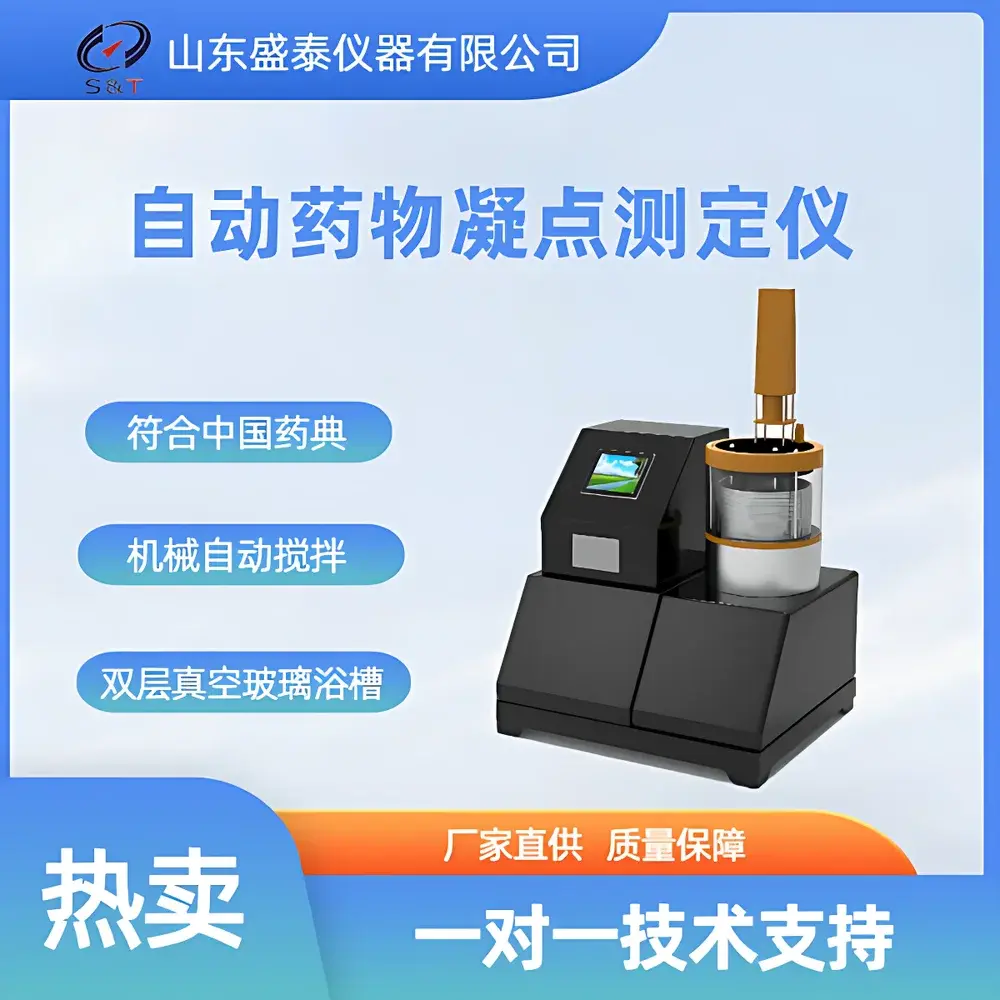
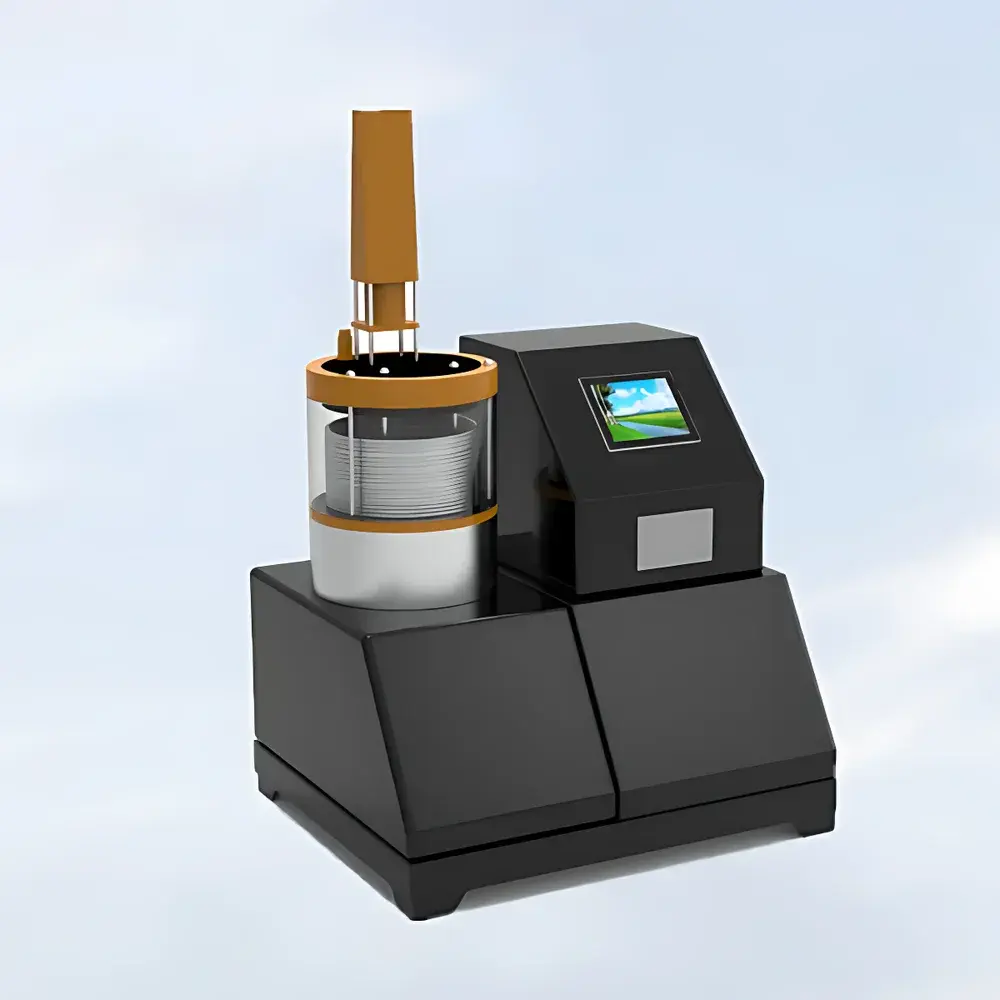
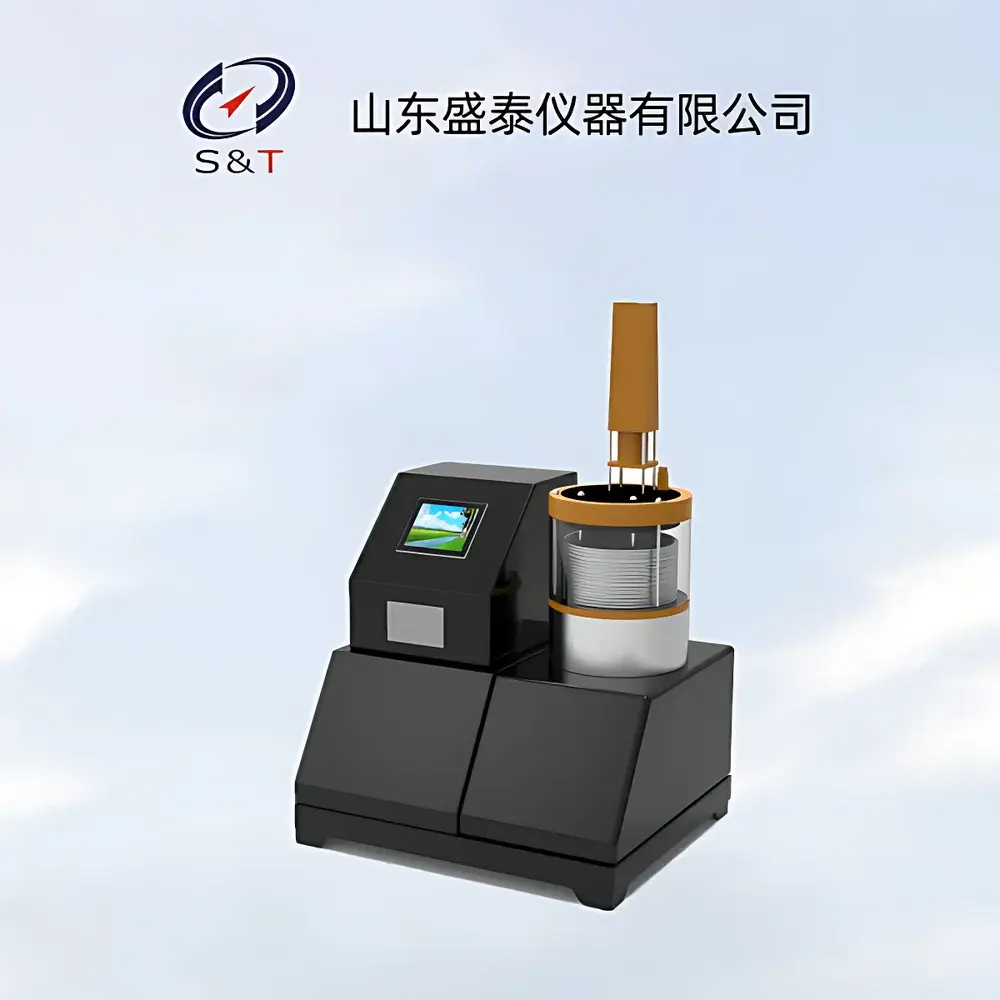
Shengtai Instruments ST203B Automatic Drug Solidification Point Analyzer
| Brand | Shengtai Instruments |
|---|---|
| Origin | Shandong, China |
| Manufacturer Type | Direct Manufacturer |
| Country of Origin | China |
| Model | ST203B |
| Pricing | Upon Request |
| Power Supply | AC 220 V ±10%, 50 Hz |
| Cooling Bath Temperature Range | −30 °C to +80 °C |
| Temperature Control Accuracy | ±0.1 °C (optional ±0.01 °C) |
| Stirring Motor Power | 6 W, 1200 rpm |
| Sample Stirring Rate | 60 cycles/min |
| Cooling Method | Air-cooled compressor refrigeration |
| Bath Construction | Double-layer vacuum glass bath |
| Heat Transfer Medium | Dimethyl silicone oil (user-supplied) |
| Display | 7-inch color touchscreen |
| Data Storage | Internal memory expandable up to 16 GB |
| Data Export | USB flash drive (CSV or Excel format) |
| Built-in Printer | Thermal micro-printer (needle printer standard |
| LIMS Integration | Optional |
| Audit Trail | Optional |
| User Account Management | Three-tier role-based access control (optional) |
| Dimensions | 680 × 450 × 580 mm |
| Weight | 38 kg |
Overview
The Shengtai Instruments ST203B Automatic Drug Solidification Point Analyzer is a precision laboratory instrument engineered for the quantitative determination of solidification point (commonly referred to as “freezing point” in pharmacopeial contexts) in pharmaceutical and biopharmaceutical liquid formulations. It operates in strict accordance with General Chapter 0613 of the Chinese Pharmacopoeia (2020 Edition), which defines solidification point as the highest temperature at which a substance remains in a temporarily stable solid–liquid coexistence state during controlled cooling. This thermodynamic transition reflects molecular homogeneity and crystalline integrity—making solidification point measurement a critical quality attribute for assessing purity, identity, and batch-to-batch consistency of active pharmaceutical ingredients (APIs), excipients, and formulated biologics intermediates. Unlike generic melting point apparatuses, the ST203B employs a dual-phase thermal equilibrium detection algorithm coupled with synchronized mechanical agitation and high-stability bath temperature control to resolve transient plateau formation with reproducible resolution. Its design targets regulatory-relevant applications where trace impurities—such as residual solvents, structural analogs, or aggregation-prone variants—induce measurable depression or broadening of the solidification plateau.
Key Features
- Pharmacopeia-compliant thermal profiling: Fully automated execution of USP General Chapter <741>, EP 2.2.16, and ChP 0613 protocols—including ramp rate control, dwell time validation, and plateau identification logic.
- High-fidelity temperature regulation: Dual-sensor feedback loop maintains bath stability within ±0.1 °C across the full operating range (−30 °C to +80 °C); optional ultra-precision mode achieves ±0.01 °C for GMP-grade method verification.
- Controlled mechanical agitation: Synchronized 60-cycle-per-minute sample stirring ensures uniform nucleation kinetics and eliminates supercooling artifacts—critical for viscous or polymer-containing biopharmaceutical matrices.
- Embedded real-time analytics: Onboard microprocessor performs continuous derivative analysis of temperature vs. time curves to auto-detect inflection points and validate plateau duration per pharmacopeial criteria.
- Regulatory-ready data handling: Supports CSV/Excel export via USB, internal storage of 199 complete test records (including raw sensor traces, timestamps, operator ID, and environmental metadata), and optional audit trail with electronic signature capability.
- Modular compliance architecture: Optional LIMS interface (HL7/ASTM E1384 compliant), three-tier user authentication (administrator/operator/auditor), and configurable electronic record retention policies aligned with FDA 21 CFR Part 11 and EU Annex 11 requirements.
Sample Compatibility & Compliance
The ST203B is validated for use with low-to-medium viscosity organic liquids and semi-solid excipients commonly employed in biopharmaceutical formulation development and QC release testing. Compatible sample types include polyethylene glycols (PEG 400–6000), acetic acid, benzyl alcohol, phenol, ethylenediamine, magnesium stearate suspensions, calcium stearate dispersions, and lauryl alcohol solutions. All measurements are performed using pharmacopeia-specified glass capillary tubes and standardized gel plugs—ensuring direct comparability with reference methods. The instrument meets ISO/IEC 17025:2017 general requirements for competence of testing and calibration laboratories, and its operational parameters satisfy the accuracy and repeatability thresholds defined in ICH Q5C (Stability Testing of Biotechnological/Biological Products) for physical property characterization.
Software & Data Management
The embedded firmware provides a fully navigable 7-inch touchscreen interface with multilingual support (English, Chinese, Spanish). Test sequences are programmable with customizable ramp rates, hold times, and acceptance criteria. All raw sensor data—including primary Pt100 resistance readings, calculated temperature values, and stir motor status logs—are timestamped and stored with immutable metadata (operator ID, date/time, ambient conditions). USB export generates structured CSV files containing columnar fields: Test_ID, Sample_ID, Start_Time, End_Time, Solidification_Point_°C, Plateau_Duration_sec, Max_Supercooling_°C, and Instrument_SN. Optional audit trail functionality logs all user actions—including parameter changes, record deletions, and calibration events—with digital signatures and tamper-evident hashing. When integrated with enterprise LIMS, the ST203B transmits results via secure HTTPS POST using RESTful API endpoints compliant with ASTM E1467-22.
Applications
- Identity testing and purity assessment of small-molecule APIs and synthetic peptides per ChP/USP monographs.
- Batch release testing of PEGylated biologics, where solidification point correlates with PEG chain length distribution and conjugation efficiency.
- Excipient qualification: Verification of specification compliance for benzyl alcohol (preservative), phenol (stabilizer), and fatty acid salts used in monoclonal antibody formulations.
- Stability-indicating method development for accelerated and real-time stability studies under ICH Q1A–Q1E guidelines.
- Investigation of cold-chain integrity failures by correlating solidification behavior with thermal history exposure.
- Supporting regulatory submissions requiring physicochemical characterization data under ICH Q5A (Viral Safety) and Q5C (Stability).
FAQ
What pharmacopeial standards does the ST203B comply with?
The instrument implements General Chapter 0613 of the Chinese Pharmacopoeia (2020), and its operational logic aligns with USP <741> and Ph. Eur. 2.2.16 for solidification point determination.
Is calibration traceable to national standards?
Yes—temperature sensors are calibrated against NIST-traceable Pt100 reference probes, and users receive a certificate of calibration valid for 12 months.
Can the ST203B be used for aqueous protein solutions?
Not recommended for undiluted therapeutic proteins due to ice nucleation interference and non-equilibrium freezing behavior; however, it is suitable for buffer components, cryoprotectants, and excipient blends.
What maintenance is required for long-term reliability?
Routine tasks include periodic replacement of silicone oil (every 12 months), cleaning of the vacuum bath exterior, and verification of stir motor torque; no consumables beyond printer paper and capillary tubes are required.
Does the system support 21 CFR Part 11 compliance out-of-the-box?
Base configuration includes electronic records and audit-ready data export; full Part 11 compliance requires activation of optional audit trail, user authentication, and electronic signature modules.





