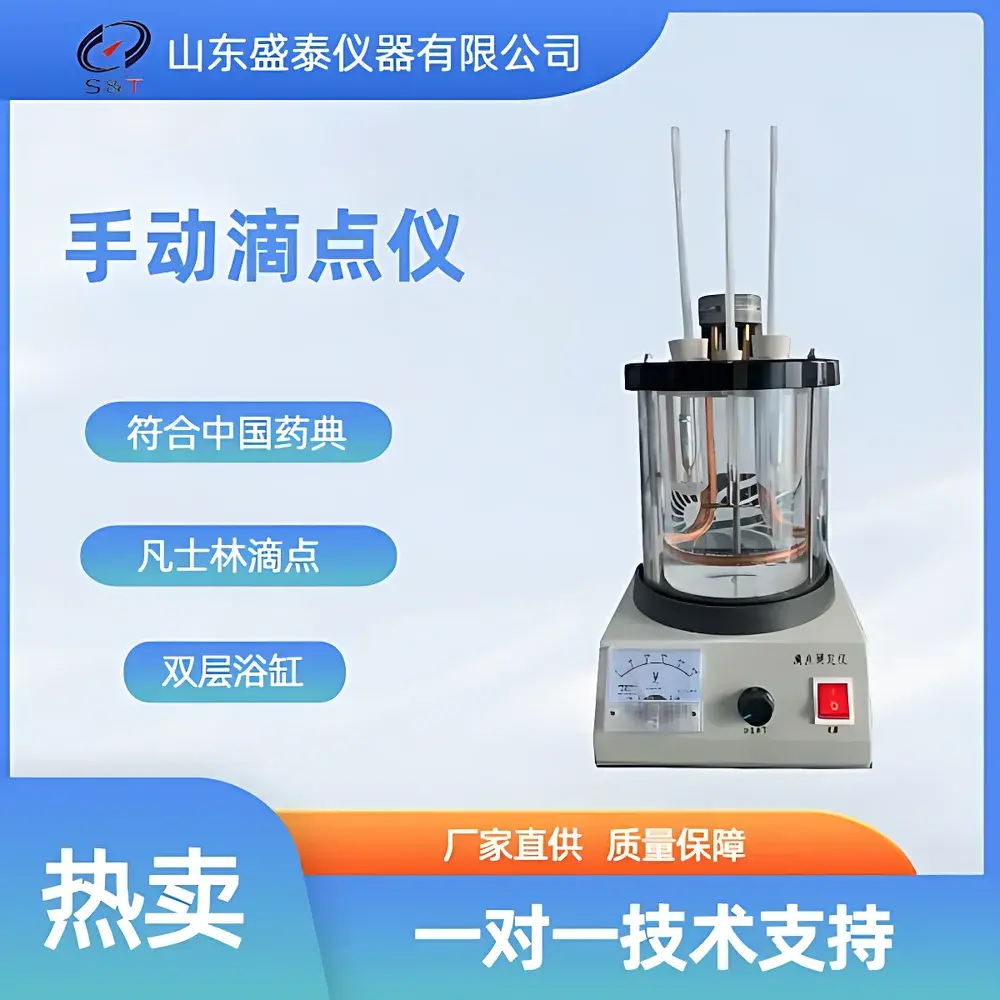
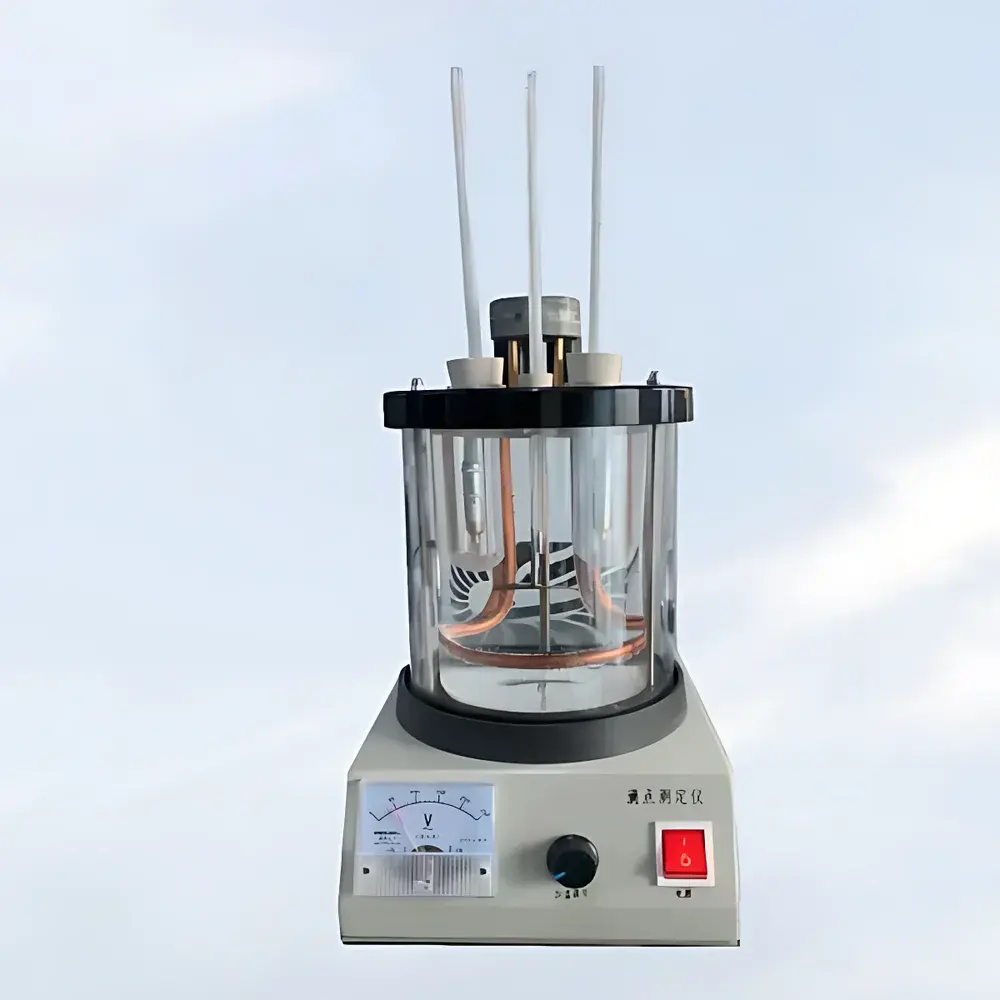
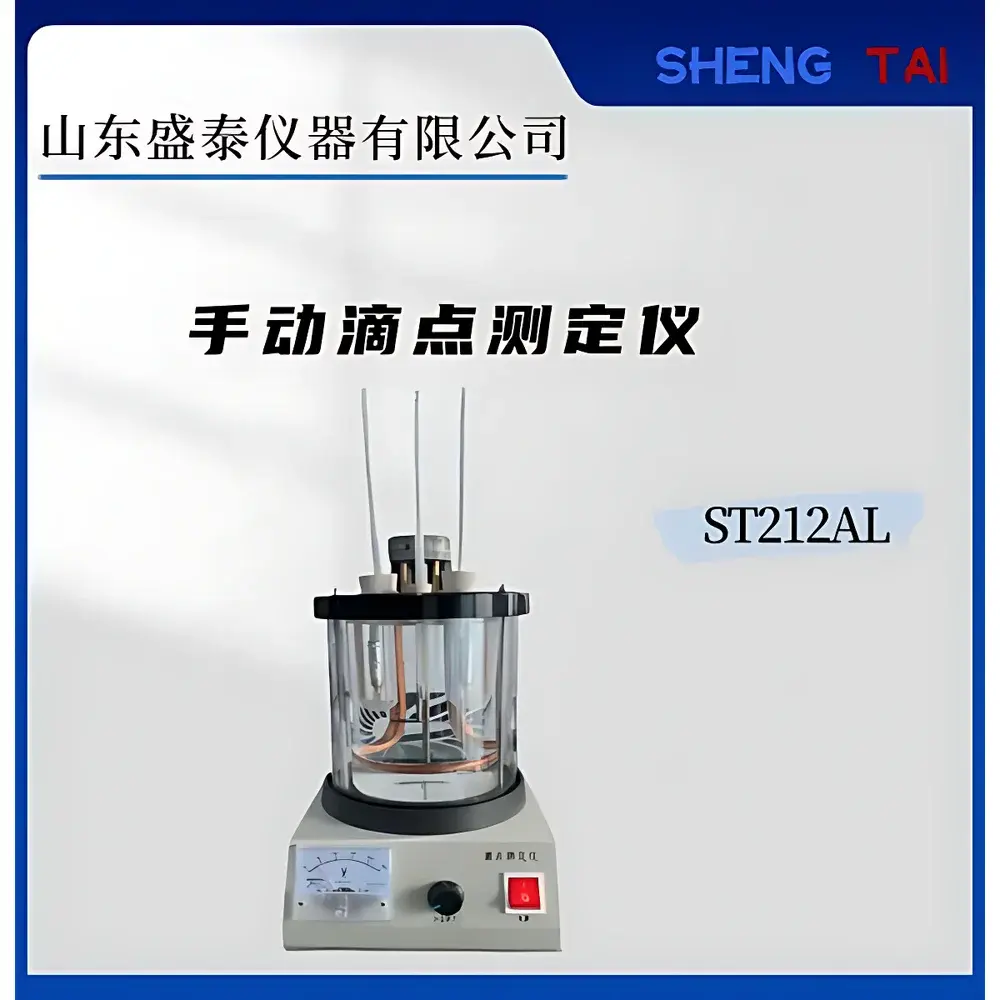
Shengtai Instruments ST212AL Manual Drop Point Tester for Petrolatum
| Brand | Shengtai Instruments |
|---|---|
| Origin | Shandong, China |
| Manufacturer Type | Direct Manufacturer |
| Country of Origin | China |
| Model | ST212AL |
| Power Supply | AC 220 V ±10%, 50 Hz |
| Bath Type | Single-layer insulated oil bath |
| Cup Material | Chrome-plated brass |
| Cup Dimensions | Wide-end ID 7.35–7.65 mm, OD 9.95–9.99 mm |
| Test Tube | Borosilicate glass, 110 mm total length, 25 mm inner diameter |
| Thermometer | Metal-sheathed, range −5 to 105 °C |
| Heater | Tubular, 400 W |
| Stirring Motor | 250 rpm |
| Operating Ambient | −10 to +40 °C, RH ≤85% |
| Max Power Consumption | ≤500 W |
| Dimensions (W×D×H) | 300 × 360 × 500 mm |
| Weight | 10 kg |
Overview
The Shengtai Instruments ST212AL Manual Drop Point Tester is a precision laboratory instrument engineered for the standardized determination of the drop point of petrolatum and other semi-solid hydrocarbon-based pharmaceutical excipients and industrial greases. Based on the principle of thermal transition under controlled heating and mechanical stability, the instrument measures the temperature at which the test specimen—confined in a standardized brass cup—begins to exhibit gravitational flow, defined as the emergence of the first discrete droplet from the cup’s narrow orifice. This endpoint corresponds directly to the material’s thermomechanical softening behavior and serves as a critical quality attribute in pharmacopeial monographs. The ST212AL strictly complies with internationally harmonized test methods, including Chinese Pharmacopoeia (ChP) 2020 Edition, British Pharmacopoeia (BP), and SH/T 0678–1999 “Standard Test Method for Drop Point of Petrolatum”, ensuring method traceability and regulatory acceptability in GMP-aligned pharmaceutical development and QC laboratories.
Key Features
- Pharmacopeia-compliant design: Fully aligned with ChP 2020, BP, and SH/T 0678–1999 specifications for cup geometry, thermometer calibration, heating rate control, and observation criteria.
- Chrome-plated brass cup with metrologically verified dimensions: Wide-end inner diameter 7.35–7.65 mm, narrow-end inner diameter 3.1–3.2 mm, height 15.0–15.4 mm—ensuring reproducible sample confinement and capillary drainage dynamics.
- Single-layer insulated oil bath with uniform thermal distribution: Minimizes axial temperature gradients across the test tube and cup assembly during ramped heating.
- Dedicated metal-sheathed thermometer (−5 to 105 °C): Calibrated to ASTM E77 and ISO 17025-accredited reference standards; housed within a fixed-position sleeve to eliminate parallax and ensure consistent immersion depth.
- 250 rpm magnetic stirring motor: Maintains homogeneous heat transfer throughout the bath medium without introducing vibration artifacts that could trigger premature droplet detachment.
- 400 W tubular heating element with fine-tuned power regulation: Enables stable, linear temperature ramping (typically 1–2 °C/min near endpoint) per pharmacopeial requirements.
- Compact benchtop footprint (300 × 360 × 500 mm) and lightweight construction (10 kg): Optimized for space-constrained QC labs and mobile validation setups.
Sample Compatibility & Compliance
The ST212AL is validated for use with USP/ChP-grade petrolatum, white and yellow ointment bases, hydrophobic ointment vehicles, and analogous semi-solid dosage form excipients. It supports routine testing under Good Manufacturing Practice (GMP) environments where documentation of method suitability, equipment qualification (IQ/OQ), and operator training are mandatory. While the instrument itself does not generate electronic audit trails, its manual operation allows full procedural transparency—enabling complete adherence to FDA 21 CFR Part 11 principles when integrated into paper-based or hybrid SOP workflows. All components—including the brass cup, glass test tube (25 × 110 mm), and calibrated thermometer—are supplied with dimensional certificates and material traceability data upon request.
Software & Data Management
As a manually operated, analog instrumentation platform, the ST212AL does not incorporate embedded software or digital data logging. Temperature readings are recorded visually via the metal-sheathed thermometer, and drop point is determined by direct visual observation of the first droplet fall—a method explicitly prescribed in ChP, BP, and SH/T 0678–1999. Laboratories implementing electronic laboratory notebooks (ELN) or LIMS may manually enter results alongside metadata such as batch number, analyst ID, ambient conditions, and calibration status. For regulated environments, Shengtai provides optional calibration verification kits and NIST-traceable thermometer calibration services to support GLP/GMP documentation requirements.
Applications
- QC release testing of petrolatum raw materials per ChP 2020 General Chapter 0621 and USP <721> Drop Point.
- Stability-indicating assessment of ointment base consistency during accelerated and long-term storage studies.
- Batch-to-batch comparability evaluation for generic topical product development.
- Supplier qualification and incoming inspection of hydrophobic excipients used in transdermal patches and rectal/vaginal suppositories.
- Teaching laboratories for pharmaceutical physical chemistry courses covering thermal transitions in colloidal dispersions and waxy matrices.
FAQ
What pharmacopeial standards does the ST212AL comply with?
The instrument conforms to Chinese Pharmacopoeia (2020 Edition), British Pharmacopoeia, and SH/T 0678–1999 “Standard Test Method for Drop Point of Petrolatum”.
Is the brass cup supplied with dimensional certification?
Yes—each cup undergoes dimensional inspection against ISO 3651 tolerances and is provided with a certificate of conformance upon request.
Can the ST212AL be used for non-petrolatum samples such as greases or waxes?
It may be applied to other semi-solids if their drop point falls within the −5 to 105 °C range and they conform to the cup geometry and flow criteria defined in applicable ASTM or ISO standards (e.g., ASTM D566, ISO 2176).
What maintenance is required for long-term accuracy?
Routine cleaning of the brass cup and glass tube with solvent (e.g., toluene), periodic verification of thermometer calibration, and annual heater/stirrer function checks are recommended.
Does Shengtai provide installation qualification (IQ) or operational qualification (OQ) documentation?
Yes—customized IQ/OQ protocols compliant with EU Annex 15 and ASTM E2500 are available upon order, including test scripts, acceptance criteria, and blank execution records.