
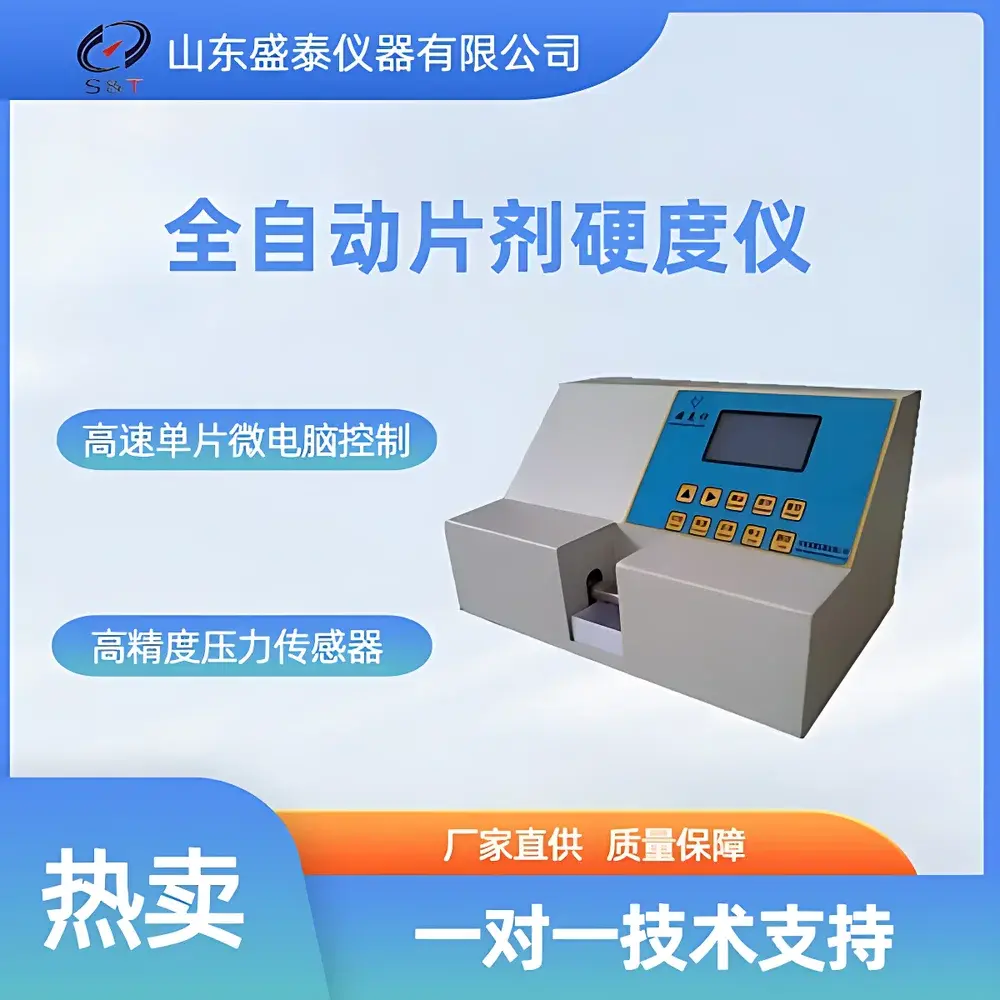
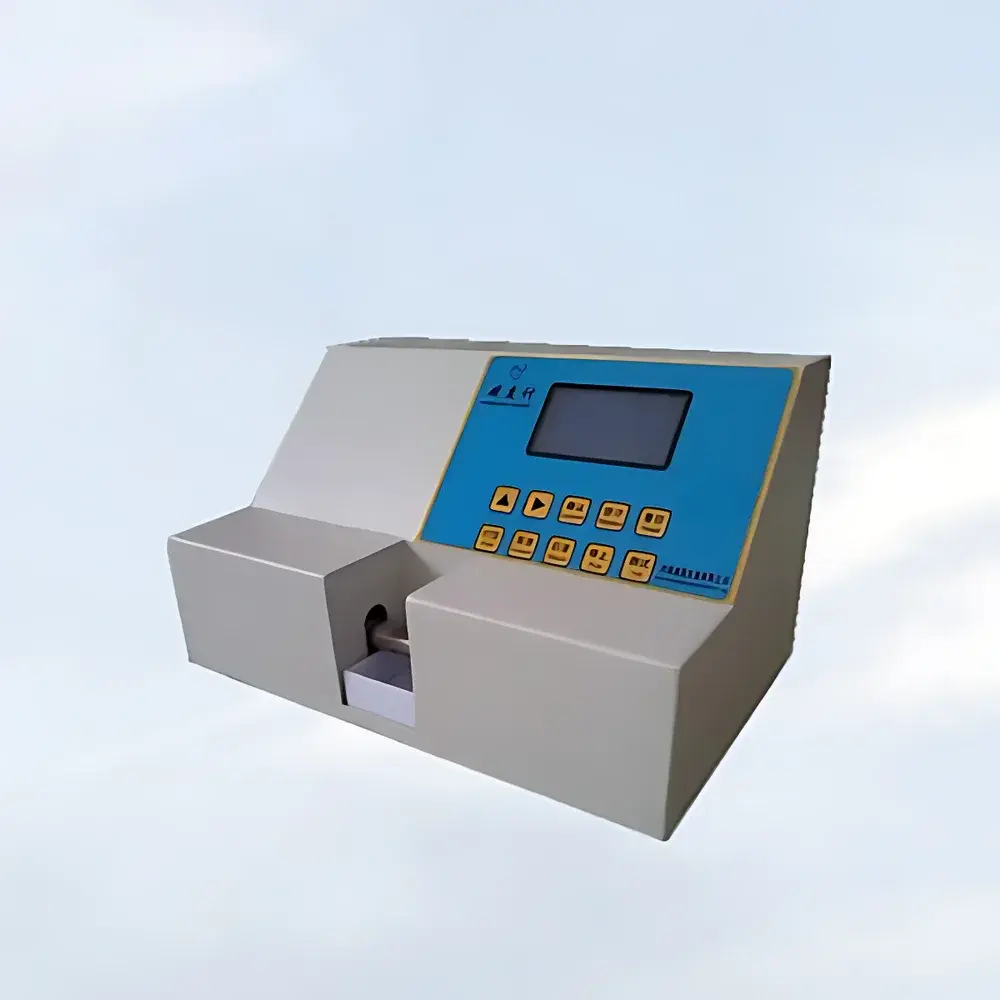
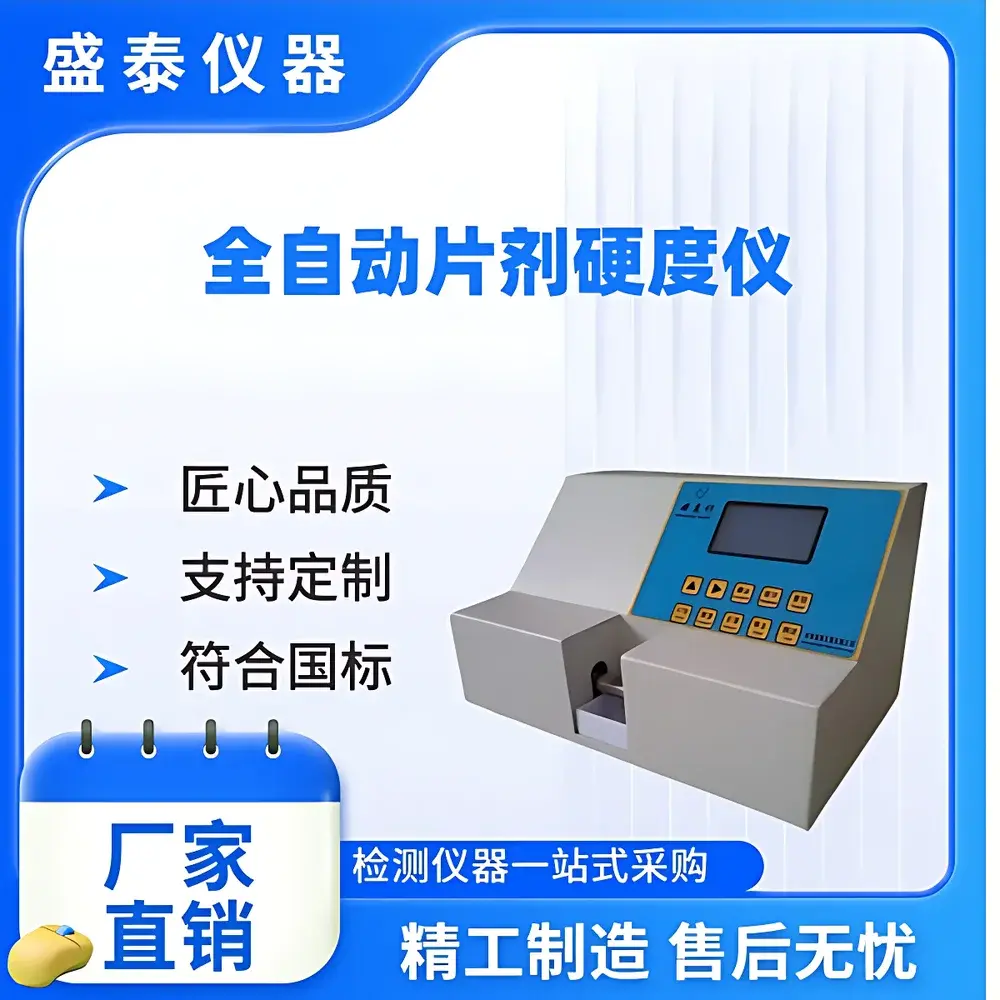
Shengtai Instruments ST220 Tablet Hardness Tester
| Brand | Shengtai Instruments |
|---|---|
| Origin | Shandong, China |
| Manufacturer Type | Direct Manufacturer |
| Model | ST220 |
| Power Supply | 220 V ±10%, 50 Hz |
| Force Range | 10–400 N (1–40 kgf) |
| Sample Diameter Range | 2–20 mm |
| Measurement Accuracy | ±0.1% FS |
| Resolution | 0.01 kgf (0.1 N) |
| Display | Blue LCD |
| Printer | Built-in thermal micro-printer |
| Input Power | 15 W |
| Dimensions (L×W×H) | 300 × 200 × 185 mm |
| Weight | Approx. 5.2 kg |
Overview
The Shengtai Instruments ST220 Tablet Hardness Tester is a dedicated mechanical testing instrument engineered for the quantitative determination of breaking force—commonly referred to as “tablet hardness”—in solid oral dosage forms. It operates on the fundamental principle of axial compression: a precision-controlled motor-driven probe applies gradually increasing compressive force perpendicular to the tablet’s diameter until fracture occurs. At the moment of mechanical failure, the peak load is captured by a high-stability strain-gauge-based pressure transducer and recorded as the hardness value in Newtons (N) or kilogram-force (kgf). This method aligns with internationally recognized pharmacopoeial guidance, including USP <1217> “Mechanical Strength of Tablets” and EP 2.9.8 “Hardness of Tablets”, and supports routine quality control in compliance with ICH Q5A and GMP Annex 15 requirements for analytical instrument qualification.
Key Features
- Microcontroller-based real-time control system with high-speed data acquisition and embedded signal conditioning for consistent force ramping and precise endpoint detection.
- High-accuracy load cell calibrated to ±0.1% full scale, traceable to national metrological standards, ensuring measurement repeatability across batches and operators.
- Motorized vertical actuation mechanism delivers uniform loading rate (default: 1 mm/s), eliminating operator-induced variability inherent in manual testers.
- Integrated thermal line printer generates immediate hard-copy reports containing sample ID, test date/time, individual readings, and statistical summaries (n, mean, min, max, standard deviation, coefficient of variation).
- Backlit blue LCD display provides clear visualization of real-time force progression, final result, and summary statistics without requiring external software or PC connection.
- Compact benchtop footprint (300 × 200 × 185 mm) and low power consumption (15 W) enable seamless integration into QC laboratories, R&D suites, and regulatory-compliant environments.
Sample Compatibility & Compliance
The ST220 accommodates tablets with diameters ranging from 2 mm to 20 mm—including conventional round, oval, and capsule-shaped formulations—and supports both uncoated and film-coated dosage units. Its fixed-anvil geometry is optimized for centrally loaded flat-faced tablets; convex or deeply embossed tablets may require verification of contact alignment per internal SOPs. The instrument meets essential electrical safety requirements per GB 4793.1–2019 (equivalent to IEC 61010-1) and is suitable for use in GLP- and GMP-regulated settings when operated under documented procedures. While the device itself does not provide electronic audit trails or user access controls, its printed output satisfies basic record-keeping needs under FDA 21 CFR Part 11 for non-critical QC testing where handwritten records are historically accepted.
Software & Data Management
The ST220 operates as a standalone instrument with no proprietary PC software or USB/Bluetooth connectivity. All data processing—including calculation of mean, standard deviation, and relative standard deviation (RSD)—is performed internally and presented directly on the LCD screen. Thermal printouts serve as primary raw data records and include timestamp, operator ID field (manually entered), and batch reference. For laboratories requiring digital archiving, users may manually transcribe results into validated LIMS or Excel-based templates compliant with ALCOA+ principles (Attributable, Legible, Contemporaneous, Original, Accurate). Optional calibration certificates (available upon request) include uncertainty budgets aligned with ISO/IEC 17025 practices.
Applications
- Routine in-process and finished-product hardness testing during tablet manufacturing (e.g., post-compression, pre-coating, and final release).
- Formulation development studies evaluating excipient effects on mechanical integrity and disintegration behavior.
- Stability program monitoring of hardness changes over time under accelerated or long-term storage conditions.
- Educational laboratory instruction in pharmaceutical sciences, covering material science fundamentals, powder compaction mechanics, and QC methodology.
- Regulatory submission support through generation of reproducible, instrument-generated physical property data for ANDA or NDA dossiers.
FAQ
What is the recommended calibration frequency for the ST220?
Calibration should be performed at installation, after any major repair or impact event, and at least once every six months using certified dead-weight standards traceable to NIM (National Institute of Metrology, China) or equivalent national metrology institute.
Can the ST220 test coated or scored tablets?
Yes—provided the coating is intact and the scoring groove does not intersect the compression axis; however, fracture initiation may occur preferentially at the score line, which must be documented per SOP.
Is the thermal printer paper included with the instrument?
One roll of thermal paper is supplied with each unit; replacement rolls (57 mm width, 30 m length) are available as consumables under part number ST-TPR-01.
Does the ST220 comply with ASTM D6178 or ISO 13275?
While not explicitly certified to these standards, its mechanical design and measurement methodology are functionally equivalent to the compression test methods described in ISO 13275:2015 (“Tablets — Determination of hardness”) and align with core performance criteria in ASTM D6178-18 (“Standard Test Method for Tablet Hardness”).
How is instrument qualification conducted for GMP use?
Installation Qualification (IQ) and Operational Qualification (OQ) protocols can be developed in-house or with Shengtai’s technical support; Performance Qualification (PQ) requires concurrent testing against reference standards and historical process data to establish acceptable hardness ranges for specific products.




