
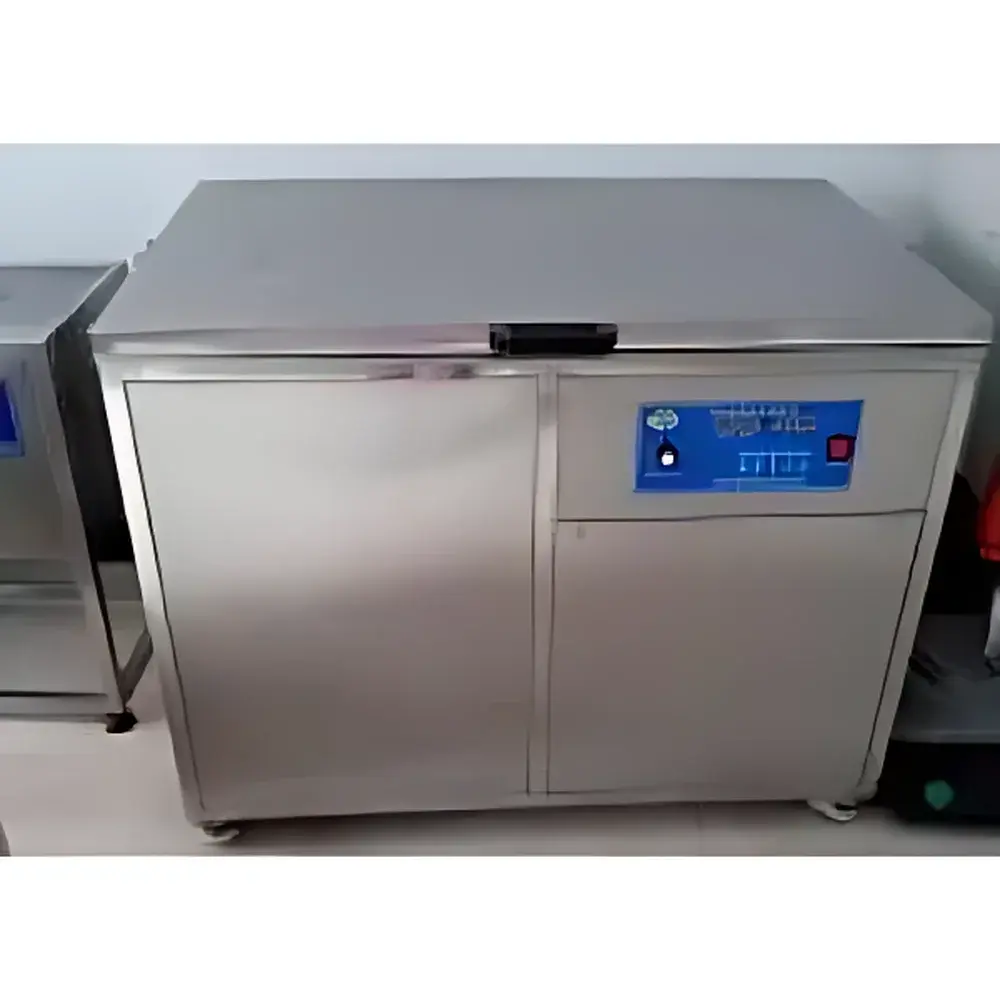
Shengyan SCQ-1010 Dedicated Ultrasonic Cleaner for Eyeglass Frames, Pens, Optical Discs, and Precision Components
| Brand | Shengyan Ultrasonic / SYCS |
|---|---|
| Origin | Shanghai, China |
| Manufacturer Type | Authorized Distributor |
| Product Category | Domestic |
| Model | SCQ-1010 |
| Instrument Type | Application-Specific Ultrasonic Cleaner |
| Tank Capacity | 132 L |
| Ultrasonic Frequencies | 25 kHz, 40 kHz, or 60 kHz (single-frequency selection) |
| Ultrasonic Power Output | 2000 W |
| Power Adjustment | Not Adjustable |
| Temperature Control | Not Available |
| Timer Range | 1–60 min |
| Sound-Dampening Lid | Included |
| Drainage | Manual Valve |
| Internal Tank Dimensions | 830 × 530 × 300 mm |
| Construction | 304 Stainless Steel Tank & Housing |
| Safety Features | Overload Protection, Overheat Protection, Auto-Alarm for Low Liquid Level (≥10 L models) |
Overview
The Shengyan SCQ-1010 is a heavy-duty, application-specific ultrasonic cleaner engineered for the reliable and repeatable cleaning of delicate yet structurally robust components including eyeglass frames, fountain pens, optical discs (CD/DVD/Blu-ray), precision metal parts, and small medical instruments. Unlike general-purpose benchtop units, the SCQ-1010 employs a high-power, single-frequency transducer array operating at 25 kHz, 40 kHz, or 60 kHz—selected at time of order—to match the optimal cavitation profile for target substrates and soil types. At 2000 W total acoustic output and a 132 L working volume, it delivers uniform energy distribution across large or batch-loaded loads, leveraging the physical principle of acoustic cavitation: rapid formation and implosive collapse of microbubbles in liquid media generates localized shear forces and micro-jets that dislodge particulate, organic, and thin-film contaminants without mechanical abrasion. Its design adheres to core engineering principles of industrial ultrasonics—including resonant tank geometry, transducer mounting optimization, and thermal mass stability—ensuring consistent cleaning efficacy under sustained operation.
Key Features
- Robust 304 stainless steel tank and exterior housing resistant to aqueous and mild solvent-based cleaning solutions, minimizing corrosion and supporting long-term operational integrity.
- Industrial-grade piezoelectric transducers mounted on the tank bottom and side walls, configured for selected frequency (25/40/60 kHz) to balance penetration depth (lower frequencies) versus fine-particle removal resolution (higher frequencies).
- Dedicated sound-dampening lid with secure latch mechanism reduces airborne noise to <75 dB(A) at 1 m distance—meeting ISO 7779-compliant laboratory ambient requirements.
- Integrated safety architecture includes dual-stage thermal cutoff, current-limiting overload protection, and automatic low-level liquid detection with audible/visual alarm—certified per IEC 61000-6-3 EMC and IEC 61010-1 safety standards.
- Manual drain valve positioned at tank base enables full solution evacuation without tilting; compatible with standard laboratory floor drains or waste collection systems.
- Fixed-timer control panel with LED display (1–60 min range) ensures process repeatability and eliminates operator variability in exposure duration.
Sample Compatibility & Compliance
The SCQ-1010 is validated for cleaning non-porous, rigid substrates with complex geometries—including titanium and stainless steel eyewear frames, anodized aluminum pen bodies, polycarbonate optical media, and chrome-plated surgical tools. It is not intended for use with soft polymers (e.g., silicone, PVC), unsealed electronics, or heat-sensitive biological samples. While not classified as a medical device under FDA 21 CFR Part 820, its construction and performance align with ISO 15883-1 (washer-disinfectors) foundational principles for mechanical cleaning validation. The unit supports GLP-aligned documentation protocols when paired with external calibration logs and maintenance records. All materials comply with RoHS Directive 2011/65/EU and REACH Annex XVII restrictions on hazardous substances.
Software & Data Management
The SCQ-1010 operates via embedded hardware logic with no onboard software or connectivity interfaces. Process parameters (timer setting, frequency selection) are set manually and retained only during active power cycles. For laboratories requiring audit trails, integration with external environmental monitoring systems (e.g., data loggers recording ambient temperature/humidity during operation) is recommended. Users may document cleaning cycles using standardized SOP templates compliant with ISO/IEC 17025 clause 7.7 (control of technical records). No firmware updates or cloud synchronization are supported—ensuring deterministic behavior and eliminating cybersecurity surface area.
Applications
- Cleaning residual polishing compounds and fingerprint oils from optical disc mastering substrates prior to metallization.
- Removing dried ink residues, metal shavings, and lubricant films from precision writing instrument assemblies.
- Decontaminating reusable ophthalmic frame components between patient fittings in regulated clinical settings.
- Pre-cleaning metallic calibration standards and reference artifacts prior to dimensional metrology (e.g., CMM, optical profilometry).
- Bulk cleaning of stainless steel watch bands, jewelry findings, and dental impression trays in ISO Class 7 cleanroom-adjacent prep areas.
FAQ
Is the ultrasonic frequency adjustable during operation?
No. Frequency is fixed at time of manufacture (25 kHz, 40 kHz, or 60 kHz) and cannot be changed in-field.
Can this unit be used with heated cleaning solutions?
No. The SCQ-1010 lacks integrated heating elements or temperature sensors; external heated baths must be used separately if thermal enhancement is required.
Does it support automated fill/drain cycles?
No. Fill and drain functions are manual only, via inlet hose connection and bottom-mounted valve.
What maintenance is required for long-term reliability?
Monthly inspection of transducer mounting bolts, quarterly verification of tank seal integrity, and annual replacement of the acoustic gasket beneath the lid are recommended per Shengyan’s Field Service Bulletin S-ULS-2023.
Is calibration traceable to national standards?
Ultrasonic intensity mapping (per ASTM E1774-22) and timer accuracy verification (±1 sec over 60 min) can be performed externally using NIST-traceable instrumentation; factory calibration certificates are available upon request.



