
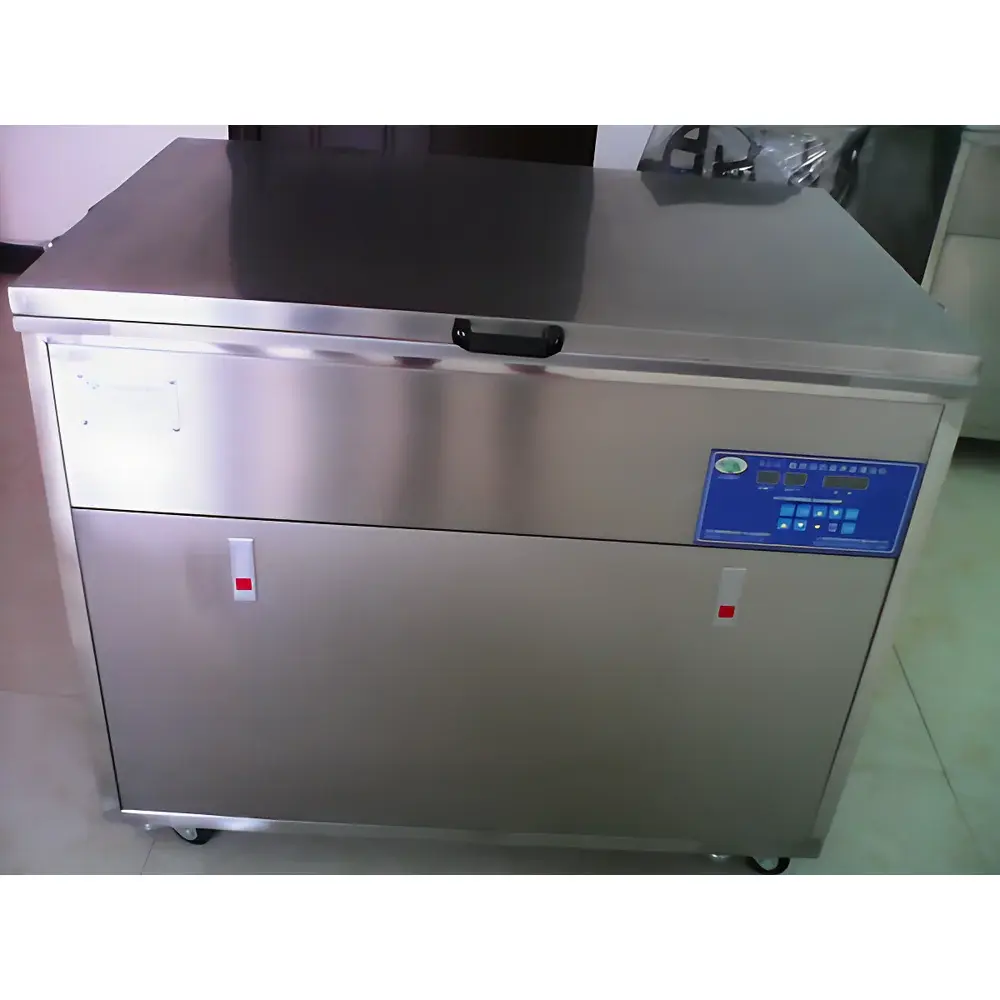
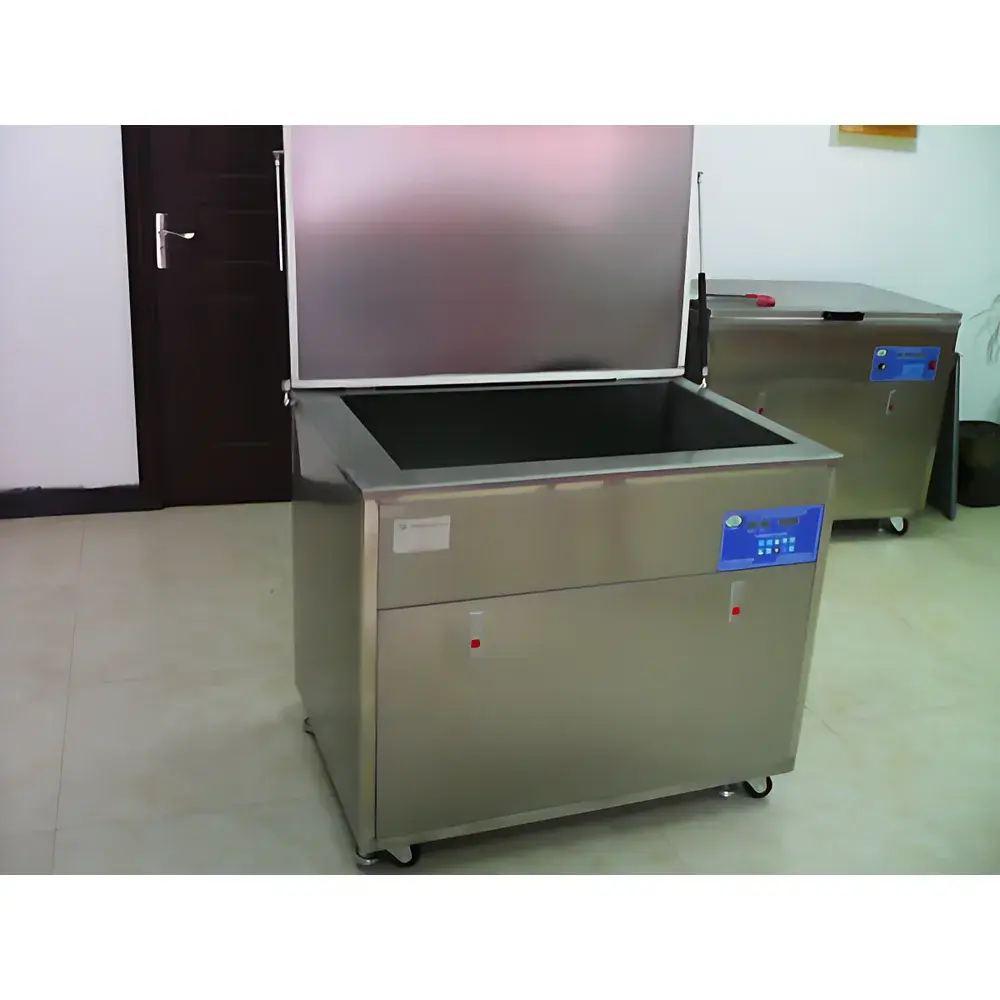
Shengyan SCQ-1020D Dual-Frequency Ultrasonic Cleaner
| Brand | Shengyan Ultrasonics (SYCS) |
|---|---|
| Origin | Shanghai, China |
| Model | SCQ-1020D |
| Tank Capacity | 176 L |
| Ultrasonic Frequencies | 20 / 25 / 28 / 40 / 63 kHz (selectable dual-frequency operation) |
| Total Ultrasonic Power | 2500 W |
| Timer Range | 1–600 min |
| Lid with Sound-Dampening Design | Yes |
| Manual Fill/Drain | Yes |
| Heating Function | None |
| Temperature Control | Not Available |
| Power Adjustment | Not Available |
| Compliance | CE-marked for laboratory use per IEC 61000-6-3 (EMC) and IEC 61000-6-4 (industrial emission) |
Overview
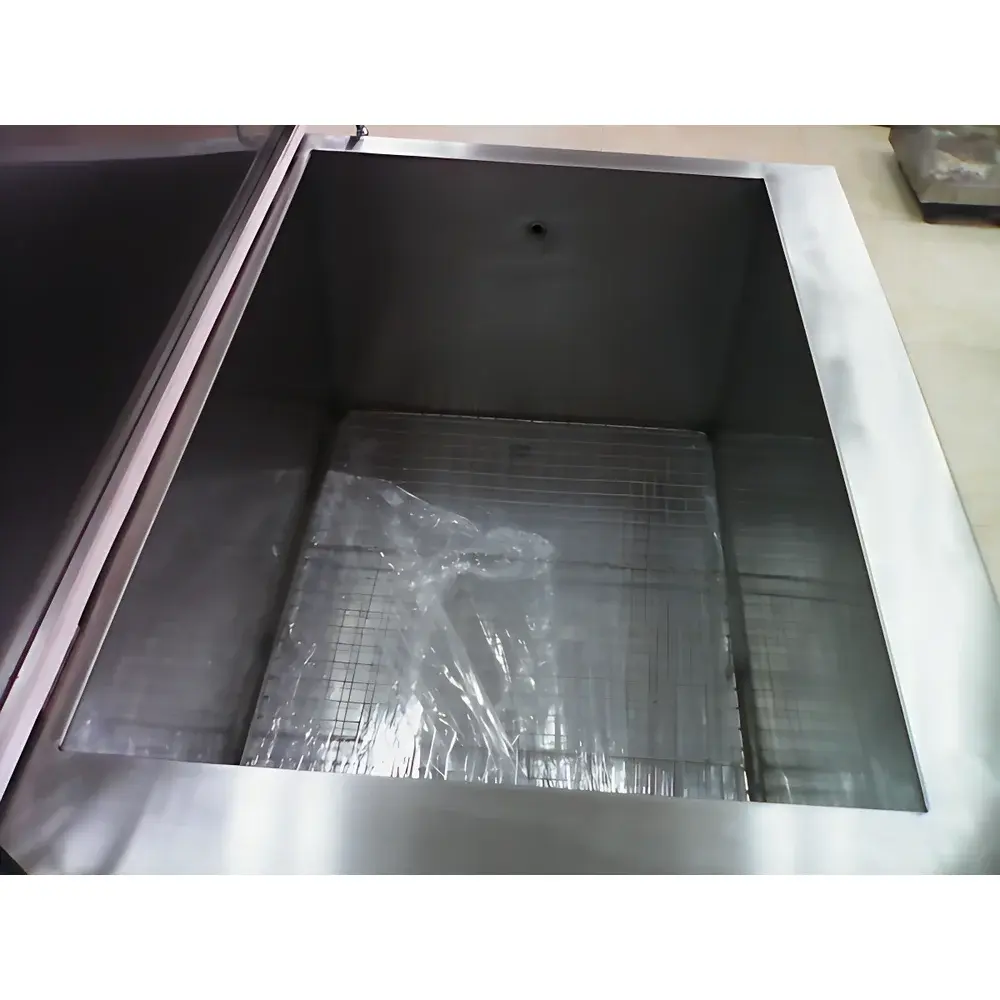
The Shengyan SCQ-1020D Dual-Frequency Ultrasonic Cleaner is an industrial-grade, large-capacity cleaning system engineered for laboratories and manufacturing facilities requiring high-efficiency removal of particulate contaminants, oils, oxides, and organic residues from complex geometries. It operates on the principle of acoustic cavitation—where high-intensity ultrasonic waves generate transient microbubbles in liquid media (e.g., aqueous detergents or solvent-based solutions), which collapse violently near solid surfaces to dislodge adherent soils without mechanical abrasion. Unlike single-frequency cleaners, the SCQ-1020D supports five discrete frequency options (20, 25, 28, 40, and 63 kHz), enabling users to select optimal cavitation intensity and penetration depth based on substrate material, part geometry, and contaminant type. Its 176 L stainless steel tank (internal dimensions: 830 × 530 × 400 mm) accommodates large assemblies, trays of glassware, or batches of medical instruments—making it suitable for QC labs, R&D cleanrooms, and pre-process staging in regulated production environments.
Key Features
- Dual-frequency architecture with five selectable frequencies (20, 25, 28, 40, 63 kHz) for application-specific optimization of cavitation energy and cleaning uniformity
- High-power transducer array delivering 2500 W total ultrasonic output across the full tank volume, ensuring consistent energy distribution even at maximum load
- Robust 304 stainless steel tank construction with reinforced corners and corrosion-resistant sealing—designed for long-term exposure to alkaline detergents and mild solvents
- Integrated sound-dampening lid that reduces ambient noise by ≥15 dB(A) during operation, meeting ISO 11201 occupational noise exposure guidelines for shared lab spaces
- Precision digital timer with 1–600 minute range (1-minute increments), supporting repeatable process validation under GLP and ISO 17025 frameworks
- Manual fill-and-drain configuration compliant with ISO 15195:2018 requirements for non-automated cleaning systems used in calibration and reference material preparation
Sample Compatibility & Compliance
The SCQ-1020D is validated for cleaning a broad spectrum of substrates including stainless steel, aluminum, titanium, borosilicate glass, fused silica optics, silicon wafers, and polymer components (e.g., PTFE, polypropylene). It meets mechanical compatibility requirements for ASTM D2601 (cleaning of precision parts), ISO 13485 Annex C (medical device reprocessing), and USP “Cleaning and Sterilization of Laboratory Glassware.” While the unit does not incorporate integrated heating or temperature feedback, its design allows integration with external recirculating chillers or heated bath systems where thermal activation of cleaning chemistry is required. All electrical components conform to IEC 61010-1:2010 safety standards for laboratory equipment.
Software & Data Management
The SCQ-1020D operates via a dedicated front-panel control interface with LED display and tactile push-button inputs. No embedded software or network connectivity is included—consistent with Class I standalone laboratory equipment per FDA 21 CFR Part 11 guidance, which exempts non-data-logging devices from electronic record requirements. However, the timer’s fixed-setpoint functionality supports audit-ready documentation when paired with lab notebook entries or LIMS-integrated batch records. For GMP-regulated environments, optional external data loggers can be connected to monitor cycle start/stop timestamps and duration compliance.
Applications
- Mechanical engineering: Degreasing of machined components, descaling of heat exchangers, and restoration of metrology tools prior to calibration
- Surface finishing: Pre-treatment cleaning before electroplating, anodizing, or phosphating; post-polishing residue removal from aerospace alloys
- Medical device manufacturing: Cleaning of surgical instruments, endoscope channels, and implant-grade components per AAMI ST91:2023
- Electronics: Removal of flux residues from PCBs, solder paste remnants from SMT stencils, and particle contamination from MEMS sensors
- Semiconductor fabrication: Particle-free cleaning of wafer carriers, quartz boats, and photomask blanks in Class 100 cleanrooms
- Optics & photonics: Non-abrasive cleaning of coated lenses, laser crystals, and fiber optic connectors without coating degradation
- Life sciences: Decontamination of centrifuge rotors, electrophoresis tanks, and cell culture flasks in accordance with CLSI GP35-A4
FAQ
Does the SCQ-1020D support temperature-controlled cleaning cycles?
No. This model lacks integrated heating elements or temperature feedback sensors. External heating baths or inline heaters must be used if thermal activation of cleaning agents is required.
Is frequency selection automated or manual?
Frequency selection is manually configured via front-panel controls prior to cycle initiation. Each frequency setting is retained until changed, supporting SOP-defined protocols.
Can the unit be validated for ISO 13485-compliant cleaning processes?
Yes—its deterministic timer, stable power delivery, and mechanical repeatability enable IQ/OQ/PQ protocol development. Full validation documentation requires user-generated test reports per ISO 13485:2016 Clause 7.5.10.
What maintenance intervals are recommended for transducer longevity?
Transducers should be inspected quarterly for delamination or epoxy cracking. Annual calibration of timer accuracy against NIST-traceable time standards is advised for GLP-aligned operations.
Is the tank compatible with acidic or chlorinated cleaning solutions?
Use of hydrochloric or hypochlorite-based solutions is not recommended due to accelerated pitting corrosion of 304 stainless steel. Alkaline and neutral-pH formulations are preferred per ASTM F312-22 guidelines.



