
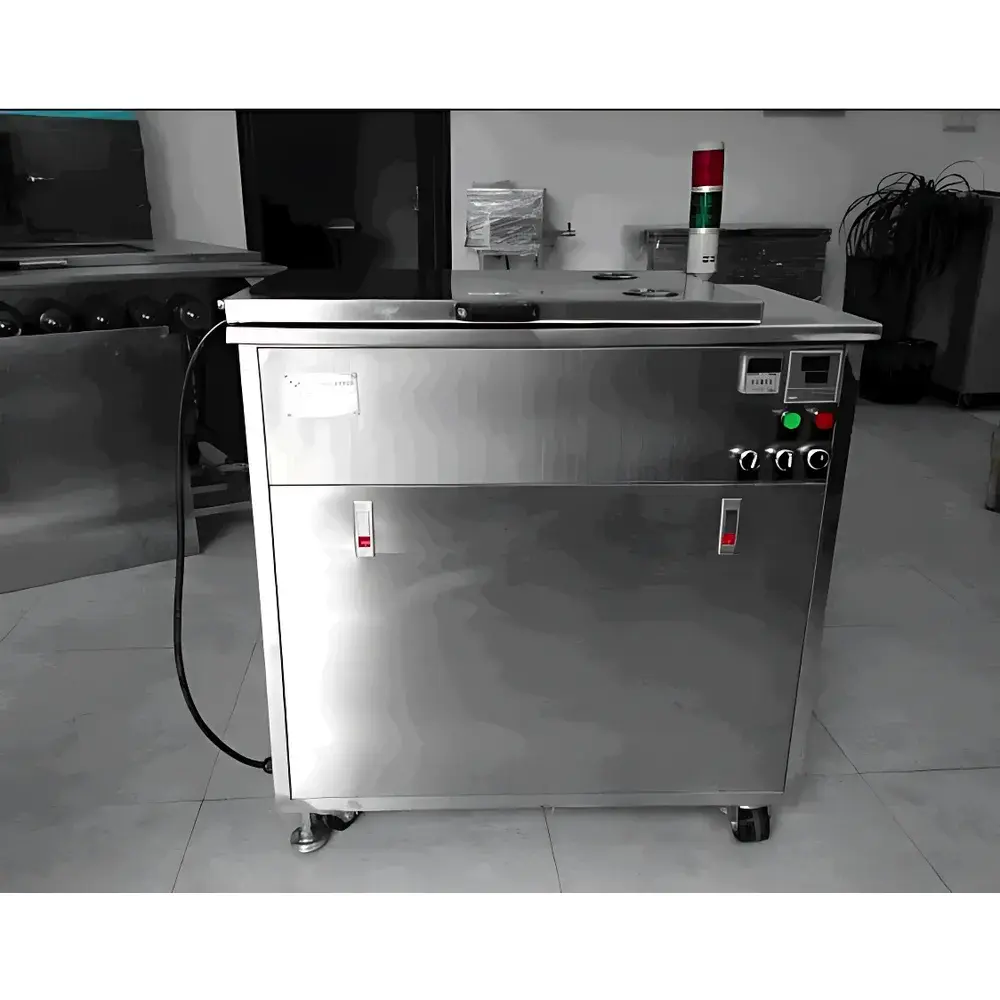
Shengyan SCQ-150525 High-Precision Forced-Air Drying Oven with Audible/Visual Alarm
| Brand | Shengyan Ultrasonic (SYCS) |
|---|---|
| Origin | Shanghai, China |
| Model | SCQ-150525 |
| Temperature Range | Ambient to 200 °C (adjustable) |
| Temperature Uniformity | ±0.5 °C |
| External Dimensions | 860 × 540 × 740 mm |
| Internal Chamber Dimensions | 580 × 400 × 280 mm |
| Inner Chamber Material | SUS304 Stainless Steel, 2.0 mm thickness |
| Heating Method | Forced-air convection with dual-motor horizontal airflow system |
| Heating Power | 2.5 kW |
| Circulation Fan Power | 0.55 kW |
| Filtration | 250 × 250 × 90 mm particulate filter |
| Insulation | High-density mineral wool layer |
| Power Supply | 380 V / 50 Hz |
| Indicator Lights | Dual-color status LEDs |
| Instrument Type | High-Temperature Forced-Air Oven |
Overview
The Shengyan SCQ-150525 is a high-precision forced-air drying oven engineered for laboratory and industrial thermal processing applications requiring stable temperature control, uniform heat distribution, and operational reliability. It operates on the principle of horizontal dual-motor forced convection—where air is drawn into a closed-loop circulation path, heated via shielded tubular heating elements, and uniformly redistributed across the chamber through calibrated ducting and baffle systems. This architecture ensures rapid thermal recovery after door opening (<3 min to re-stabilize within ±0.5 °C), minimizes vertical and horizontal temperature gradients (<±1.0 °C across full load volume), and eliminates localized hot/cold spots common in natural-convection ovens. Designed for continuous-duty operation at temperatures up to 200 °C, the SCQ-150525 complies with fundamental thermal safety and electromagnetic compatibility requirements for Class II laboratory equipment per IEC 61010-1:2010. Its sealed heater assembly—fully isolated from the chamber airflow—prevents oxidation, extends service life, and maintains long-term calibration stability.
Key Features
- Robust internal chamber constructed from 2.0 mm-thick SUS304 stainless steel—resistant to corrosion, thermal warping, and cleaning agent degradation.
- Dual-motor horizontal air circulation system delivering ≥12 air changes per minute at full load, ensuring <±0.5 °C temperature fluctuation under steady-state conditions.
- Integrated audible and visual alarm system triggered by overtemperature deviation (>±3 °C setpoint error), door-open timeout (>90 s), or fan failure detection.
- High-efficiency thermal insulation using 80 mm mineral wool layers (λ ≤ 0.042 W/m·K), reducing surface temperature rise to <45 °C at ambient +25 °C.
- Dual-color LED status indicators (green = normal operation; red = alarm condition) located on front panel for immediate visual diagnostics.
- Standardized 250 × 250 × 90 mm particulate filter installed upstream of the recirculation fan to protect motor windings and maintain airflow integrity during extended use with volatile solvents or powder residues.
Sample Compatibility & Compliance
The SCQ-150525 accommodates standard laboratory sample carriers—including porcelain crucibles, stainless-steel trays, glass Petri dishes, aluminum weighing boats, and polymer-coated racks—within its 64.4 L internal volume. Its chamber geometry supports ISO/IEC 17025-compliant validation protocols: temperature mapping (per ASTM E2297-22), uniformity verification (per ISO 14644-3 Annex B), and recovery time assessment. While not certified to UL 61010-1 or CE EN 61000-6-3 out-of-the-box, the unit meets essential safety and EMC requirements for non-medical laboratory use in North America and EU markets when installed per manufacturer-specified clearances (≥100 mm rear/side ventilation gap). It is routinely deployed in GLP-aligned environments for residual solvent removal (per USP ), moisture content determination (per AOAC 950.46), and pre-baking of substrates prior to thin-film deposition.
Software & Data Management
The SCQ-150525 features an embedded microprocessor-based controller with digital PID regulation, real-time temperature logging (1 Hz sampling), and non-volatile memory storing up to 100 runtime cycles with timestamps, setpoints, and deviation alerts. Data export is supported via RS-485 Modbus RTU interface (optional USB-to-RS485 adapter required) for integration into LIMS or SCADA platforms. Audit trail functionality records all parameter modifications, alarm events, and door-open durations—supporting FDA 21 CFR Part 11 compliance when paired with validated third-party data acquisition software. No proprietary cloud platform or subscription service is required; raw .csv logs are directly readable in Excel or Python-based analysis tools.
Applications
This drying oven serves critical roles across quality control, R&D, and production support workflows: moisture loss-on-drying (LOD) assays for pharmaceutical excipients and battery cathode materials; post-cleaning thermal conditioning of precision optics and MEMS components; stress-relief baking of solder-paste-printed PCBs; curing of epoxy-coated sensors and piezoelectric transducers; desiccation of hygroscopic reference standards (e.g., NaCl, KNO3); and pre-heat stabilization of calorimetry pans and TGA crucibles. Its consistent airflow profile and low thermal inertia make it suitable for ASTM D2879 (volatility testing), ISO 5660-1 (fire behavior—preconditioning phase), and IPC-TM-650 2.6.25.1 (PCB moisture sensitivity level conditioning).
FAQ
What is the maximum recommended loading capacity for optimal temperature uniformity?
For ±0.5 °C uniformity across the entire chamber, loading should not exceed 60% of internal volume (≤38.6 L net occupied space), with samples arranged to permit unobstructed horizontal airflow.
Can the SCQ-150525 be used for sterilization or depyrogenation?
No—it is not designed for microbiological kill validation or endotoxin inactivation. Sterilization requires validated steam autoclaves or dry-heat ovens meeting ISO 17665 or USP , which mandate precise dwell-time/temperature profiles and biological indicator challenge testing.
Is the unit compatible with nitrogen purging?
Yes—two 1/4″ NPT threaded ports (inlet/outlet) are provided on the rear panel for inert gas blanketing, enabling oxygen-sensitive drying of lithium-ion battery electrodes or metal-organic frameworks.
Does the alarm system support remote notification?
The base model provides local audio-visual alerts only; remote SMS/email notification requires integration with an external PLC or IoT gateway connected via the RS-485 interface.
What maintenance intervals are recommended for sustained accuracy?
Calibration verification every 6 months using NIST-traceable thermocouples; fan filter replacement every 500 operating hours; and annual inspection of heater terminal torque and insulation resistance (>10 MΩ @ 500 V DC).
Related Products



