
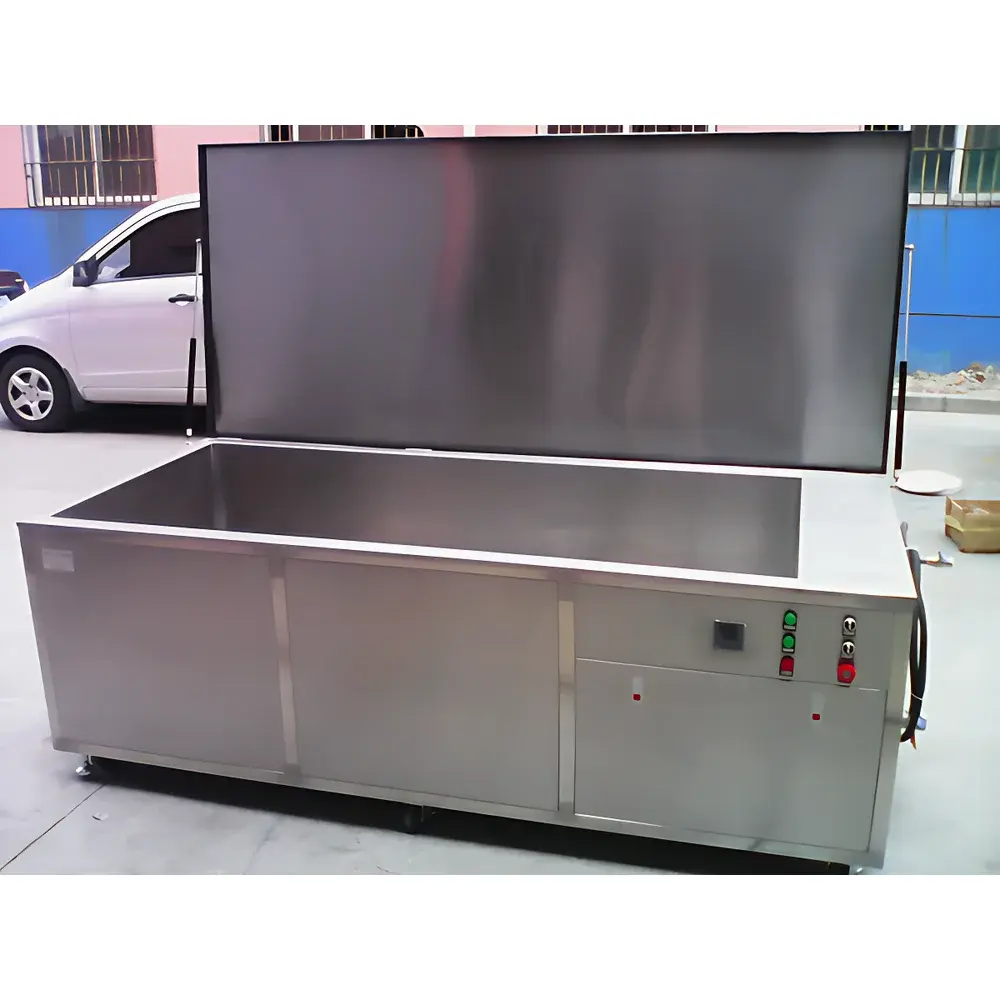
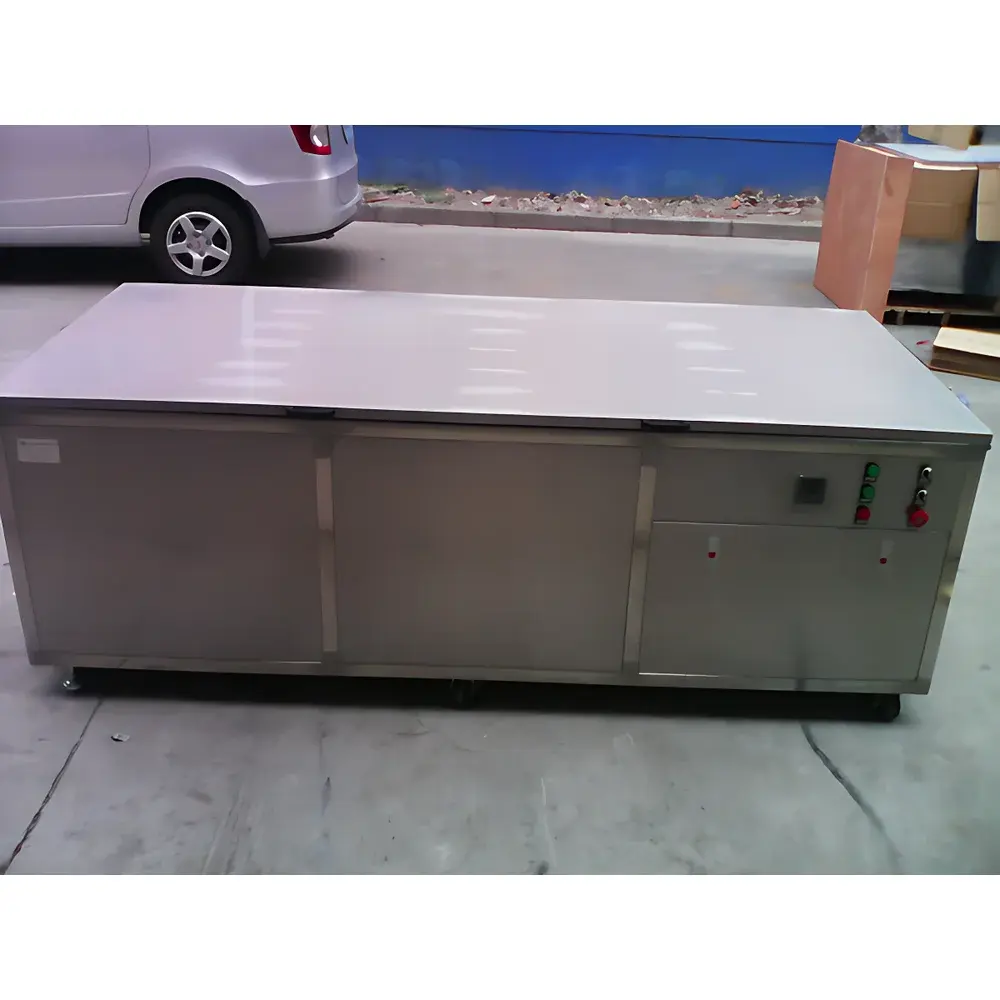
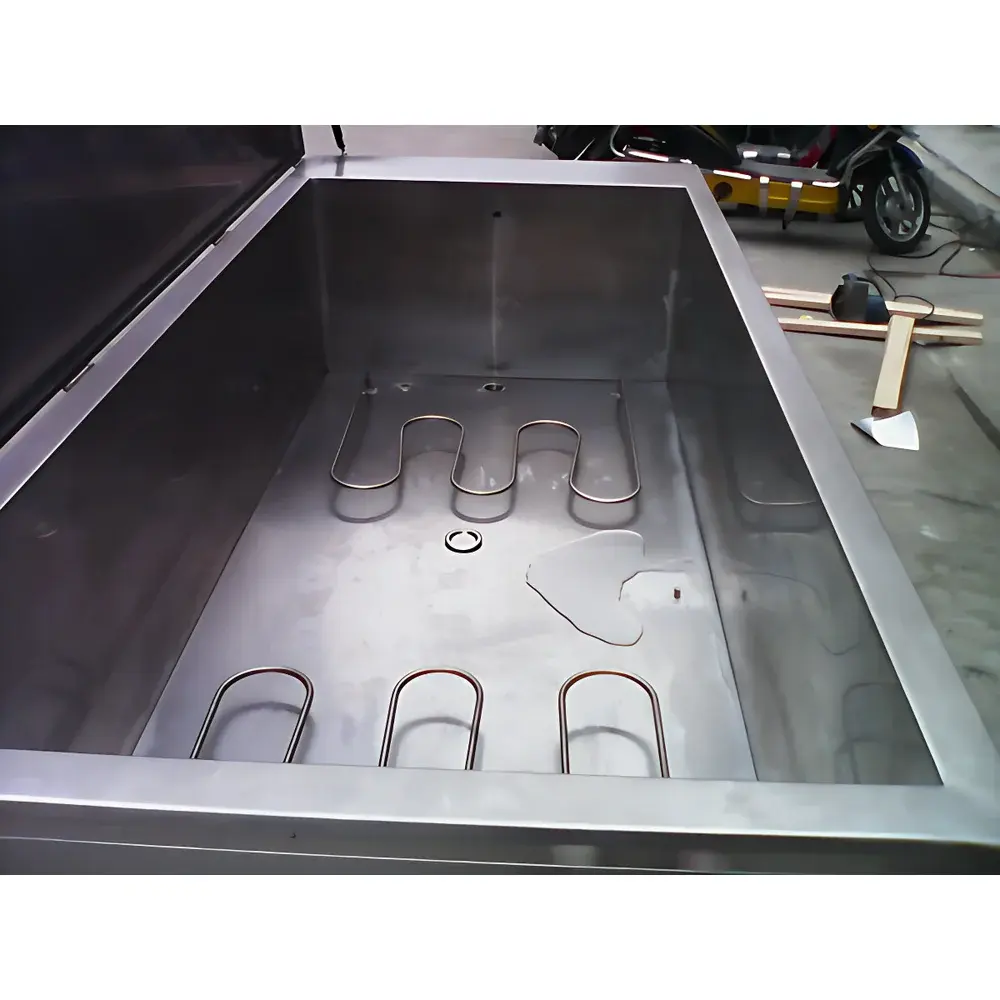
Shengyan SCQ-20140520 Constant-Temperature Water Bath
| Brand | Shengyan Ultrasonic (SYCS) |
|---|---|
| Origin | Shanghai, China |
| Manufacturer Type | Authorized Distributor |
| Country of Origin | China |
| Model | SCQ-20140520 |
| Instrument Type | Constant-Temperature Bath |
| Circulation Mode | Internal Circulation |
| Temperature Control | Refrigeration & Heating Capable |
| Bath Volume | 900 L |
| Temperature Range | Ambient to 100 °C |
| Temperature Stability | ±0.1 °C |
| Heating Power | 8 kW |
| Circulation Pump Power | 0.75 kW |
| Tank Dimensions (L×W×H) | 2000 × 900 × 500 mm |
| External Dimensions (L×W×H) | 2100 × 950 × 800 mm |
| Tank Material | SUS304 Stainless Steel (2 mm wall thickness) |
| Casing Material | SUS304 Stainless Steel (1 mm wall thickness) |
| Filtration System | Integrated |
| Heavy-Duty Mesh Rack | Included |
| Acoustic Dampening Lid | Included |
| Inlet/Drain/Outlet Ports | Provided |
| Casters | Heavy-Duty Locking Casters |
| Power Supply | 220 V / 50 Hz |
Overview
The Shengyan SCQ-20140520 Constant-Temperature Water Bath is an industrial-grade, large-capacity thermal control system engineered for stable, uniform temperature maintenance across extended operational cycles. Designed around a dual-mode thermoregulation architecture—integrating resistive heating and active cooling—it delivers precise thermal management from ambient up to 100 °C with a certified stability of ±0.1 °C under steady-state conditions. Its 900-liter working volume accommodates oversized sample arrays, multi-vessel reaction setups, or immersion-based calibration protocols common in pharmaceutical stability testing, material science aging studies, and biotechnology incubation workflows. The bath employs a robust SUS304 stainless steel tank (2 mm wall thickness) to ensure long-term resistance against corrosion, thermal fatigue, and chemical exposure—critical for laboratories handling aqueous buffers, saline solutions, or mild organic solvents. A high-efficiency internal circulation pump (0.75 kW) ensures homogeneous temperature distribution throughout the bath volume, minimizing axial and radial thermal gradients that could compromise assay reproducibility.
Key Features
- Large-volume capacity (900 L) with reinforced SUS304 tank construction (2 mm wall thickness) for structural integrity and corrosion resistance
- Dual-function temperature control system supporting both heating (up to 100 °C) and active cooling—enabling operation below ambient when paired with external chillers
- High-precision digital PID temperature controller with real-time monitoring and programmable ramp/soak profiles
- Integrated internal circulation pump (0.75 kW) delivering consistent flow velocity and thermal homogeneity across full bath volume
- Standard acoustic-dampening lid to reduce operational noise and minimize evaporative loss during prolonged use
- Heavy-duty stainless steel mesh rack with load-rated support for uniform sample placement and thermal transfer efficiency
- Full-service fluid management: dedicated inlet, drain, and overflow ports with quick-connect fittings compatible with standard laboratory tubing
- Mobility-enabled design with industrial-grade locking casters rated for continuous static loads exceeding 300 kg
- Thermal insulation layer integrated into tank walls to reduce energy consumption and improve temperature retention during unattended operation
Sample Compatibility & Compliance
The SCQ-20140520 is compatible with glassware (e.g., Erlenmeyer flasks, jacketed reactors), stainless steel vessels, and polymer containers rated for continuous immersion at temperatures up to 100 °C. Its non-reactive SUS304 wetted surfaces meet general requirements for ISO 17025-accredited laboratories performing routine thermal conditioning of reference standards, dissolution media, or biological samples. While not intrinsically certified to GLP or GMP, the unit supports audit-ready operation when deployed with documented SOPs, calibrated temperature probes (NIST-traceable), and periodic verification per ASTM E1112 or ISO 13406-2 for thermal uniformity assessment. Optional data logging modules can be configured to satisfy 21 CFR Part 11 compliance requirements for electronic record integrity.
Software & Data Management
The bath operates via a front-panel touchscreen interface with embedded firmware supporting temperature setpoint storage, time-based profile execution, and alarm event logging (e.g., overtemperature, low-level detection, pump failure). Optional RS485 or Ethernet connectivity enables integration into centralized lab management systems (LIMS) or SCADA platforms. When equipped with third-party data acquisition hardware, the unit supports automated generation of CSV-formatted temperature logs compliant with FDA validation documentation standards—including timestamps, sensor IDs, deviation flags, and operator audit trails.
Applications
- Pharmaceutical dissolution testing (USP Apparatus I & II water baths)
- Accelerated stability studies per ICH Q1A(R3) guidelines
- Calibration of liquid-in-glass thermometers and RTDs using fixed-point reference baths
- Enzyme kinetics assays requiring strict thermal control over multi-hour durations
- Material aging tests for polymers, composites, and adhesives per ASTM D570 and ISO 62
- Cell culture pre-warming and reagent equilibration in academic and clinical research labs
- Environmental simulation chambers where auxiliary thermal mass stabilization is required
FAQ
What is the maximum operating temperature and stability specification?
The SCQ-20140520 achieves a maximum setpoint of 100 °C with a temperature stability of ±0.1 °C under stabilized conditions (load-dependent; verified per ISO 13406-2 Annex B).
Does the unit support external temperature probe input for independent verification?
Yes—the controller accepts optional PT100 inputs for redundant monitoring and deviation alerting.
Is the internal circulation system suitable for viscous media?
The pump is optimized for aqueous and low-viscosity fluids (≤50 mPa·s); for higher-viscosity applications, external recirculation loops are recommended.
Can this bath be validated for GxP environments?
With appropriate IQ/OQ documentation, NIST-traceable sensors, and version-controlled firmware, it meets baseline requirements for non-critical thermal support functions in GMP labs.
What maintenance intervals are recommended for long-term reliability?
Filter cleaning every 2 weeks, pump inspection quarterly, and full system calibration annually—per manufacturer’s Maintenance Protocol MP-SCQ-20140520 Rev. 3.



