
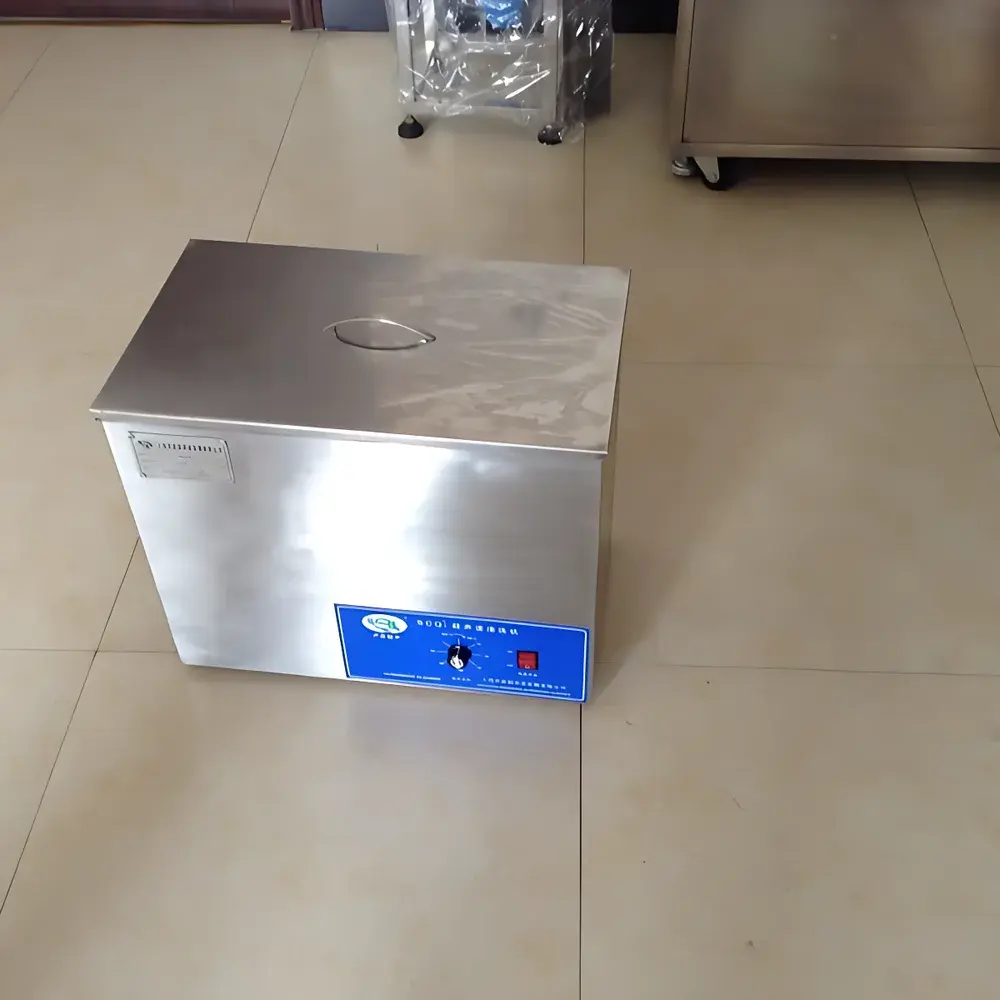
Shengyan SCQ-5201H Benchtop Ultrasonic Cleaner
| Brand | Shengyan Ultrasonics (SYCS) |
|---|---|
| Origin | Shanghai, China |
| Model | SCQ-5201H |
| Capacity | 13 L |
| Ultrasonic Frequency | 28 kHz |
| Ultrasonic Power | 500 W |
| Timer Range | 1–60 min |
| Tank Material | 2.0 mm thick SUS304 stainless steel |
| Internal Dimensions | 300 × 240 × 180 mm (L×W×H) |
| Lid | Acoustic-dampening cover included |
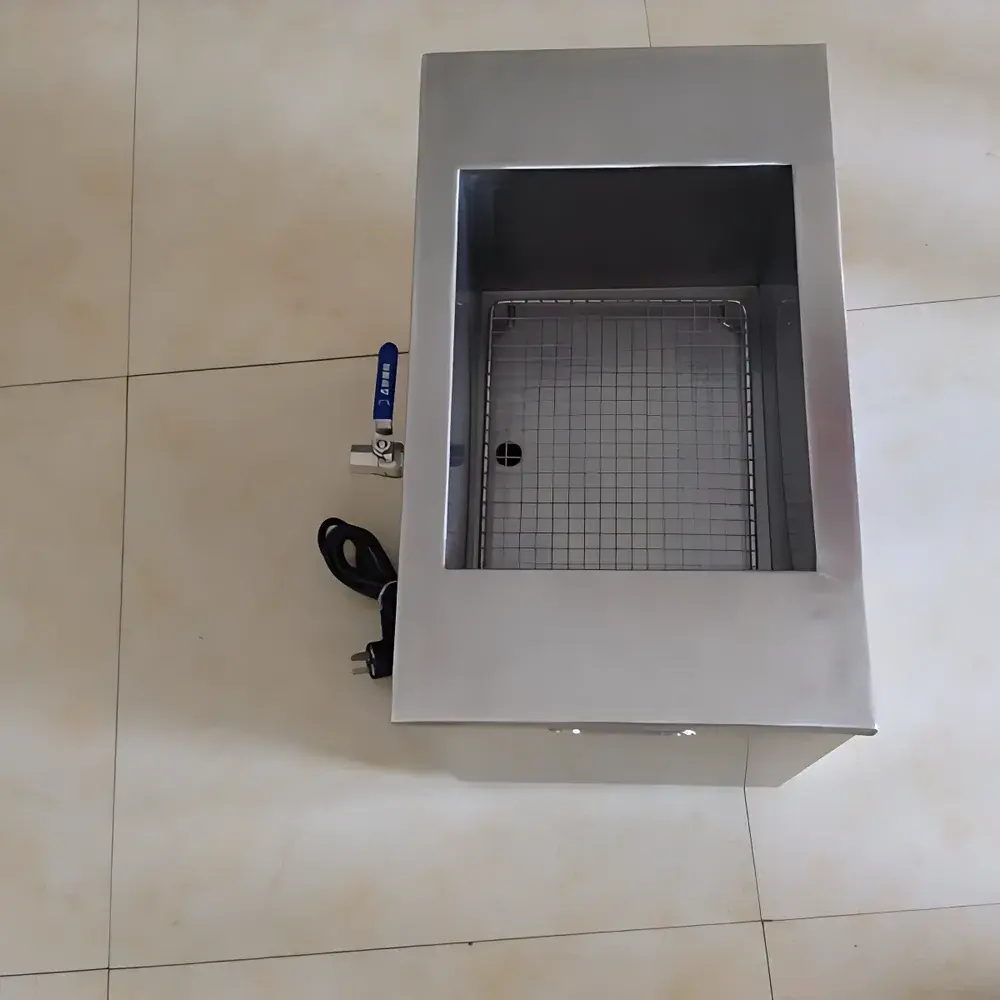
| Drain Valve | Manual |
| Basket | Stainless steel mesh rack included |
| Power Supply | 220 V / 50 Hz |
| Temperature Control | Not available |
| Power Adjustment | Not available |
Overview
The Shengyan SCQ-5201H is a benchtop ultrasonic cleaner engineered for routine laboratory cleaning, degreasing, and particle removal from precision components, glassware, surgical instruments, and analytical sample preparation tools. It operates on the principle of acoustic cavitation—generating high-frequency mechanical vibrations (28 kHz) in a liquid medium to produce transient microbubbles that collapse with localized energy release, effectively dislodging contaminants from surfaces without mechanical abrasion. Designed for stability and repeatability in non-GMP research environments, the unit features a robust 13-liter tank constructed from 2.0 mm thick SUS304 stainless steel, offering corrosion resistance and long-term structural integrity under repeated solvent exposure. Its fixed-frequency, fixed-power architecture ensures consistent energy delivery across operational cycles, making it suitable for standardized cleaning protocols where parameter variability must be minimized.
Key Features
- Stainless steel tank (SUS304, 2.0 mm thickness) with internal dimensions of 300 × 240 × 180 mm—optimized for compatibility with standard labware including beakers, crucibles, pipette tips, and small instrumentation parts.
- 500 W ultrasonic transducer output at a single frequency of 28 kHz, delivering sufficient cavitation intensity for removal of particulates, oils, flux residues, and light biofilms from metal, glass, and ceramic substrates.
- Precise digital timer with adjustable range from 1 to 60 minutes, enabling reproducible exposure durations aligned with validated cleaning SOPs.
- Integrated acoustic-dampening lid reduces ambient noise by up to 15 dB(A) during operation and minimizes solvent evaporation—critical for extended cycle times or volatile cleaning solutions.
- Manual drain valve positioned at the tank base allows controlled, residue-free fluid evacuation after each cycle; compatible with common lab floor drains or waste collection systems.
- Included stainless steel mesh basket supports uniform part immersion while preventing direct contact between delicate items and the tank bottom, reducing risk of scratching or acoustic shadowing.
Sample Compatibility & Compliance
The SCQ-5201H accommodates a broad range of sample types, including but not limited to: chromatography vials, syringe filters, electrophoresis combs, microscope slides, optical lenses, printed circuit boards (PCBs), and dental/orthopedic instruments. While not certified for sterile processing or ISO 13485 medical device reprocessing, its construction and performance align with general laboratory hygiene standards per CLSI GP26-A4 and ASTM D2603-20 (Standard Test Method for Sonic Shear Stability of Lubricating Oils). The absence of temperature control limits use with thermally sensitive materials or enzymatic cleaning agents requiring precise thermal activation; users are advised to pre-condition cleaning solutions externally when necessary. All electrical components comply with IEC 61010-1 safety requirements for laboratory equipment.
Software & Data Management
This model operates via a dedicated hardware-based control interface with no embedded software, network connectivity, or data logging capability. Timer settings are retained only for the duration of power-on; no audit trail, user authentication, or electronic record retention is provided. As such, the SCQ-5201H is intended for use in non-regulated or low-compliance environments—e.g., academic teaching labs, R&D prototyping, and QC screening where manual logbook documentation satisfies traceability requirements. For applications requiring FDA 21 CFR Part 11 compliance or GLP/GMP audit readiness, integration with external time-stamped process logs or third-party environmental monitoring systems is recommended.
Applications
- Routine cleaning of HPLC and GC sample vials, autosampler needles, and column frits prior to analysis.
- Preparation of electron microscopy specimens by removing dust and hydrocarbon films from TEM grids and SEM stubs.
- Degreasing of machined metal parts, calibration weights, and metrology fixtures before dimensional inspection.
- Removal of solder paste residues and flux contaminants from PCB assemblies during electronics failure analysis.
- Supporting microbiology workflows by cleaning reusable Petri dishes, spreaders, and inoculation loops—when paired with appropriate disinfectant solutions and post-cycle sterilization steps.
FAQ
Is the SCQ-5201H suitable for cleaning delicate optics or MEMS devices?
Yes, provided appropriate low-surface-tension solvents (e.g., isopropanol or specialized optical cleaners) are used and exposure time is optimized to avoid prolonged cavitation-induced surface pitting.
Can this unit be operated continuously for multiple cycles without cooldown?
It is rated for intermittent duty; continuous operation beyond three consecutive 60-minute cycles is not recommended without ≥15-minute passive cooling intervals to prevent transducer thermal drift.
Does the tank support ultrasonic cleaning in aqueous alkaline solutions?
Yes—SUS304 construction provides adequate resistance to pH 9–11 detergent formulations commonly used in industrial parts cleaning, though prolonged exposure to chloride-containing alkaline baths should be avoided.
Is a CE or UL mark affixed to the unit?
The device meets IEC 61010-1 safety requirements; however, formal CE marking or UL certification is not included in the base configuration and must be verified separately for regional import compliance.
What maintenance is required for long-term reliability?
Routine inspection of the drain valve seal, periodic descaling using 5% citric acid solution (if hard water is used), and visual verification of transducer bonding integrity every 6 months are recommended practices.
Related Products



