
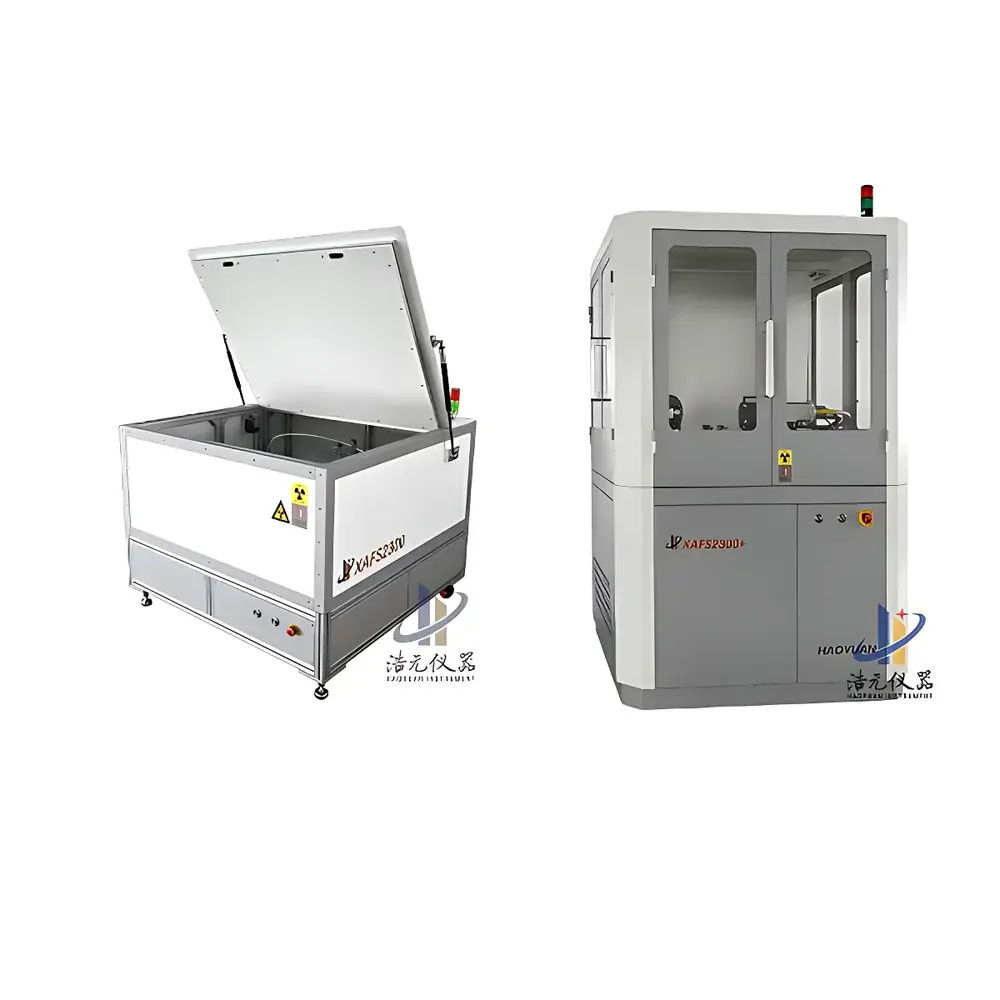
Shenketai XAFS2300+ Laboratory-Scale X-ray Absorption Fine Structure Spectrometer
| Brand | Haoyuan |
|---|---|
| Origin | Jilin, China |
| Manufacturer Type | Authorized Distributor |
| Product Origin | Domestic (China) |
| Model | XAFS2300+ |
| X-ray Source Power (XAFS mode) | 3 kW |
| X-ray Source Power (XES mode) | 50 W |
| Monochromatic Photon Flux | > 2 × 10⁶ photons/sec (at 7–9 keV) |
| Minimum Detectable Elemental Concentration | ≥ 1 wt% |
| Tunable X-ray Absorption Energy Range | 4.5–25 keV |
| Energy Resolution | 0.5–3 eV |
| Energy Scale Drift Reproducibility | < 50 meV per measurement session |
| Monochromator Architecture | Spherical-bent crystal on high-precision Rowland-circle geometry |
| Detector | High-resolution silicon drift detector (SDD) |
Overview
The Shenketai XAFS2300+ is a laboratory-scale, non-synchrotron X-ray Absorption Fine Structure (XAFS) and X-ray Emission Spectroscopy (XES) spectrometer engineered for precision structural and electronic characterization of materials under ambient laboratory conditions. Unlike conventional synchrotron-based XAFS, which requires beamtime access and macroscopic infrastructure, the XAFS2300+ delivers synchrotron-comparable data quality through an integrated architecture comprising a high-flux continuous-spectrum X-ray source, a high-reflectivity bent-crystal monochromator, and a high-energy-resolution silicon drift detector (SDD). Its core measurement principle relies on tunable monochromatic X-ray excitation across the absorption edge of target elements (4.5–25 keV), enabling quantitative extraction of local coordination geometry—including coordination number, bond distance, Debye–Waller factor, and oxidation state—via Fourier-transform analysis of the extended X-ray absorption fine structure (EXAFS) and near-edge structure (XANES). In XES mode, the system operates as a high-resolution wavelength-dispersive X-ray fluorescence spectrometer, resolving spin-state splitting and ligand-field effects with sub-eV energy resolution—particularly valuable for transition-metal chemistry and 3d/4d element speciation.
Key Features
- Dual-mode operation: Seamless switching between high-power XAFS mode (3 kW metal-ceramic side-window X-ray tube) and low-power, high-resolution XES mode (50 W microfocus end-window tube), with pre-aligned optical paths eliminating recalibration requirements.
- High photon throughput: Monochromatic flux exceeding 2 × 10⁶ photons/sec at 7–9 keV ensures sufficient signal-to-noise ratio for dilute samples and rapid data acquisition.
- Precision monochromator: Spherical-bent crystal optics mounted on a Rowland-circle goniometer enable sub-50 meV energy scale stability over multi-hour measurements without active re-tuning.
- Elemental flexibility: Covers K-edges of elements from P (2.1 keV) through L₃-edges of actinides (e.g., U L₃ at 17.2 keV), fully supporting 4.5–25 keV absorption edge scanning.
- Robust sample environment compatibility: Accommodates solid powders, thin films, foils, frozen solutions, and air-sensitive samples via optional glovebox or He-purged chamber integration.
- Modular vacuum path: Differential pumping design maintains high vacuum in the monochromator and detector chambers while allowing atmospheric or controlled-gas sample environments.
Sample Compatibility & Compliance
The XAFS2300+ supports heterogeneous sample forms including pressed pellets, self-supporting foils, electrode-coated substrates, and cryogenically immobilized biological specimens. It meets ISO/IEC 17025 general requirements for competence of testing and calibration laboratories when operated with documented SOPs and traceable energy calibration standards (e.g., Fe foil, Cu foil, Ni foil). Data acquisition protocols are compatible with GLP-compliant workflows, and raw spectral files adhere to NeXus/HDF5 format standards for long-term archival and cross-platform interoperability. While not certified to FDA 21 CFR Part 11 out-of-the-box, audit-trail logging, user-access controls, and electronic signature support can be implemented via optional software modules compliant with GMP and regulated research environments.
Software & Data Management
The instrument is controlled by Shenketai’s proprietary XAFSControl Suite, a Python-based platform integrating real-time motor control, energy calibration, detector dead-time correction, and automated background subtraction. Data reduction follows standard Demeter/Athena workflows: energy calibration against reference foils, μ(E) normalization, k-space conversion, EXAFS oscillation isolation, Fourier transformation, and shell-fitting using FEFF-generated theoretical scattering paths. All processed spectra export to CIF, CSV, and SPEC-compatible formats. Raw HDF5 datasets include full metadata: motor positions, detector live time, incident flux monitor readings, and environmental sensor logs (temperature, pressure)—ensuring full traceability for peer-reviewed publication and regulatory submission.
Applications
- Catalysis: Quantitative analysis of single-atom catalyst coordination environments, support–metal charge transfer, and dynamic restructuring under operando conditions.
- Energy materials: In situ/operando tracking of Ni/Co/Mn redox states in layered oxide cathodes; Fe/Ni oxidation dynamics in PEM fuel cell catalysts; local structure evolution during CO₂ electroreduction.
- Environmental science: Speciation of As, Cr, Se, and U in soils and sediments; redox-dependent mobility modeling; identification of organometallic complexes in biogeochemical cycles.
- Materials engineering: Local lattice distortion in doped perovskites; oxygen vacancy clustering in resistive switching oxides; cation disorder in high-entropy alloys.
- Bioinorganic chemistry: Metalloprotein active-site geometry (e.g., Fe–S clusters in nitrogenase, Mn–Ca cluster in PSII); metal uptake pathways in plant root tissues.
FAQ
Is the XAFS2300+ capable of in situ or operando measurements?
Yes—the system supports custom reaction cells (electrochemical, gas-flow, heating/cooling stages) with beamline-compatible flanges and real-time data acquisition synchronized to external triggers.
What calibration standards are recommended for energy alignment?
Fe foil (7.112 keV), Cu foil (8.979 keV), and Ni foil (8.333 keV) are routinely used; NIST-traceable standards are supported via built-in calibration routines.
Can the instrument measure light elements such as C, N, or O?
Direct K-edge XAFS below 4.5 keV is not supported due to absorption in Be windows and air path limitations; however, L-edge measurements of 3d transition metals (e.g., Co L₃ at 778 eV) are feasible with ultra-high vacuum sample chambers and optional soft-X-ray optics.
How is data reproducibility ensured across multiple users and sessions?
The Rowland-circle monochromator’s mechanical stability, coupled with automated energy referencing and internal flux monitoring, ensures energy reproducibility better than ±50 meV and intensity repeatability within ±3% RSD over 72 hours.
Does the system support third-party data analysis packages?
Yes—raw data exports in HDF5 and SPEC formats are natively readable by Athena, Artemis, LARCH, and MATLAB-based toolboxes; Python API access enables custom pipeline integration.
Related Products



