
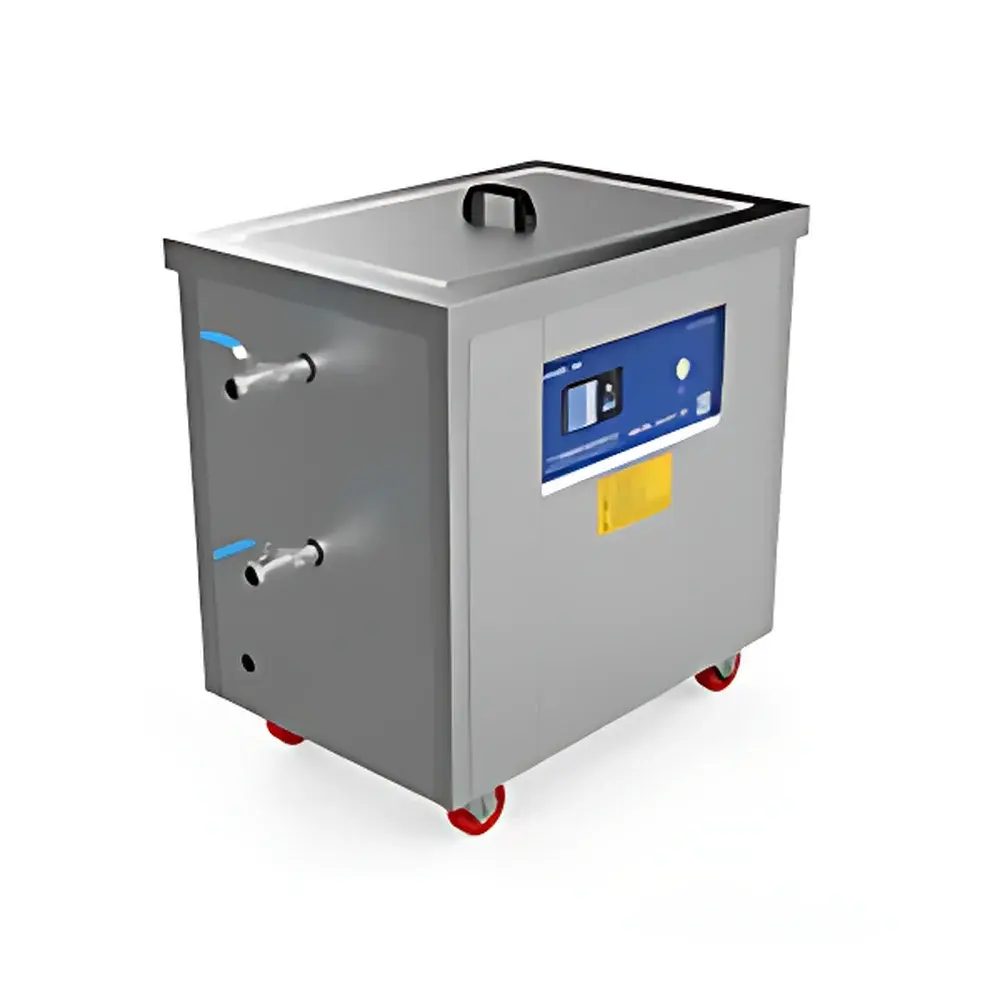
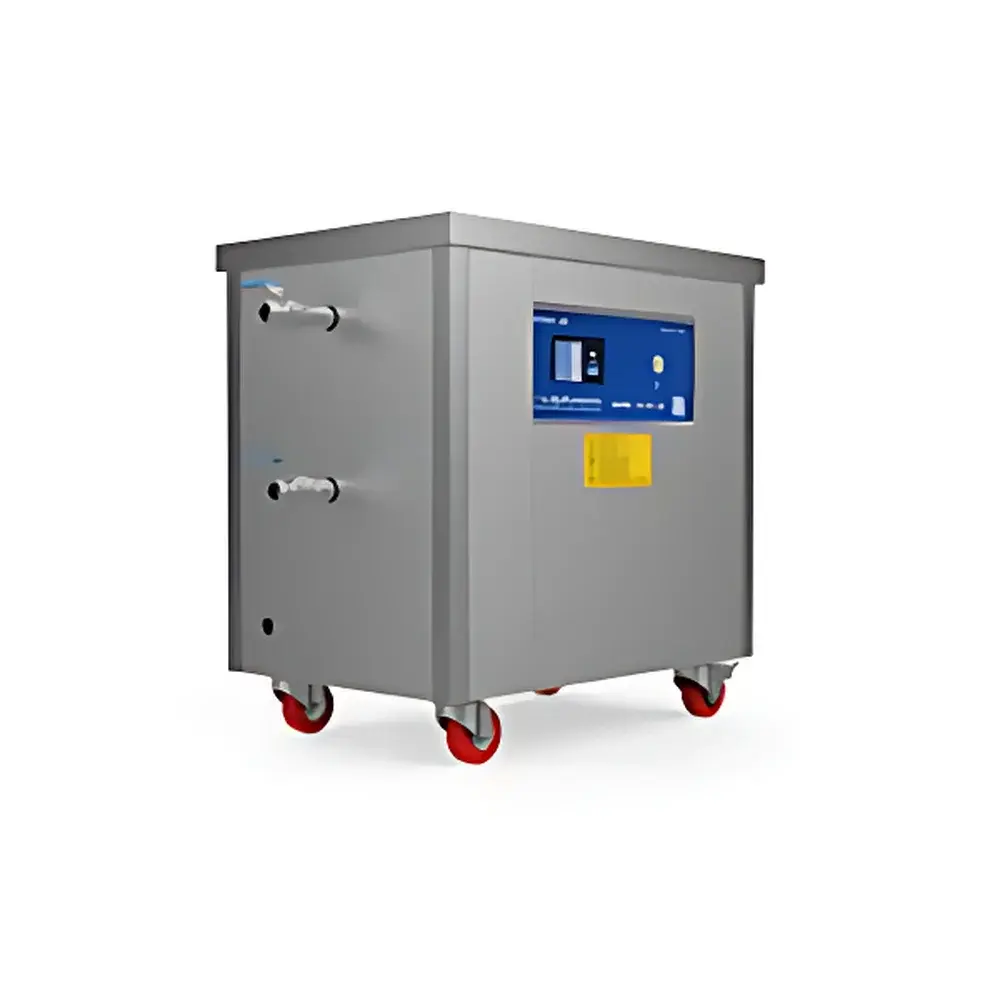
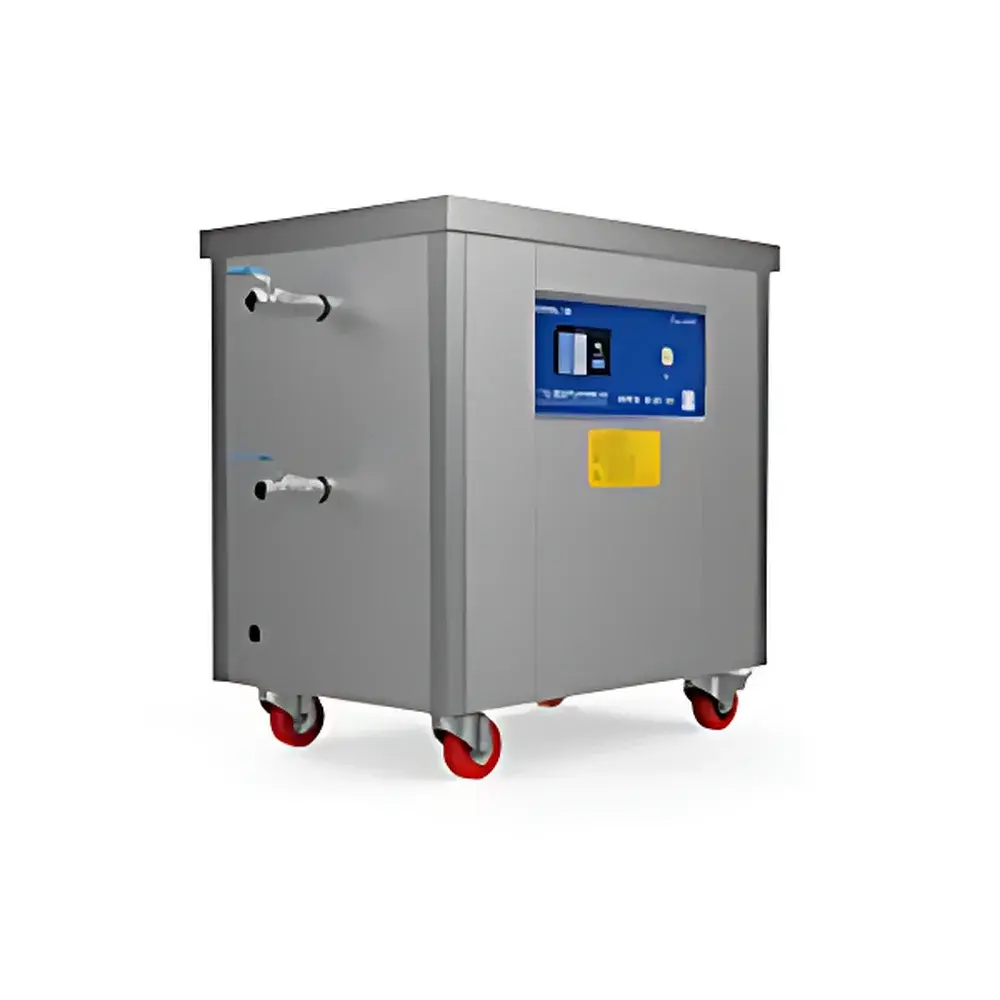
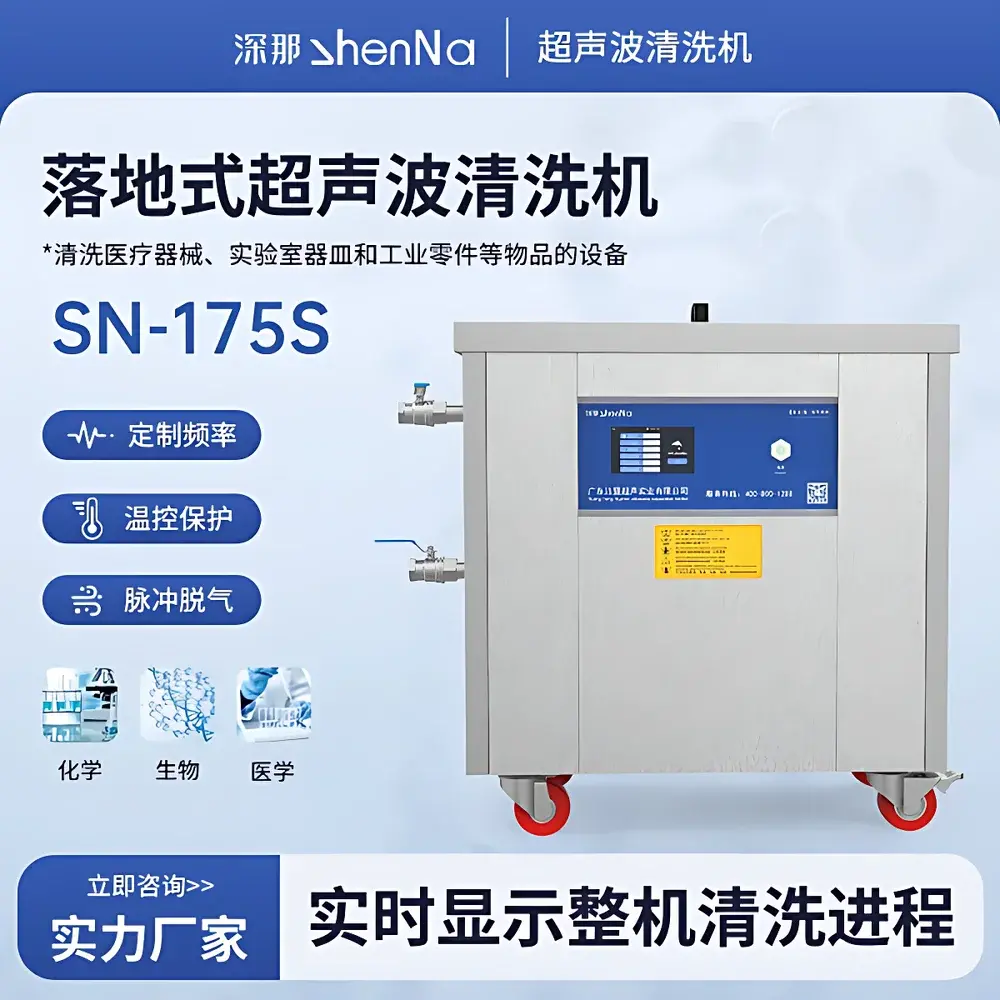
ShenNa SN-175S-40 Laboratory Ultrasonic Bottle Washer
| Brand | ShenNa |
|---|---|
| Origin | Guangdong, China |
| Model | SN-175S-40 |
| Chamber Volume | 175 L |
| Ultrasonic Frequency | 40 kHz |
| Ultrasonic Power | 2400 W |
| Heating Power | 6000 W |
| Temperature Range | Ambient to 95 °C |
| Timer Range | 0–960 min |
| Tank Dimensions (W×D×H) | 700 × 500 × 500 mm |
| Tank Material | 304 Stainless Steel |
| Control Interface | 5-inch Touchscreen |
| Voltage | 380 V AC, 3-phase |
| Drain/Inlet Fitting | 1/2" (6-point) and 1" NPT |
| Standard Power Cord Length | 3 m |
Overview
The ShenNa SN-175S-40 is a high-capacity, industrial-grade ultrasonic bottle washer engineered for rigorous cleaning and decontamination of laboratory glassware, plastic containers, stainless steel vessels, and reusable instrumentation. Utilizing 40 kHz piezoelectric transducers mounted on the tank bottom and side walls, it generates uniform cavitation fields across the entire 175 L chamber—ensuring consistent energy distribution and reproducible cleaning performance. Unlike benchtop units, this system integrates high-power heating (6000 W), precise digital temperature control (ambient to 95 °C), and programmable cycle timing (up to 960 minutes) to support multi-stage cleaning protocols—including pre-rinse, alkaline wash, acid rinse, and final deionized water rinse—commonly required in GLP-compliant labs and regulated QC environments.
Key Features
- Robust 304 stainless steel tank (700 × 500 × 500 mm internal dimensions) with seamless welded construction and electropolished interior surface for corrosion resistance and ease of validation.
- Industrial-grade 2400 W ultrasonic generator with self-diagnostic feedback circuitry, delivering stable output across varying load conditions and liquid levels.
- Intelligent liquid-level monitoring system with low-fluid protection—automatically suspends ultrasonic operation and triggers audible alert when fluid volume falls below operational threshold.
- 5-inch capacitive touchscreen HMI with intuitive icon-based navigation, supporting up to 20 user-defined cleaning programs stored in non-volatile memory (EEPROM) with timestamped recall capability.
- Programmable temperature ramping and hold functions enable precise thermal activation of detergent chemistry—critical for removing organic residues, biofilms, or proteinaceous contaminants.
- Triple-layer insulation and reinforced 380 V / 3-phase power architecture ensure thermal stability during extended cycles and compliance with IEC 61000-3-12 harmonic emission standards.
- Standard 1/2″ (6-point) inlet and 1″ NPT drain ports facilitate integration into centralized lab utility networks with optional automatic fill/drain modules.
Sample Compatibility & Compliance
The SN-175S-40 accommodates a broad range of laboratory containers, including volumetric flasks (up to 2 L), serum bottles (25–500 mL), culture dishes, centrifuge tubes (50 mL), pipette tips racks, and reusable PPE components. Its geometry supports both upright and inverted loading configurations. The system meets structural requirements outlined in ISO 13485:2016 (for medical device reprocessing equipment), conforms to EN 61000-6-3 (EMC emissions), and supports audit-ready documentation via optional RS-485 Modbus RTU interface for integration with LIMS or electronic lab notebooks. While not certified as a sterilizer, its validated cleaning cycles—when paired with compatible enzymatic or alkaline detergents—achieve ≥4-log reduction of model soil (BSA, yeast, endotoxin) per ASTM E2523-22 and USP <1211> cleaning verification guidelines.
Software & Data Management
The embedded firmware supports full-cycle logging—including start time, setpoint temperature, actual bath temperature (±0.5 °C accuracy), ultrasonic duty cycle, elapsed time, and fault codes—with data export via USB 2.0 port in CSV format. Optional Ethernet module enables remote monitoring, alarm notification via SMTP, and secure HTTP-based configuration access. All parameter changes are recorded with operator ID (if enabled), date/time stamp, and reason-for-change field—supporting 21 CFR Part 11 compliance when deployed with validated authentication and electronic signature workflows.
Applications
This washer serves critical roles in analytical chemistry labs (e.g., HPLC vial cleaning prior to trace metal analysis), biotechnology facilities (removal of residual cell culture media from bioreactor accessories), pharmaceutical QA/QC (preparation of dissolution test vessels per USP <711>), and academic core facilities (high-throughput cleaning of cryovials and microcentrifuge tubes). It is routinely employed in preparation workflows for ICP-MS, GC-MS, and ELISA assays where carryover contamination directly impacts detection limits and assay specificity.
FAQ
What is the maximum recommended load weight for optimal cavitation efficiency?
For consistent cleaning performance, total submerged mass should not exceed 45 kg per cycle to maintain acoustic coupling integrity and avoid damping effects.
Can this unit be integrated with an automated water purification system?
Yes—the 1/2″ inlet and 1″ drain ports support direct connection to DI water loops or reverse osmosis systems using standard sanitary fittings.
Is validation documentation available for IQ/OQ/PQ protocols?
ShenNa provides a Factory Acceptance Test (FAT) report and configurable URS template; site-specific qualification support is available through authorized service partners.
Does the system include detergent dosing capability?
No—detergent injection is not built-in, but the control interface allows synchronization with external peristaltic pumps via dry-contact relay outputs.
What maintenance intervals are recommended for the ultrasonic transducers?
Transducer performance should be verified quarterly using calibrated hydrophone mapping; visual inspection of bonding layers and impedance testing are advised annually.



