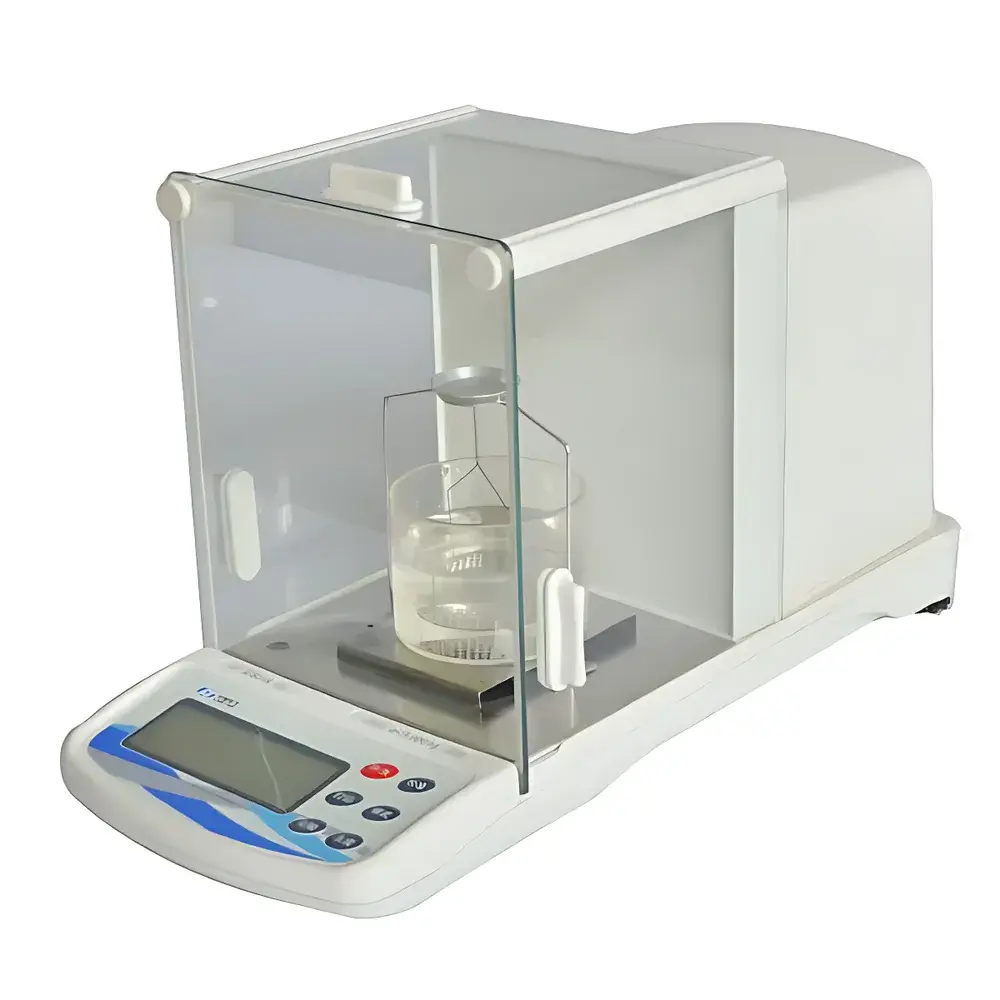
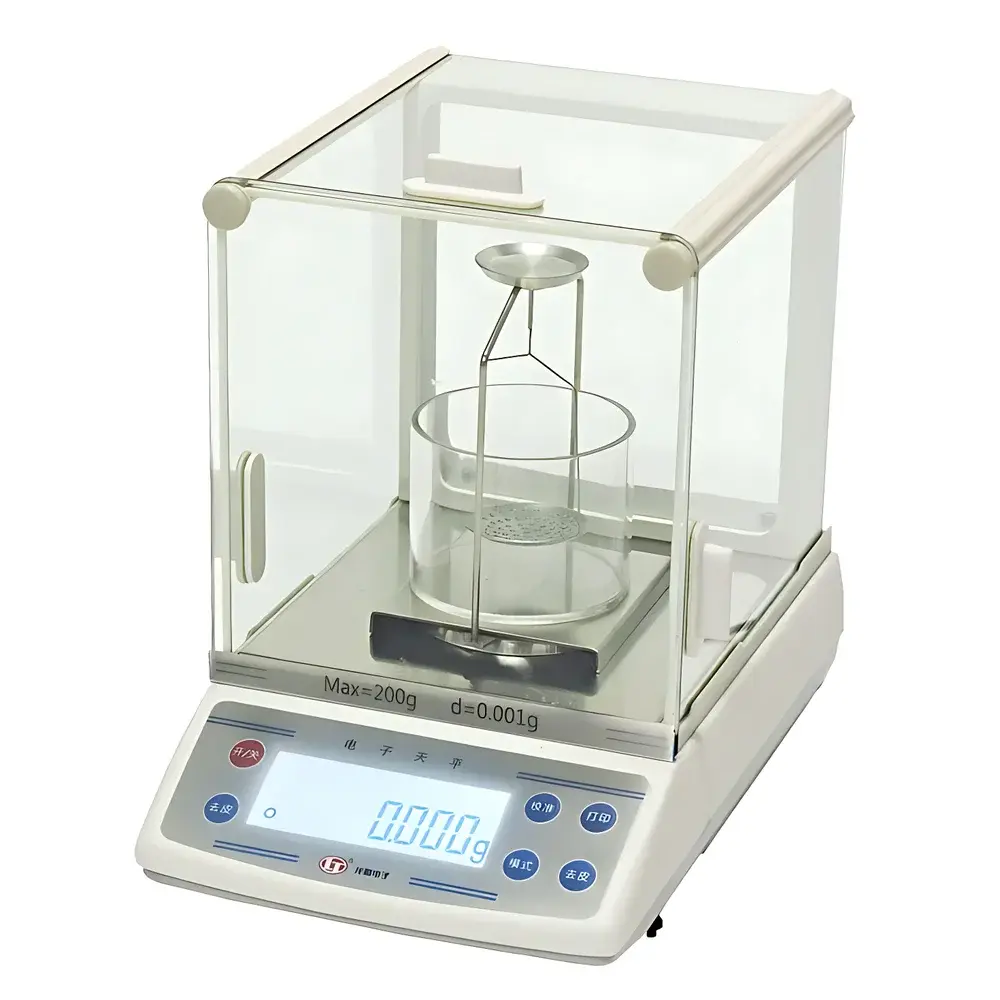
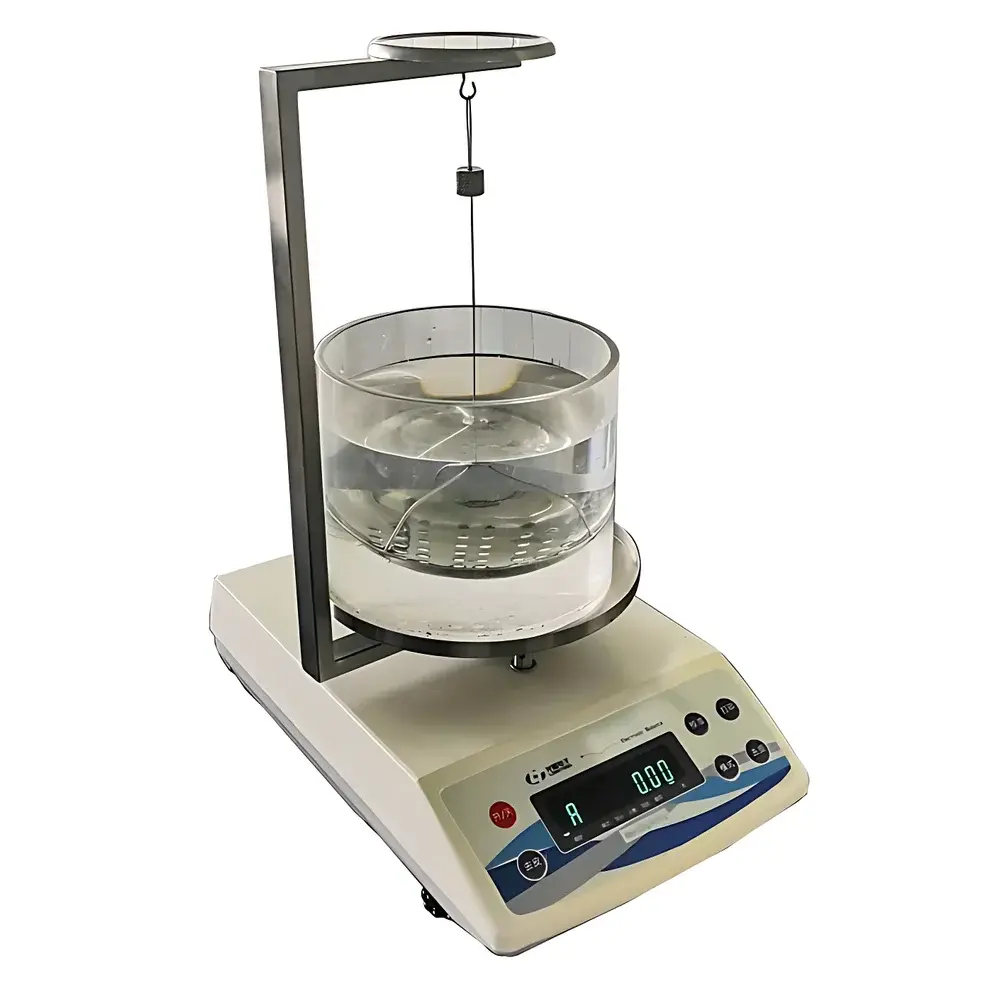
Shenyang Longteng ESJ Series Density & Hydrostatic Weighing Balance
| Brand | Shenyang Longteng / Longteng |
|---|---|
| Origin | Liaoning, China |
| Manufacturer Type | Authorized Distributor |
| Regional Classification | Domestic (PRC) |
| Model Series | ESJ Series (Density & Hydrostatic Weighing) |
| Instrument Type | Analytical Balance with Integrated Density/Hydrostatic Module |
| Maximum Capacity | 200–500 g (ESJ variants) |
| Readability | 0.0001 g (ESJ-4A models), 0.001 g (JD-3M), 0.01 g (JD-2M) |
| Repeatability | ±0.0001 g (ESJ), ±0.001 g (JD-3M), ±0.01 g (JD-2M) |
| Calibration | Internal Automatic Calibration |
| Pan Size | Φ90 mm (standard) |
| Dimensions (ESJ220-4AM) | Approx. W120 × D125 × H310 mm (stand assembly included) |
Overview
The Shenyang Longteng ESJ Series Density & Hydrostatic Weighing Balance is an integrated analytical instrument engineered for high-precision density determination of solid materials using the hydrostatic weighing principle—also known as Archimedes’ method. Unlike conventional balances, the ESJ series incorporates a dedicated mechanical suspension system and calibrated fluid immersion accessories (including precision-machined suspension pans, standardized water cups, and rigid support frames) to enable direct mass measurement in air and in liquid medium (typically distilled water at controlled temperature). This dual-mode operation allows calculation of true density (ρ = mair / [(mair − mliquid) / ρliquid]) with traceable uncertainty under ISO 1183-1 and ASTM D792 standards. Designed for routine QC labs, material science research, and polymer quality control, the ESJ platform delivers 0.0001 g readability and internal automatic calibration—ensuring long-term stability and metrological integrity without external weights.
Key Features
- Integrated hydrostatic weighing architecture with optimized suspension geometry for minimal buoyancy error and torsional interference
- Internal automatic calibration system compliant with ISO 9001 calibration traceability requirements
- Dual-mode operation: standard analytical weighing (air mode) and submerged weighing (liquid mode) via interchangeable hardware kits
- Modular design supporting model-specific configurations: ESJ-4AM (density + software), ESJ-4BJ (hydrostatic-only, no software), and JD-series heavy-duty variants (300–5000 g capacity)
- Stainless steel weighing pan (Φ90 mm for ESJ; Φ160 mm for JD-3M/2M) and corrosion-resistant suspension components for aqueous environments
- Thermal drift compensation algorithm embedded in firmware to minimize environmental influence on repeatability (±0.0001 g)
Sample Compatibility & Compliance
The ESJ series accommodates solid specimens ranging from small granules (≥10 mg) to irregularly shaped parts (max. dimensions compatible with Φ80 mm water cup and 125 mm frame clearance). Samples must be non-porous or surface-sealed to prevent liquid ingress during immersion. The system meets fundamental metrological requirements outlined in OIML R76-1 (non-automatic weighing instruments) and supports GLP-compliant workflows through documented calibration records and user-accessible calibration logs. While not FDA 21 CFR Part 11–certified out-of-the-box, audit trails and operator authentication can be implemented via external LIMS integration. All models conform to IEC 61000-4 electromagnetic compatibility standards and operate within ambient conditions of 10–30 °C and ≤80% RH (non-condensing).
Software & Data Management
The ESJ-4AM variant includes proprietary Windows-based density calculation software that automates input of water temperature, air density, and thermal expansion coefficients per ISO 5725 and ASTM E202. Software outputs include raw mass values (mair, mliquid), calculated density (g/cm³), relative density (specific gravity), and statistical summaries (mean, SD, CV%) across multiple replicates. Data export is supported in CSV and XLSX formats with timestamped metadata. No cloud connectivity or remote access functionality is embedded; all processing occurs locally to ensure data sovereignty and network isolation—critical for regulated manufacturing environments.
Applications
- Quality assurance of plastics, ceramics, and metal powders per ISO 1183-1 and ASTM D792
- Density profiling of sintered components in powder metallurgy
- Verification of composite material homogeneity and void content estimation
- Educational laboratories performing Archimedes’ principle experiments with quantitative uncertainty analysis
- In-process density checks for rubber vulcanization and elastomer formulation
- Supporting USP density testing protocols for pharmaceutical excipients where gravimetric methods are permitted
FAQ
What is the difference between ESJ-4AM and ESJ-4BJ models?
The ESJ-4AM includes pre-installed density calculation software and automated reporting; the ESJ-4BJ provides only the mechanical hydrostatic weighing hardware—requiring manual computation or third-party software.
Can the ESJ series measure liquid density?
No—the ESJ series is configured exclusively for solid sample density via hydrostatic weighing. Liquid density requires a pycnometer or digital densitometer (e.g., Anton Paar DMA series).
Is temperature compensation built into the density calculation?
Yes—the included software applies real-time water density correction based on user-entered temperature (range: 15–30 °C) using NIST-traceable water density tables.
Does the balance support external printer or RS-232 output?
All ESJ and JD models feature standard RS-232 interface for bidirectional communication with PCs or label printers; USB-to-serial adapters are recommended for modern systems.
How often should internal calibration be performed?
Longteng recommends internal calibration at power-on, after significant ambient temperature shifts (>2 °C), and prior to critical measurements—consistent with ISO/IEC 17025 clause 5.5.2 for measurement equipment verification.