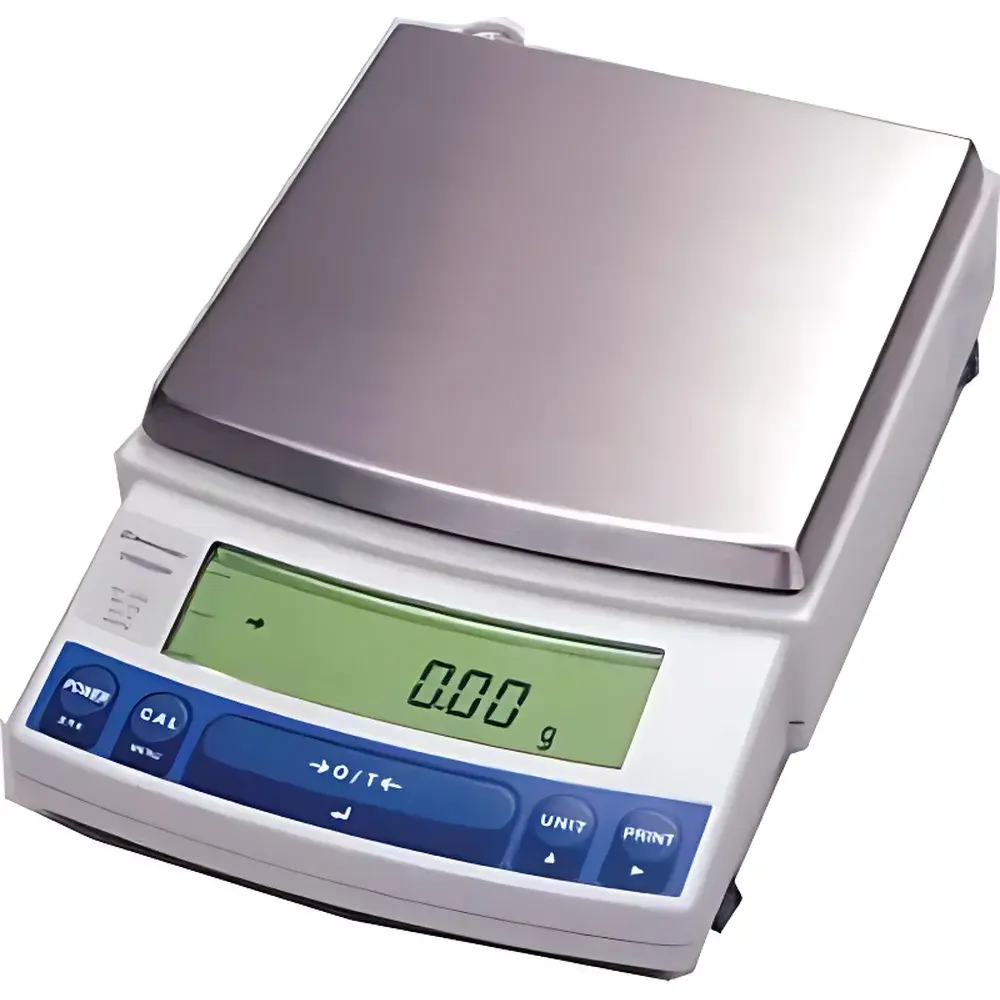
Shimadzu BL Series Portable Electronic Balance
| Origin | Japan |
|---|---|
| Manufacturer Type | Distributor |
| Origin Category | Imported |
| Model | BL Series |
| Quotation | Upon Request |
| Instrument Type | Precision Balance |
| Capacity | 3200 g |
| Minimum Display | 10 mg |
| Standard Deviation | 0.01 g |
| Linearity | ±0.02 g |
| Operating Temperature | 5–40 °C |
| Interface | RS-232C (with IFB-102A interface board), EP-50/EP-80 printer support |
| Sensitivity Drift (10–30 °C) | ±3 ppm/°C (PSC OFF) |
| Units | g, kg, %, pcs, ct, mom, oz, ozt, liang (HK/SG/TW/MY), dwt, gn |
| Pan Dimensions | 160 × 124 mm |
| Body Dimensions | 170 × 240 × 75 mm (W×D×H) |
| Weight | 2.2 kg |
| Power Supply | AC 220 V / DC 12 V, 1 A |
| Standard Accessories | Dust Cover |
| Sensor Type | Electromagnetic Force Compensation |
Overview
The Shimadzu BL Series Portable Electronic Balance is an engineered precision weighing instrument designed for laboratory, quality control, and field-deployable applications where accuracy, stability, and operational flexibility are essential. Built upon Shimadzu’s proprietary electromagnetic force compensation (EMFC) transduction principle—identical to that used in high-end analytical and semi-micro balances—the BL Series delivers metrological performance consistent with ISO/IEC 17025-compliant weighing practices. Unlike strain-gauge-based portable scales, the EMFC architecture ensures inherent linearity, minimal hysteresis, and immunity to mechanical creep over time. The balance operates within a controlled environmental envelope (5–40 °C), with temperature-induced sensitivity drift rigorously specified at ±3 ppm/°C between 10–30 °C when the proportional sensitivity control (PSC) is disabled—enabling traceable, repeatable measurements across variable ambient conditions. Its compact footprint (170 × 240 × 75 mm) and lightweight construction (2.2 kg) facilitate seamless integration into mobile QC carts, production line stations, or on-site calibration workflows without compromising repeatability (standard deviation ≤ 0.01 g) or linearity (±0.02 g).
Key Features
- Electromagnetic force compensation sensor—same core technology employed in Shimadzu’s benchtop precision balances, ensuring long-term stability and zero-point integrity.
- Fast stabilization time (~1 second for S-type models), optimized for high-throughput sample handling in regulated environments.
- Dual-mode display: numeric readout with real-time analog bar graph—enhancing visual confirmation of equilibrium state during dynamic or vibration-prone operations.
- Multi-unit capability: supports 11 units including metric (g, kg), apothecary (dwt, ozt), troy (ct, gn), regional weight systems (liang), and dimensionless modes (%, pcs)—configured via single-key toggle.
- RS-232C serial interface compliant with EIA/TIA-232 standards; compatible with Shimadzu IFB-102A interface board for bidirectional data transfer to LIMS or ERP systems.
- Direct one-touch printing via EP-50 or EP-80 thermal printers (optional); no driver installation required.
- Rectangular weighing pan (160 × 124 mm) with chamfered edges—designed for ergonomic placement of irregular or multiple samples while maintaining center-of-load fidelity.
- Integrated dust cover included as standard—critical for maintaining calibration integrity in non-classified lab spaces or industrial settings.
Sample Compatibility & Compliance
The BL Series accommodates a broad range of sample types—from discrete solid components (e.g., pharmaceutical tablets, electronic components, jewelry) to bulk powders and granular materials—without requiring recalibration between unit modes. Its 3200 g capacity and 10 mg readability meet ASTM E1223-22 requirements for sampling plan validation in manufacturing process control. All models comply with JIS B 7721:2019 (Japanese Industrial Standard for non-automatic weighing instruments) and carry CE marking per EU Directive 2014/30/EU (EMC) and 2014/35/EU (LVD). While not classified as Class I or II legal-for-trade devices under OIML R76, the BL Series satisfies internal calibration verification protocols referenced in USP , ISO 9001:2015 clause 7.1.5, and FDA 21 CFR Part 11 when paired with validated data capture software (e.g., Shimadzu LabSolutions WS).
Software & Data Management
Data output is ASCII-formatted and configurable for delimiter-separated values (DSV) or fixed-field alignment, supporting direct ingestion into Excel, SQL databases, or statistical process control (SPC) platforms. When connected to a host PC via RS-232C and IFB-102A, the balance supports full audit trail functionality—including operator ID, timestamp, gross/net/tare values, unit selection, and error flags—when used with Shimadzu’s optional Data Collection Software (DCS-Win). This configuration satisfies ALCOA+ principles (Attributable, Legible, Contemporaneous, Original, Accurate, Complete, Consistent, Enduring, Available) and enables compliance with GLP/GMP documentation requirements. No firmware updates require physical service intervention; field-upgradable via serial command protocol.
Applications
- Pharmaceutical: tablet weight uniformity testing per USP , excipient dispensing verification, and raw material receipt inspection.
- Electronics: component counting (pcs mode), PCB weight verification, and solder paste mass validation.
- Jewelry & Precious Metals: karat-specific alloy verification using ct, dwt, and ozt units with traceable calibration against NIST-traceable mass standards.
- Academic Teaching Labs: foundational metrology instruction on uncertainty propagation, repeatability assessment, and environmental influence factors.
- Food & Beverage: portion control auditing, ingredient reconciliation, and HACCP critical control point monitoring.
FAQ
Is the BL Series suitable for use in regulated GMP environments?
Yes—when operated with documented calibration procedures, environmental monitoring, and validated data capture software, it fulfills data integrity requirements under 21 CFR Part 11 and EU Annex 11.
Can the balance be calibrated internally without external weights?
No—internal calibration is not supported; external calibration using Class M1 or better certified weights is mandatory per ISO/IEC 17025 Clause 6.5.
What is the recommended recalibration interval?
Shimadzu recommends quarterly verification under stable conditions; more frequent checks are advised following mechanical shock, temperature cycling >5 °C/hour, or relocation.
Does the RS-232C interface support Modbus RTU or other industrial protocols?
No—it implements a proprietary ASCII command set; third-party integration requires middleware translation or custom parsing logic.
Is the dust cover chemically resistant to common solvents?
The standard polycarbonate cover resists IPA and ethanol but is not rated for acetone, chloroform, or strong alkaline solutions.