
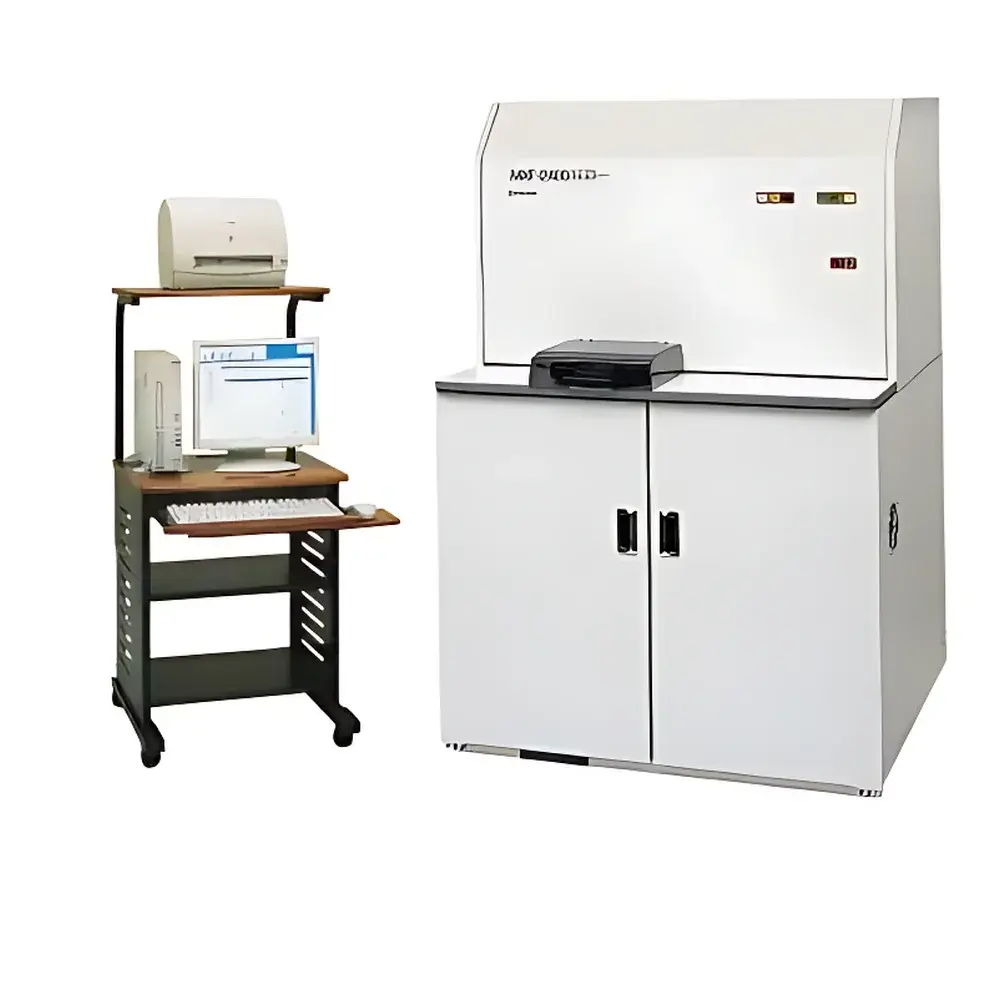
Shimadzu MXF-2400 Wavelength Dispersive X-Ray Fluorescence Spectrometer
| Origin | Japan |
|---|---|
| Manufacturer Type | Authorized Distributor |
| Origin Category | Imported Instrument |
| Model | MXF-2400 |
| Pricing | Available Upon Request |
Overview
The Shimadzu MXF-2400 is a high-performance wavelength dispersive X-ray fluorescence (WDXRF) spectrometer engineered for precision elemental analysis in industrial quality control, metallurgical process monitoring, and advanced materials R&D laboratories. Operating on the fundamental principle of Bragg diffraction, the instrument measures characteristic X-ray photons emitted from a sample upon excitation by a high-power X-ray tube, resolving spectral lines via crystal-based dispersion to deliver quantitative and qualitative data with exceptional peak-to-background ratio and inter-element interference suppression. Designed for robust 24/7 operation in production-critical environments, the MXF-2400 supports simultaneous multi-element analysis across the full periodic table—from beryllium (Be, Z = 4) to uranium (U, Z = 92)—with optimized vacuum-path optics enabling reliable detection of light elements down to sodium (Na) without helium purging.
Key Features
- Simultaneous analysis of up to 36 elements in a single measurement cycle; expandable to 48 elements with optional scanning spectrometer channels
- High-stability 4 kW thin-window X-ray tube delivering enhanced photon flux and improved detection limits for trace and minor constituents
- Dual optical architecture: fixed-channel spectrometers with bent-crystal focusing optics for high-intensity, high-resolution analysis of major and minor elements; scanning spectrometer with flat-crystal parallel-beam geometry for flexible, high-accuracy quantification of additional elements
- Sealed gas-flow proportional counter detector optimized for long-term stability and low-noise performance—critical for reproducible Na–F light-element analysis under ambient vacuum conditions
- Automated sample handling interface compatible with standard 32 mm or 40 mm pressed pellets, fused beads, and solid metal blocks; programmable alignment and calibration routines minimize operator dependency
- Thermal and mechanical stabilization systems ensure drift compensation over extended run times, supporting GLP-compliant batch analysis protocols
Sample Compatibility & Compliance
The MXF-2400 accommodates a broad range of sample forms including powdered pellets (with binder), borate-fused glasses, polished metal alloys, thin films, and geological digests—enabling direct analysis without matrix-matched standards in many routine applications. Its vacuum-path optical train eliminates atmospheric absorption of soft X-rays, ensuring accurate quantification of elements from Be through Mg. The system meets key international analytical standards, including ASTM E1361 (Standard Practice for WDXRF Analysis of Metals), ISO 21043 (XRF — General Requirements), and JIS Z 8821 (X-ray Fluorescence Spectrometry). Instrument firmware and software support audit trails, electronic signatures, and user-access controls aligned with FDA 21 CFR Part 11 requirements for regulated environments.
Software & Data Management
Shimadzu’s proprietary WDXRF analysis software provides integrated workflows for qualitative screening, quantitative calibration (including fundamental parameter and empirical coefficient methods), standardless analysis, and custom report generation. Key modules include: spectrum acquisition and peak deconvolution; multi-point calibration curve construction with statistical validation (R², RMSE, LOD/LOQ); batch processing with automatic drift correction; customizable data export (CSV, XML, PDF) compliant with LIMS integration; and secure user role management (administrator, analyst, reviewer). All analytical sequences are timestamped and logged with full metadata—including instrument parameters, sample ID, operator, and environmental conditions—for full traceability in GMP and ISO/IEC 17025 accredited labs.
Applications
- Metallurgy & Foundry: Rapid grade identification, inclusion analysis, and alloy composition verification per ASTM E1086, ISO 11577
- Cement & Building Materials: Quantitative determination of SiO₂, Al₂O₃, Fe₂O₃, CaO, MgO, SO₃, and alkalis in raw meal, clinker, and finished cement
- Mining & Geochemistry: Multi-element profiling of ores, concentrates, and exploration samples with minimal sample preparation
- Environmental Monitoring: Heavy metal screening in soils, sediments, and fly ash per EPA Method 6200
- Electronics & Ceramics: Trace impurity control (e.g., Pb, Cd, Cr, Br) in RoHS-compliant components and functional oxides
FAQ
What is the minimum detectable concentration for sodium (Na) using the MXF-2400 under vacuum conditions?
Typical LOD for Na in homogeneous glass standards is ≤100 ppm (w/w) with 100 s counting time and optimized crystal/detector configuration.
Can the MXF-2400 analyze liquid samples directly?
No—samples must be presented as solids (pressed pellets, fused beads, or polished blocks); liquids require evaporation or precipitation followed by pelletization.
Is the instrument compatible with third-party LIMS platforms?
Yes—data export formats (CSV, XML) and ODBC connectivity enable seamless integration with major LIMS vendors including Thermo Fisher SampleManager, LabVantage, and STARLIMS.
Does the MXF-2400 support automated calibration verification checks?
Yes—software includes scheduled QC check routines using certified reference materials, with pass/fail criteria configurable per element and concentration range.
What maintenance intervals are recommended for the X-ray tube and detector?
The 4 kW X-ray tube has an expected service life of ≥20,000 hours; sealed proportional counters require no routine gas replenishment but benefit from annual performance validation using certified check sources.
Related Products




