
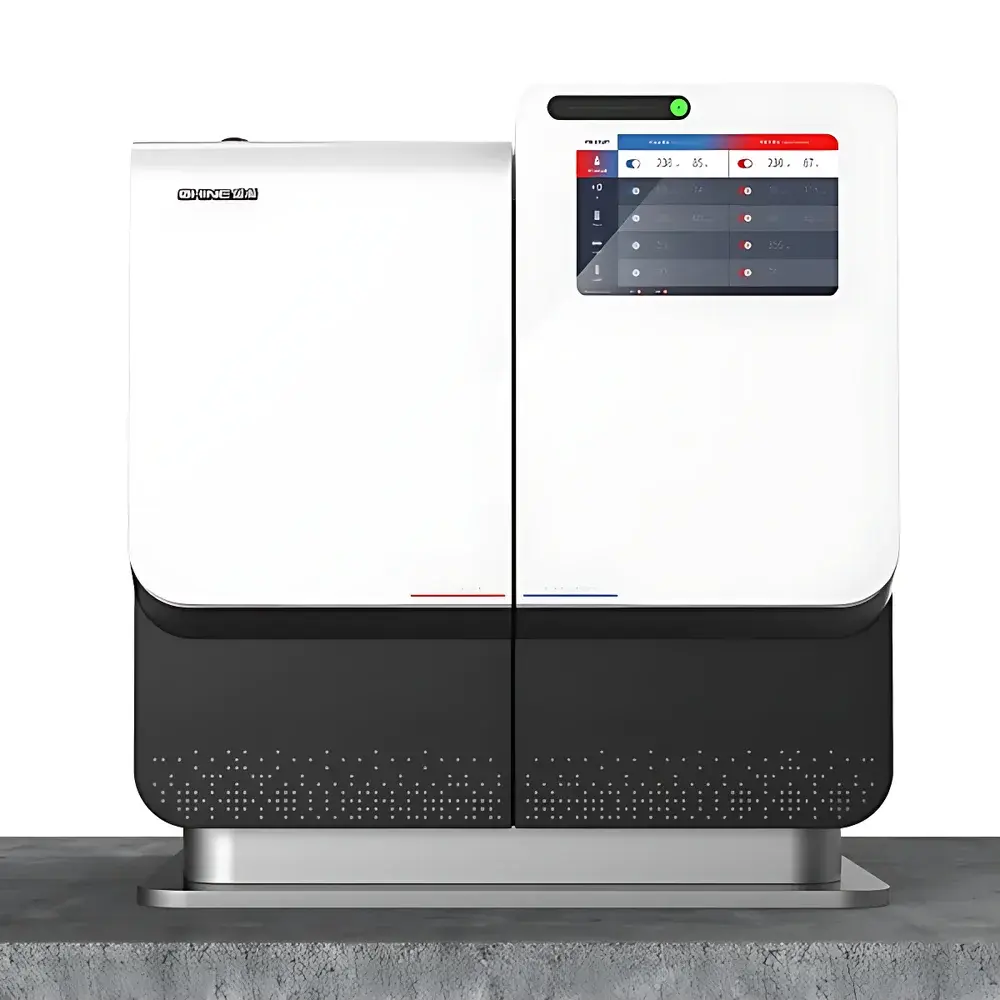
Shine CIC-D300H High-Pressure Dual-Channel Ion Chromatography System
| Brand | Shine |
|---|---|
| Origin | Shandong, China |
| Manufacturer Type | OEM Manufacturer |
| Instrument Type | Laboratory Benchtop IC System |
| Application Scope | Universal |
| Maximum Pump Pressure | 42 MPa (PEEK construction) |
| Flow Rate Range | 0.1–5.0 mL/min |
| Eluent Flow Accuracy | 0.001–9.999 mL/min |
| Operating Temperature Range | Ambient +5 °C to 60 °C (±0.01 °C setpoint stability) |
| Temperature Reproducibility | ±0.2 °C |
| Eluent Concentration Range | 0.1–100 mM |
| Dual Independent Channels | Yes |
| Online Eluent Generator | Integrated |
| Suppressor Type | Next-generation membrane-based suppressor |
| Detector Compatibility | Conductivity, Pulsed/Ampere, Integrative Amperometric |
| IC-MS & IC-ICP/MS Ready | Yes |
| Online Degassing | Dual-stage (low-pressure vacuum + gas–liquid phase separation) |
| Pre-column Eluent Thermal Buffering | Yes |
| Post-run Auto-Flush | Yes |
| Pure Water Purification Module | Integrated inline deionization and particulate filtration |
Overview
The Shine CIC-D300H is a high-pressure, dual-channel ion chromatography (IC) system engineered for precision, reproducibility, and operational flexibility in modern analytical laboratories. It operates on the fundamental principle of ion-exchange chromatography—where analyte ions are separated based on their charge, size, and affinity toward the stationary phase under precisely controlled eluent composition, flow rate, and temperature conditions. Designed for universal application across environmental, pharmaceutical, food safety, and industrial quality control labs, the CIC-D300H supports both anion and cation analysis simultaneously via two fully independent fluidic paths. Its 42 MPa (6000 psi) PEEK-based high-pressure architecture enables use with sub-2 µm particle-packed columns, delivering enhanced resolution, faster separations, and improved peak capacity—particularly critical for complex matrices such as wastewater extracts, biological fluids, or multi-component electrolyte solutions.
Key Features
- Dual independent chromatographic channels with synchronized or asynchronous operation—enabling concurrent anion and cation analysis without cross-contamination or method interference.
- High-pressure binary pump system with <0.1% flow pulsation and real-time pressure monitoring; compatible with narrow-bore (e.g., 2 mm ID) and capillary columns for low solvent consumption and high sensitivity.
- Integrated online eluent generator (OEG) supporting automated preparation of KOH, NaOH, methanesulfonic acid (MSA), and other common eluents across 0.1–100 mM concentration range—eliminating manual dilution errors and enabling precise gradient elution.
- Advanced thermal management: column oven with ±0.01 °C setpoint accuracy and ±0.2 °C intra-run reproducibility; pre-column eluent thermal buffering ensures consistent mobile-phase viscosity and retention time stability.
- Two-stage online degassing: combines low-pressure vacuum degassing with a passive gas–liquid phase separator to minimize baseline noise and prevent bubble-induced detector artifacts—critical for conductivity detection.
- Modular detector interface supporting conductivity, pulsed amperometric detection (PAD), and integrated amperometric detection (IAD); optional hardware triggers and analog/digital I/O enable seamless coupling to mass spectrometers (IC-MS) or ICP-MS systems.
- Onboard water purification module featuring mixed-bed deionization and 0.22 µm filtration—ensuring consistent eluent purity, reducing background conductivity, and extending suppressor lifetime.
Sample Compatibility & Compliance
The CIC-D300H accommodates aqueous samples across diverse matrices—including drinking water, soil leachates, pharmaceutical excipients, battery electrolytes, and food additives—following standard sample pretreatment protocols (e.g., filtration, dilution, solid-phase extraction). Its design aligns with internationally recognized regulatory frameworks: methods developed on this platform are compatible with ASTM D4327 (anions in water), ISO 14911 (cation analysis), USP (conductivity of purified water), and EPA Methods 300.0, 300.1, and 317.0. The system supports full audit trail generation, electronic signatures, and instrument qualification documentation per FDA 21 CFR Part 11 and EU Annex 11 requirements when deployed with compliant LIMS or chromatography data systems (CDS).
Software & Data Management
Controlled via ShineChrom v3.x software—a Windows-based platform supporting method development, sequence scheduling, real-time monitoring, and quantitative reporting—the CIC-D300H provides intuitive workflow automation. The software includes built-in tools for peak integration (tangent skim, valley-to-valley), calibration curve fitting (linear, quadratic, weighted), and system suitability assessment (theoretical plates, tailing factor, resolution). All raw data are stored in vendor-neutral .cdf format (compatible with OpenLab CDS, Chromeleon, and Empower). Audit trails record user actions, parameter changes, and instrument events with timestamps and operator IDs—ensuring traceability during GLP/GMP audits.
Applications
- Environmental monitoring: quantification of F⁻, Cl⁻, NO₂⁻, Br⁻, NO₃⁻, PO₄³⁻, SO₄²⁻, and AsO₄³⁻ in surface water, groundwater, and effluent streams.
- Pharmaceutical QC: assay of counterions (Na⁺, K⁺, Ca²⁺, Mg²⁺) in APIs; residual acetate, citrate, or chloride in biologics formulations.
- Food & beverage: detection of preservatives (benzoate, sorbate), sweeteners (acesulfame-K, saccharin), and inorganic anions in dairy, soft drinks, and infant formula.
- Electrochemical materials: speciation of Li⁺, Na⁺, K⁺, PF₆⁻, TFSI⁻, and BF₄⁻ in lithium-ion battery electrolytes and electrode slurries.
- Industrial process control: monitoring of sulfate, chloride, and fluoride in semiconductor rinse waters and plating baths.
FAQ
What eluent types are supported by the online eluent generator?
The OEG supports potassium hydroxide (KOH), sodium hydroxide (NaOH), and methanesulfonic acid (MSA) for gradient and isocratic elution—automatically generating concentrations from 0.1 mM to 100 mM with ≤0.5% relative standard deviation.
Can the system operate unattended overnight?
Yes—full sequence scheduling, auto-start/stop, post-run column flushing, and error-triggered shutdown protocols ensure robust 24/7 operation with minimal supervision.
Is hardware validation documentation available for GMP environments?
Shine provides IQ/OQ/PQ templates, calibration certificates for flow, pressure, and temperature sensors, and a complete 21 CFR Part 11 compliance package upon request.
What maintenance intervals are recommended for the suppressor and OEG?
The membrane-based suppressor typically requires replacement every 12–18 months under normal usage; the OEG electrolytic cell has a service life of ≥5,000 operating hours and includes real-time status diagnostics.
Does the system support external triggering for hyphenated techniques?
Yes—TTL-compatible trigger inputs/outputs allow synchronization with MS detectors, fraction collectors, or auxiliary pumps for IC-MS, IC-ICP/MS, or heart-cutting 2D-IC configurations.






