
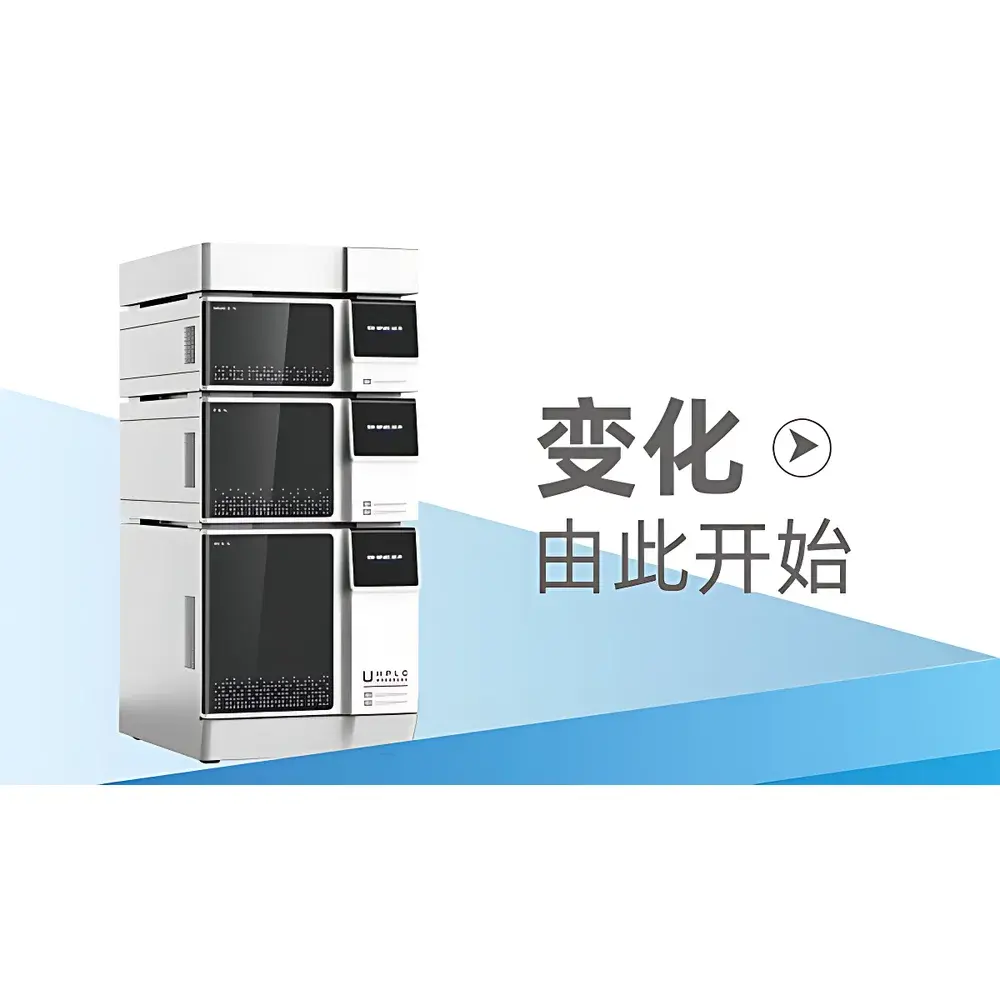
Shine CLC-2100 UHPLC/HPLC System
| Brand | Shine |
|---|---|
| Origin | Shandong, China |
| Manufacturer Type | Direct Manufacturer |
| Instrument Type | Ultra-High-Performance Liquid Chromatograph (UHPLC) |
| Flow Rate Range | 0.001–10.000 mL/min |
| Maximum Pressure | 700 bar (standard), 1000 bar (optional high-pressure configuration) |
| Autosampler Capacity | 768-well microplate or 108-position 2 mL vial tray |
| Column Oven Temperature Range | 5–85 °C |
| UV-Vis Detection Wavelength Range | 190–1000 nm |
| Data Acquisition Rate | 50–100 Hz |
| Gradient Formation Options | Isocratic, Binary High-Pressure, Quaternary Low-Pressure |
| Pump Head Options | Interchangeable 5 mL, 10 mL, and 50 mL heads |
| Detector Options | UV/VIS, Diode Array Detector (DAD), Refractive Index Detector (RID) with Intelligent Temperature Control |
| System Architecture | Modular, Front-Access Design for Maintenance |
Overview
The Shine CLC-2100 UHPLC/HPLC System is a modular, high-pressure liquid chromatography platform engineered for precision, flexibility, and long-term operational stability in regulated and research laboratory environments. Based on the principles of high-performance liquid chromatography—where analytes are separated through differential partitioning between a mobile phase (liquid solvent gradient) and a stationary phase (packed column)—the CLC-2100 supports both conventional HPLC and ultra-high-performance applications requiring sub-2 µm particle columns and pressures up to 1000 bar. Its dual-capability architecture eliminates the need for separate instrument platforms when transitioning between routine QC assays, method development, preparative-scale fractionation, or high-resolution UHPLC separations. The system adheres to fundamental chromatographic performance criteria including retention time reproducibility (<0.1% RSD), baseline noise (<±0.5 × 10⁻⁵ AU), and gradient delay volume consistency (<50 µL), ensuring method transferability across labs and instruments.
Key Features
- Triple-Mode Gradient Capability: Select from isocratic, binary high-pressure, or quaternary low-pressure solvent delivery—each configurable via software without hardware modification. This enables seamless adaptation to ISO 17025-compliant method validation protocols requiring robustness testing across gradient slope, dwell volume, and solvent compressibility variables.
- Interchangeable Pump Heads (5/10/50 mL): A single pump chassis accommodates multiple displacement volumes, supporting flow regimes from nanoflow UHPLC (0.001 mL/min) to preparative-scale HPLC (10.000 mL/min). No recalibration is required upon head exchange due to factory-traceable piston geometry and pressure transducer compensation algorithms.
- Front-Access Modular Design: All major modules—including pump, autosampler, column oven, and detectors—are serviceable from the front panel. Seals, check valves, and lamp assemblies can be replaced without disassembling adjacent units or disturbing fluidic alignment, reducing mean time to repair (MTTR) by >40% versus rear-access architectures.
- Intelligent RID Temperature Control: The refractive index detector integrates active thermal stabilization with ±0.01 °C setpoint accuracy over 30–55 °C, minimizing baseline drift during extended isocratic runs—critical for carbohydrate, polymer, and excipient analysis where UV-inactive compounds dominate.
Sample Compatibility & Compliance
The CLC-2100 accommodates standard 2 mL vials (108-position tray) and high-density 768-well microplates, enabling full integration into automated sample preparation workflows compliant with ASTM D7213 (petroleum hydrocarbon profiling) or USP (chromatographic separations). Its column oven maintains temperature uniformity within ±0.2 °C across 5–85 °C, satisfying ICH Q5C stability-indicating method requirements. All electronic modules log timestamped operational events with audit trail capability, supporting GLP/GMP compliance per FDA 21 CFR Part 11 when paired with validated ChromaLink™ CDS software (v3.2+).
Software & Data Management
ChromaLink™ CDS provides intuitive sequence building, real-time chromatogram overlay, peak purity assessment (via DAD spectral deconvolution), and automated system suitability testing (SST) against user-defined thresholds (e.g., tailing factor ≤2.0, resolution ≥2.0). Raw data files conform to ANDI/NetCDF format for third-party reprocessing. Electronic signatures, role-based access control, and encrypted database backups ensure traceability across multi-user environments. Method templates are exportable as XML for cross-platform deployment and version-controlled archiving.
Applications
- Pharmaceutical QC: Assay, related substances, and dissolution testing per USP monographs using reversed-phase C18 columns under 1000 bar conditions.
- Food & Beverage Safety: Pesticide multiresidue screening (EN 15662) with DAD spectral library matching and confirmatory RID detection for sucrose/maltose quantitation.
- Environmental Analysis: PAHs and PCBs in soil extracts using gradient elution and post-column derivatization-compatible flow paths.
- Biopharmaceutical Characterization: mAb aggregate/degradant profiling via SEC-UHPLC with 100 Hz data capture for accurate shoulder resolution.
- Academic Research: Method scouting with rapid column/mobile phase screening enabled by programmable dwell volume compensation and auto-zero baseline correction.
FAQ
Does the CLC-2100 support 21 CFR Part 11 compliance?
Yes—when operated with ChromaLink™ CDS v3.2 or later and configured with electronic signature policies, audit trail logging, and secure user authentication.
Can I upgrade from HPLC to UHPLC performance without purchasing a new system?
Yes—the same pump chassis accepts 5 mL and 10 mL high-pressure heads; column oven and detector modules are rated for continuous operation at 1000 bar.
Is the DAD wavelength range truly 190–1000 nm?
Yes—the diode array uses a holographic grating and InGaAs photodiode array, delivering linear response across this full range with <0.5 nm wavelength accuracy verified per NIST SRM 2034.
What maintenance intervals are recommended for routine operation?
Pump seal replacement every 3,000–5,000 injections; DAD lamp every 2,000 hours; RID flow cell cleaning after every 500 injections with viscous samples.
How does the system handle gradient delay volume variability across configurations?
The ChromaLink™ software includes an automated dwell volume measurement routine that adjusts gradient start timing based on actual system volume—ensuring retention time consistency across binary and quaternary setups.





