
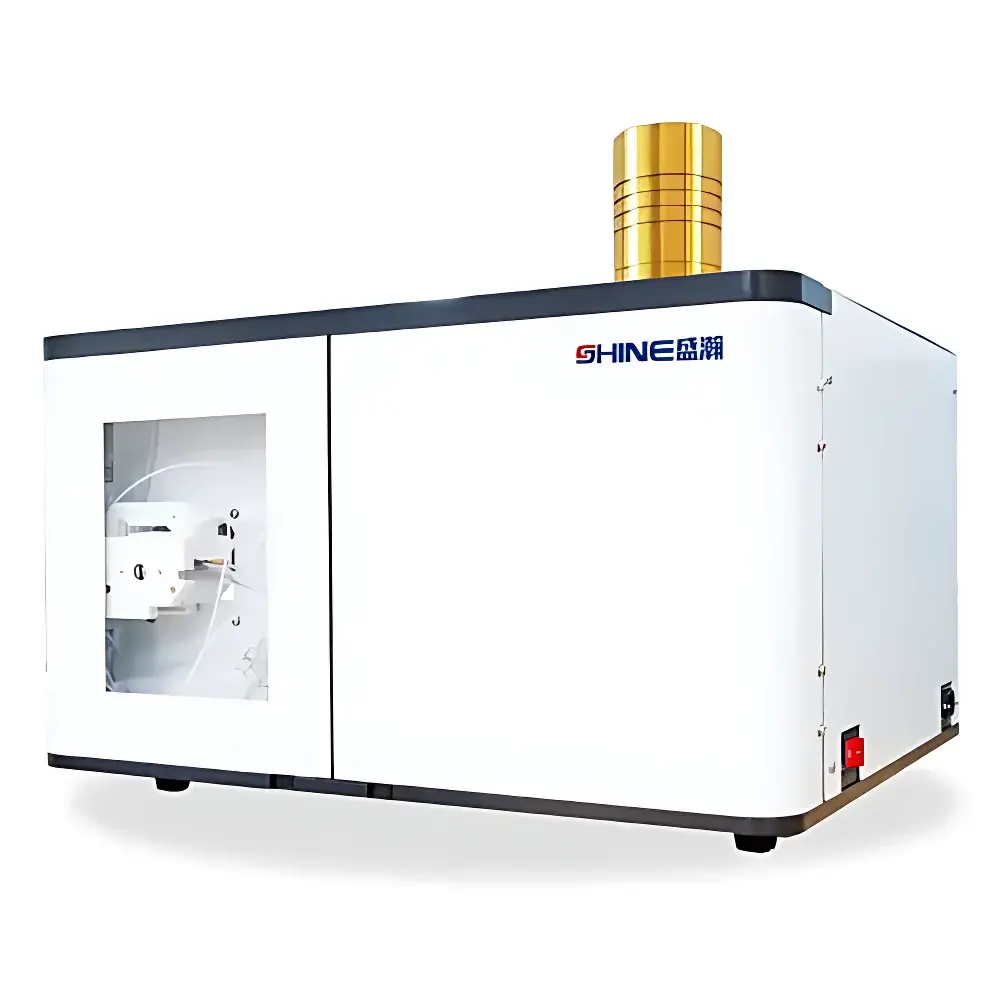
Shine SH-AFS2200 Dual-Channel Atomic Fluorescence Spectrometer
| Brand | Shine |
|---|---|
| Origin | Shandong, China |
| Manufacturer Type | Original Equipment Manufacturer (OEM) |
| Instrument Type | Dual-Channel Atomic Fluorescence Spectrometer |
| Sample Introduction | Peristaltic Pump |
| Waste Liquid Disposal | Peristaltic Pump Extraction |
| Hydride Generation Mode | Vapor Generation / Hydride Generation |
| Gas Flow Control | Mass Flow Controller |
| Detectable Elements | As, Se, Pb, Bi, Sb, Te, Sn, Hg, Ge, Zn, Cd, Au |
| RSD (Dual Channel) | ≤1% |
| Linearity (Dual Channel) | ≥0.9996 |
| Detection Limits (ng/mL) | As/Se/Pb/Bi/Sb/Te/Sn ≤0.01 |
| PMT Wavelength Range | 180–380 nm |
| Atomizer Temperature Control Range | 200 °C |
Overview
The Shine SH-AFS2200 Dual-Channel Atomic Fluorescence Spectrometer is a high-performance analytical instrument engineered for trace elemental quantification in environmental, food, pharmaceutical, geological, and industrial matrices. It operates on the principle of hydride generation atomic fluorescence spectrometry (HG-AFS), wherein target analytes—primarily hydride-forming elements—are chemically reduced to volatile covalent hydrides (e.g., AsH3, Hg0, SeH2) in acidic medium with sodium borohydride (NaBH4). These gaseous species are swept into an argon–hydrogen flame, where thermal dissociation yields ground-state atoms. A high-intensity, element-specific hollow cathode lamp (HCL) excites these atoms, and the resulting atomic fluorescence—emitted isotropically at characteristic wavelengths—is collected perpendicular to the excitation path and measured by a low-noise photomultiplier tube (PMT). This orthogonal optical geometry minimizes background interference and ensures high signal-to-noise ratio, enabling sub-ppt detection capability for key toxic and essential elements.
Key Features
- Dual-channel simultaneous measurement architecture supports concurrent quantification of two hydride-forming elements (e.g., As and Hg), improving throughput without compromising precision (RSD ≤1%); single-channel mode is also available for method flexibility.
- Pulse-powered, high-intensity coded hollow cathode lamps with automatic element recognition and dual-lamp energy-matching algorithms ensure stable spectral output and optimal excitation efficiency across all 12 supported elements.
- Hermetically sealed optical path with integrated stray-light suppression and concealed observation window for real-time argon–hydrogen flame monitoring—enabling visual verification of flame stability and ignition integrity.
- Shielded quartz furnace atomizer operating at precisely controlled 200 °C, minimizing fluorescence quenching and vapor-phase interferences; designed as a maintenance-free, non-adjustable unit for long-term reproducibility.
- Integrated chemical vapor separation module with automated water vapor removal, eliminating condensation-induced signal drift; peristaltic pump parameters (speed, sampling time) are programmable and memory-retained between sessions.
- Mass flow controller-based gas regulation delivers stable, continuously adjustable Ar/H2 flow—reducing argon consumption by up to 30% versus fixed-orifice systems while maintaining optimal flame stoichiometry and atomization efficiency.
- Comprehensive safety architecture includes gas depletion shutdown, power-fail data retention, self-diagnostic boot sequence, and real-time fault logging with audible/visual alerts.
Sample Compatibility & Compliance
The SH-AFS2200 is validated for use with liquid samples subjected to standardized acid digestion or microwave-assisted digestion protocols (e.g., EPA Method 3050B, GB/T 6682-2008 Grade I water). Its hydride generation interface accommodates aqueous extracts from soils, sediments, biological tissues, food composites, and industrial effluents. The system complies with multiple internationally referenced regulatory methods, including ISO 17294-2:2016 (water analysis), ASTM D5673-18 (trace metals in water), and Chinese national standards such as GB/T 22105-2008 (soil total As/Hg/Pb), GB 5009.17-2021 (food total Hg), HJ 694-2014 (water As/Hg/Se/Bi/Sb), and HJ 1133-2020 (ambient particulate matter). Data acquisition and reporting meet GLP/GMP documentation requirements, with full audit trail support—including user login tracking, parameter change logs, and electronic signature capability—aligned with FDA 21 CFR Part 11 principles.
Software & Data Management
The embedded Windows-based control software provides fully automated workflow execution: system initialization, calibration curve generation (multi-point with bracketing blanks), sample sequencing, and quantitative report export. It supports up to five independent calibration curves per session, batch correction using multiple procedural blanks and certified reference materials (CRMs), and cross-sample carryover compensation via automatic needle washing. Data handling includes raw intensity values, net fluorescence signals, concentration outputs, and statistical summaries (mean, SD, RSD, % recovery). Reporting templates conform to ISO/IEC 17025 requirements, with customizable PDF/CSV/XLSX export, image capture of spectra and calibration plots, and hierarchical user permission levels (administrator, analyst, reviewer). Integrated method guidance includes optimized digestion protocols, reagent preparation instructions, and recommended instrumental parameters for each target element—accessible via context-sensitive help modules.
Applications
The SH-AFS2200 serves as a core platform for regulated trace metal analysis across diverse sectors. In environmental laboratories, it quantifies As, Hg, Sb, and Se in drinking water (EPA 1631), wastewater (HJ 694), soil (GB/T 22105), and airborne particulates (HJ 1133). Food safety labs apply it for total mercury in seafood (GB 5009.17), inorganic arsenic in rice (ISO 17294-2 Annex B), and cadmium in infant formula. Pharmaceutical QA/QC teams deploy it for elemental impurities screening in APIs and excipients per ICH Q3D guidelines. Geological survey institutions utilize its sensitivity for ultra-trace Bi, Te, and Ge in ore leachates and geochemical reference materials. Additionally, its compact footprint and optional 160-position autosampler enable mobile deployment—supporting field-based soil screening during national land quality assessments or emergency contamination response.
FAQ
What hydride-forming elements can be measured with the SH-AFS2200?
The instrument is validated for quantitative determination of As, Se, Pb, Bi, Sb, Te, Sn, Hg, Ge, Zn, Cd, and Au in aqueous digests or extracts.
Is the system compatible with existing laboratory information management systems (LIMS)?
Yes—raw data and reports are exportable in standard formats (CSV, XML, PDF) and support ODBC connectivity for direct LIMS integration.
Does the software support 21 CFR Part 11 compliance?
The system provides electronic signatures, audit trails, role-based access control, and data integrity safeguards consistent with FDA 21 CFR Part 11 expectations for regulated environments.
Can the SH-AFS2200 be used for speciation analysis?
No—this is a total elemental quantification platform based on hydride generation. Speciation requires coupling with HPLC or CE separation prior to AFS detection (not included).
What maintenance is required for the quartz atomizer and optical components?
The shielded quartz furnace is designed for >10,000 analyses without adjustment or cleaning; PMT and lamp housings require only periodic dust inspection per manufacturer-recommended intervals (every 6 months under continuous operation).
Related Products





