
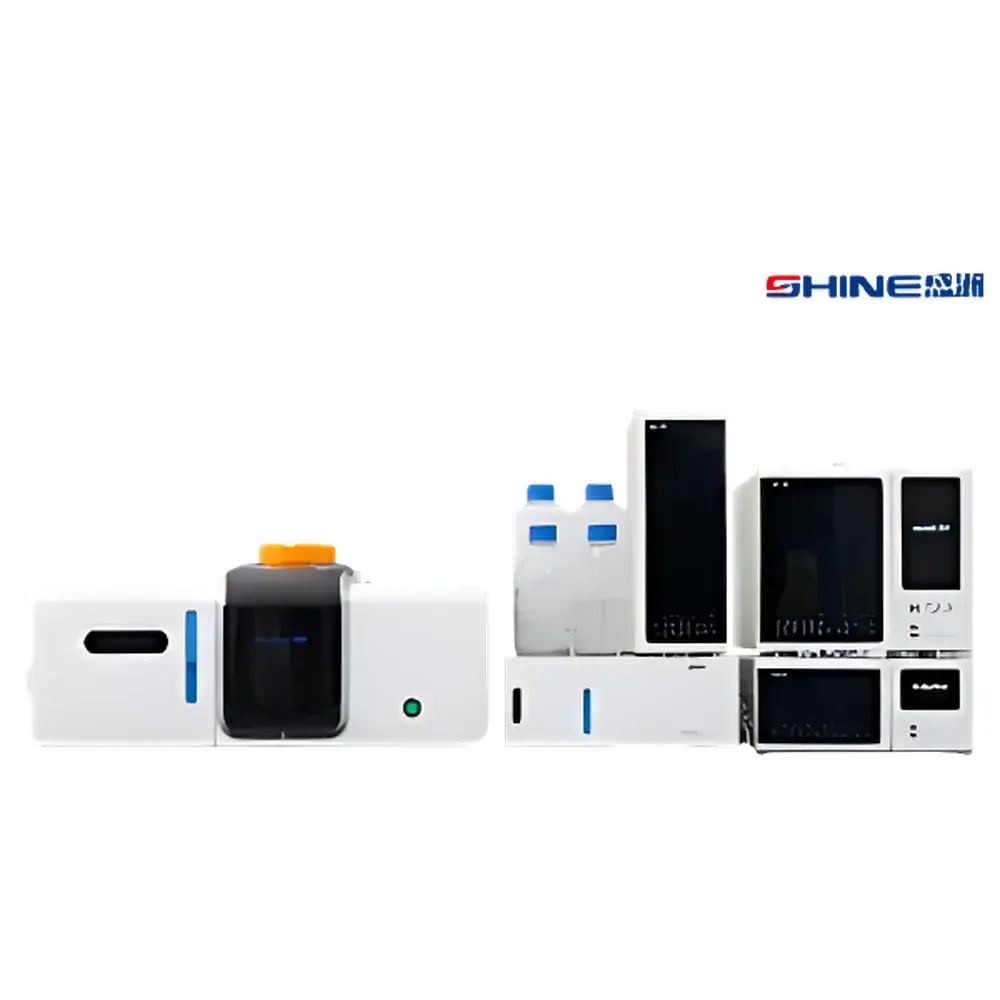
Shine SH-LA200 LC-AFS Speciation Analyzer
| Brand | Shine |
|---|---|
| Origin | Shandong, China |
| Manufacturer Type | Original Equipment Manufacturer (OEM) |
| Country of Origin | China |
| Model | SH-LA200 |
| Price | Upon Request |
| Relative Standard Deviation (RSD) | <0.5% |
Overview
The Shine SH-LA200 LC-AFS Speciation Analyzer is an integrated hyphenated analytical system combining high-performance liquid chromatography (HPLC) with atomic fluorescence spectrometry (AFS) for trace elemental speciation analysis. Engineered for precision and regulatory compliance, the instrument employs a fully domesticated HPLC module developed by Shine and a dedicated AFS detection unit based on cold-vapor atomic fluorescence principles. The system operates on the fundamental principle of species-selective separation followed by element-specific, ultra-sensitive detection—enabling quantitative determination of individual chemical forms (e.g., As(III), As(V), methylmercury, ethylmercury, selenomethionine, SeCys) rather than total elemental concentration. Its design prioritizes robustness in routine laboratory environments, particularly where low-level speciation quantification (<1 ng/L) and long-term measurement stability are required under GLP or ISO/IEC 17025-aligned workflows.
Key Features
- Domestically engineered HPLC module with four-channel online vacuum degassing, delivering exceptional gradient accuracy and minimal dwell volume (≤ 450 µL) for improved peak resolution and reproducibility.
- Wide-range column oven with precise temperature control up to 85 °C, ensuring retention time stability across diverse mobile phase compositions and ambient fluctuations.
- Intelligent hollow cathode lamp (HCL) current regulation—automatically optimized per analyte concentration—to extend lamp lifetime and enhance signal-to-noise ratio.
- Jet-type three-stage gas–liquid separator with enhanced foam suppression, enabling reliable analysis of high-organic-content samples (e.g., fish tissue extracts, algal digests) without carryover or baseline drift.
- Fully enclosed quartz-trap atomization system, isolated from ambient drafts and temperature gradients, minimizing signal variability and improving inter-day repeatability.
- Active mercury capture system with high-capacity adsorbent and continuous purge airflow—reducing background Hg contamination, protecting operator health, and meeting OSHA and EU Directive 2017/852 occupational exposure limits.
- Patented low-temperature atomization technology: argon–hydrogen flame ignition is fully automated, lowering thermal decomposition artifacts, suppressing hydride-forming interferences (e.g., transition metal co-elution), and reducing memory effects for mercury and arsenic species.
- Pressure-balanced purge-flow manifold design ensures consistent hydride generation kinetics across injections, critical for achieving ≤0.5% RSD in replicate analyses.
Sample Compatibility & Compliance
The SH-LA200 supports aqueous extracts, enzymatic digests, acid-leached solids, and organic solvent-based sample preparations—compatible with EPA Method 1638, HJ 1268–2022 (Determination of Methylmercury and Ethylmercury in Water by LC-AFS), GB 5009.11–2014 and GB 5009.17–2021 (Chinese food safety standards for inorganic arsenic and organic mercury), NY/T 3947–2021 and NY/T 3870–2021 (selenium speciation in animal and plant matrices), and WS/T 635–2018 (arsenic species in urine). All hardware and software components are designed to support audit-ready data integrity: electronic signatures, full audit trail logging, and user-access-level permissions align with FDA 21 CFR Part 11 requirements when deployed in regulated QC/QA laboratories.
Software & Data Management
Shinelab™ workstation—developed in-house by Shine—is a modular, Windows-based platform providing synchronized control of HPLC pump, autosampler, column oven, reaction interface, and AFS detector. It features real-time spectral visualization, peak deconvolution tools for co-eluting species, built-in calibration curve fitting (linear, quadratic, weighted), and automated report generation compliant with ISO/IEC 17025 documentation templates. Raw data files are stored in vendor-neutral formats (e.g., .csv, .mzXML-compatible metadata headers) to ensure long-term archival accessibility. System suitability checks—including retention time shift tolerance, peak asymmetry thresholds, and RSD validation for bracketing standards—are programmable and enforced prior to sample sequence execution.
Applications
- Environmental monitoring: Speciation of As, Hg, Se, and Sb in wastewater, drinking water, soil leachates, and solid waste extracts per HJ 1268–2022 and ISO 17294-2.
- Agricultural & food safety: Quantification of inorganic arsenic in rice, methylmercury in seafood products, selenium-containing amino acids (SeMet, SeCys) in fortified cereals and dietary supplements.
- Clinical & biomonitoring: Urinary arsenic species profiling (AsB, MMA, DMA, As(III), As(V)) for exposure assessment; blood or hair mercury speciation in occupational health screening.
- Pharmaceutical & herbal quality control: Arsenic speciation in traditional Chinese medicinal herbs (e.g., Realgar-derived formulations); mercury content verification in fungal-derived nutraceuticals (e.g., Ganoderma spore powders).
- Research applications: Method development for novel selenium metabolites in mammalian cell cultures; redox-speciation studies of antimony in battery recycling effluents.
FAQ
What regulatory standards does the SH-LA200 support out-of-the-box?
The system includes pre-configured method templates and calibration protocols aligned with HJ 1268–2022, GB 5009.11–2014, GB 5009.17–2021, and NY/T 3947–2021—covering >95% of routine speciation workflows in Chinese environmental and food testing labs.
Is the Shinelab software compliant with 21 CFR Part 11?
Yes—when deployed on validated Windows OS platforms with domain-authenticated user accounts, Shinelab supports electronic signatures, immutable audit trails, and role-based access control as defined in FDA 21 CFR Part 11 Subpart B.
Can the SH-LA200 analyze selenium species without derivatization?
Yes—the system directly detects selenomethionine, selenocystine, and methylselenocysteine using hydride generation AFS after reversed-phase HPLC separation; no post-column oxidation or UV digestion is required.
What maintenance intervals are recommended for the gas–liquid separator?
Under normal operation (≤200 injections/week), the jet-type separator requires cleaning every 3 months using 10% v/v HNO₃; consumable gaskets should be replaced semiannually or after 500 injections.
Does the instrument support unattended overnight operation?
Yes—integrated autosampler with 120-position tray, automatic rinse cycle between injections, and real-time pressure/flow fault detection enable fully autonomous 24-hour sequencing with minimal operator intervention.
Related Products





