
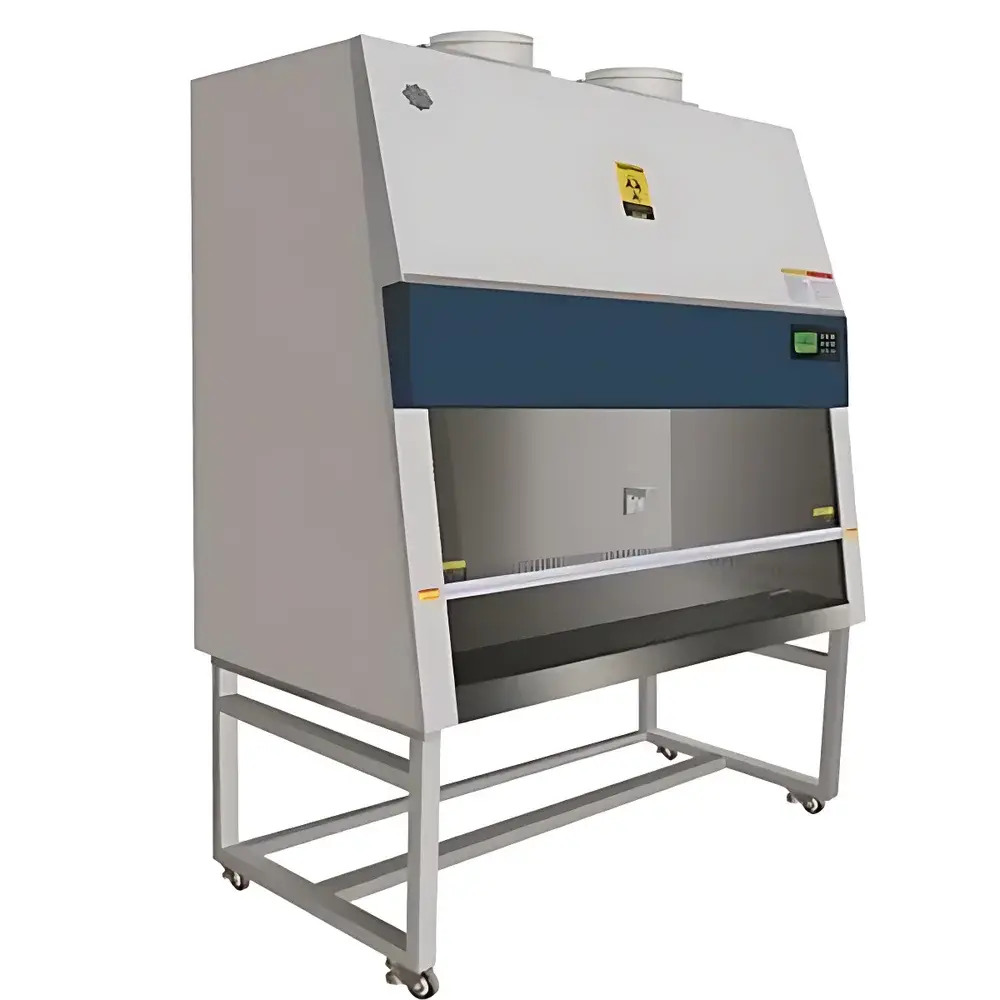
Shinsco BHC-1300II B2 Class II Type B2 Biosafety Cabinet
| Brand | Shinsco |
|---|---|
| Origin | Shandong, China |
| Manufacturer | Yes |
| Type | Class II, Type B2 (Total Exhaust) |
| Model | BHC-1300II B2 |
| Airflow | 100% externally exhausted |
| Inflow Velocity | 0.53 ± 0.025 m/s |
| Downflow Velocity | 0.33 ± 0.025 m/s |
| Filtration | Dual HEPA (supply & exhaust), ≥99.999% @ 0.12–0.3 µm |
| Safety Certification | Compliant with EN 12469:2000, NSF/ANSI 49-2022 |
| Cleanliness Class | ISO 5 (Class 100) operational, achievable ISO 4 (Class 10) under controlled conditions |
| Noise Level | ≤67 dB(A) at 30 cm from sash, 38 cm above work surface |
| Lighting | ≥650 lx (T5-28W × 2) |
| UV Lamp | 30 W × 1 |
| Work Surface Load Capacity | 23 kg (no permanent deformation) |
| Power Supply | 220 ± 22 V, 50 Hz |
| Max Power Consumption | ≤1.8 kW |
| Drain Pan Volume | ≥4.0 L |
| Exhaust Port Diameter | Ø300 mm |
| Electrical Safety | Dielectric strength ≥1500 V (10 mA), insulation resistance ≥2 MΩ (500 V DC) |
| Structural Integrity | Leak-tight at 500 Pa (soap bubble test) |
| Vibration Amplitude | ≤5 µm (10 Hz–10 kHz) |
| Sash Height Alarm | Visual & audible alert beyond safe operating range |
| Auto Fan Compensation | Variable-frequency drive (VFD) for real-time airflow stabilization |
| UV Timer | 24-hour programmable scheduling |
| Pre-set Sash Angle | 10° ergonomic incline |
Overview
The Shinsco BHC-1300II B2 is a certified Class II, Type B2 biosafety cabinet engineered for maximum personnel, product, and environmental protection in high-risk microbiological and molecular biology applications. As a total-exhaust (100% external venting) system, it eliminates recirculation entirely—drawing ambient air through the front intake grille, passing it across the work surface, and expelling all contaminated air through a dedicated ducted exhaust system after dual-stage HEPA filtration. Its aerodynamic design adheres to the fundamental principles of unidirectional laminar downflow and inward inflow, ensuring consistent containment of aerosols generated during procedures involving Risk Group 2 and 3 agents. The cabinet complies fully with international performance standards including NSF/ANSI 49-2022 and EN 12469:2000, supporting GLP/GMP-aligned laboratory operations where regulatory traceability and reproducible containment are non-negotiable.
Key Features
- Double-walled side and rear panels forming integrated negative-pressure ducts—reducing internal airflow resistance while establishing dual physical and pressure barriers between the work area and external environment.
- Seamless 304 stainless steel work chamber with no internal welds or crevices, enabling rapid decontamination and minimizing microbial retention points.
- Digital differential pressure monitoring with real-time visual display and audible/visual alarms for both supply and exhaust HEPA filter integrity, sash height deviation, and airflow anomalies.
- Large-format LCD interface showing dynamic values for downflow velocity (0.33 ± 0.025 m/s), inflow velocity (0.53 ± 0.025 m/s), and filter delta-P—integrated with microprocessor-based control logic for automatic fan speed adjustment via VFD technology.
- ULPA-grade HEPA filters (≥99.999% efficiency at 0.12–0.3 µm) with leak integrity ≤0.01%, validated per IEST-RP-CC001 and tested using sodium chloride or DOP challenge protocols.
- Programmable UV sterilization cycle with 24-hour scheduler, T5 fluorescent lighting (≥650 lx), and ergonomic 10° sash tilt for reduced operator fatigue during extended use.
- Interlocked blower sequence: exhaust fan initiates first; supply fan starts automatically upon exhaust stabilization; exhaust continues post-shutdown to purge residual contaminants before full system shutdown.
- Comprehensive electrical safety architecture—including dielectric strength ≥1500 V (10 mA), insulation resistance ≥2 MΩ (500 V DC), and overload-rated 500 W receptacles meeting IEC 60320-C13 specifications.
Sample Compatibility & Compliance
The BHC-1300II B2 accommodates standard 1300 mm wide work surfaces and supports common lab instrumentation including centrifuges, pipetting stations, and small-scale bioreactors—provided total heat load remains within thermal dissipation limits (≤1.8 kW). Its ISO 4 (Class 10) cleanroom performance—verified by particle counters measuring ≤0.35 particles/L ≥0.5 µm—meets stringent requirements for sterile cell culture, recombinant protein purification, and viral vector handling. Structural leak-tightness is confirmed per EN 12469 Annex C (500 Pa soap bubble test), and vibration compliance (≤5 µm, 10 Hz–10 kHz) ensures compatibility with sensitive optical assays. All materials comply with RoHS Directive 2011/65/EU and REACH Regulation (EC) No. 1907/2006.
Software & Data Management
While the BHC-1300II B2 operates via embedded firmware without cloud connectivity, its microcontroller logs timestamped events—including sash position excursions, filter pressure differentials, UV activation cycles, and alarm triggers—for local audit trail generation. Data export is supported via USB interface in CSV format, facilitating integration into laboratory information management systems (LIMS) for FDA 21 CFR Part 11–compliant recordkeeping when paired with qualified electronic signature workflows. Firmware updates are performed offline using manufacturer-validated binaries, preserving configuration integrity during version transitions.
Applications
This cabinet is routinely deployed in academic core facilities, pharmaceutical QC labs, and clinical diagnostics centers for applications requiring absolute containment and zero recirculation: handling of genetically modified organisms (GMOs), preparation of oncology therapeutics, mycobacterial culture, lentiviral transduction, and synthesis of antisense oligonucleotides. Its 100% exhaust configuration makes it suitable for volatile toxic chemical use when combined with appropriate ducting and scrubbing infrastructure—though chemical compatibility must be verified against cabinet gasket and interior material specifications (e.g., resistance to aldehydes, halogenated solvents).
FAQ
What distinguishes Type B2 from Type A2 biosafety cabinets?
Type B2 cabinets provide total exhaust with zero air recirculation, whereas Type A2 units recirculate ~70% of filtered air back into the work area. B2 models require dedicated hard-ducted exhaust and are mandatory for work involving volatile radionuclides or toxic chemicals.
Is ducting included with the cabinet?
No—exhaust ductwork, termination hoods, and balancing dampers must be specified separately per site-specific HVAC engineering requirements and local building codes.
Can the cabinet be installed in a room without a dedicated exhaust system?
No. Type B2 operation mandates connection to a continuously running, capacity-matched exhaust system capable of maintaining stable static pressure and flow rates per NSF/ANSI 49 Section 7.3.
How often should HEPA filters be replaced?
Filter service intervals depend on usage intensity and particulate loading; typical replacement occurs every 3–5 years, but real-time delta-P monitoring and annual third-party certification per ISO 14644-3 are required for compliance maintenance.
Does the unit support remote monitoring integration?
It does not feature native Ethernet or Modbus RTU ports; however, analog 4–20 mA outputs for airflow and pressure signals are available as an optional factory-configured interface for integration into building management systems (BMS).



