
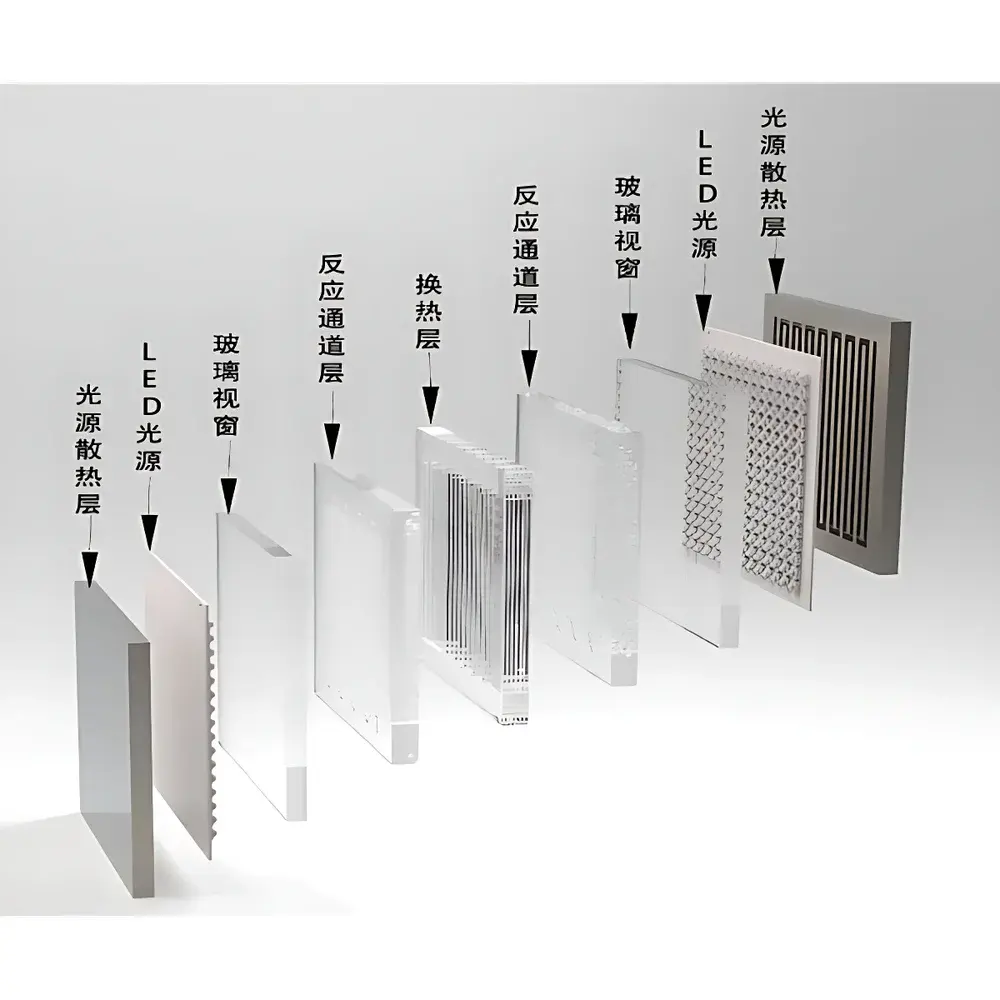
Shinsco SSC-FPCR500C Plate-Type Glass Microchannel Continuous-Flow Photochemical Reactor
| Brand | Shinsco |
|---|---|
| Model | SSC-FPCR500C |
| Origin | Shandong, China |
| Manufacturer Type | OEM Manufacturer |
| Country of Origin | China |
| Hold-up Volume | 18 mL (two reaction layers in series + one thermal control layer) / 23 mL (two reaction layers in series + one thermal control layer) |
| Max Operating Pressure | <20 bar |
| Temperature Control Range | −20 °C to 180 °C |
| Thermal Exchange Medium | Water, ethanol, silicone oil (external chiller required) |
| Reactor Material | High-borosilicate glass (transmission >320 nm) |
| Flow Rate Range | 0.1–100 mL/min |
| LED Light Source Options | 365 nm (quartz lens assembly), 395 nm, 405 nm, 420 nm, 455 nm, 470 nm, 500 nm, 520 nm, 590 nm, 620 nm, 660 nm, 740 nm, 810 nm, 850 nm, 940 nm, or broadband white LED (400–800 nm) |
| Cooling Method | Air-cooled or water-cooled (integrated |
Overview
The Shinsco SSC-FPCR500C is a plate-type, high-transparency glass microchannel continuous-flow photochemical reactor engineered for precision photoreaction engineering under controlled thermal and irradiation conditions. Based on the principle of laminar flow photochemistry within optically transparent, chemically inert borosilicate glass microstructures, this reactor enables uniform photon flux delivery across defined reaction cross-sections while maintaining precise residence time distribution (RTD). Unlike batch photochemical systems—where light attenuation, thermal gradients, and mass transfer limitations compromise reproducibility—the SSC-FPCR500C leverages its dual-layer parallel microchannel architecture to ensure consistent photon absorption per unit volume, enhanced interfacial contact between reagents, catalysts (heterogeneous or immobilized), and irradiated surface area, and rapid heat dissipation via an integrated thermal regulation layer. Its design conforms to fundamental requirements for scalable photochemical process development: high surface-to-volume ratio (>10,000 m²/m³), low axial dispersion (Péclet number >100), and compatibility with both liquid-phase and gas–liquid segmented flow regimes.
Key Features
- Optically optimized high-borosilicate glass construction with >90% UV–Vis transmission above 320 nm—enabling efficient utilization of narrowband LED irradiation without spectral cutoff or fluorescence interference.
- Modular plate-stack architecture: two independently addressable reaction channel layers (18 mL or 23 mL total hold-up depending on configuration) plus a dedicated thermal exchange layer—allowing simultaneous reaction control and dynamic temperature management.
- Pressure-rated microfluidic manifold capable of sustained operation up to 20 bar—supporting high-boiling solvents, supercritical CO₂-assisted reactions, and pressurized gas–liquid photocatalysis (e.g., O₂-, H₂-, or CO-saturated flows).
- Integrated thermal interface compatible with standard external chillers or heating circulators using water, ethanol, or silicone oil—enabling precise isothermal, linear ramp, or stepwise temperature profiles from −20 °C to 180 °C.
- Plug-and-play LED illumination system with 16 discrete wavelength options (365–940 nm) and broadband white LED (400–800 nm), each equipped with collimated output and optional quartz lens assemblies for UV-grade optical coupling.
- Air- or water-cooled LED driver and emitter module—eliminating need for auxiliary cooling loops when paired with the reactor’s thermal management layer.
Sample Compatibility & Compliance
The SSC-FPCR500C accommodates a broad range of photochemically active systems, including homogeneous photocatalysts (e.g., Ru(bpy)₃²⁺, Ir(ppy)₃), heterogeneous semiconductors (TiO₂, g-C₃N₄), enzymatic photobiocatalysts, and radical-mediated transformations (e.g., [2+2] cycloadditions, C–H functionalizations, decarboxylative couplings). Its all-glass fluidic path ensures compatibility with strong acids (e.g., TFA), bases (e.g., NaOH in methanol), halogenated solvents (CH₂Cl₂, CHCl₃), and oxidizing agents (H₂O₂, peracids). The reactor meets material compliance standards for laboratory-scale GMP-aligned synthesis workflows per ISO 17025 and ASTM E2500 guidelines. When operated with audit-trail-enabled process controllers and validated LED intensity monitoring (via calibrated photodiode feedback), it supports data integrity requirements aligned with FDA 21 CFR Part 11 for regulated photoprocess development.
Software & Data Management
While the base SSC-FPCR500C operates as a hardware-integrated platform, it is fully compatible with third-party lab automation ecosystems—including LabVIEW-based PID controllers, Modbus RTU/ASCII interfaces for PLC integration, and Python-driven flow/temperature/irradiance orchestration via RS485 or Ethernet gateways. Optional firmware upgrades enable real-time logging of LED drive current, junction temperature, flow rate (via Coriolis or gear pump encoder feedback), and jacket temperature with timestamped CSV export. All logged parameters adhere to ALCOA+ principles (Attributable, Legible, Contemporaneous, Original, Accurate, Complete, Consistent, Enduring, Available) for GLP/GMP traceability during technology transfer or regulatory filing.
Applications
- Photoinduced C–X (X = N, O, S) bond formation under mild conditions for pharmaceutical intermediate synthesis.
- Visible-light-driven asymmetric catalysis using chiral iridium or copper complexes in continuous mode.
- Photoredox-mediated late-stage functionalization of complex APIs with minimized byproduct formation.
- Gas–liquid photooxidation (e.g., selective alcohol → aldehyde conversion using O₂ and 455 nm irradiation).
- Rapid screening of photocatalyst performance across wavelength and residence time matrices.
- Scale-out photopolymerization process development for functional coatings and microstructured hydrogels.
FAQ
What is the maximum recommended flow rate for optimal photon efficiency?
For most photochemical transformations requiring high quantum yield, we recommend operating between 0.5–20 mL/min to maintain residence times ≥30 s and ensure >95% photon absorption in the primary reaction layer.
Can the reactor be used with solid catalysts or immobilized enzymes?
Yes—the microchannel geometry supports packed-bed configurations using glass frits or monolithic catalyst supports; custom inlet/outlet manifolds are available upon request.
Is quartz required for UV-C applications below 320 nm?
The standard high-borosilicate glass transmits down to ~320 nm; for wavelengths below this threshold (e.g., 254 nm), quartz microchannel plates can be supplied as a configuration option.
How is light intensity calibrated and maintained over time?
Each LED module includes factory-calibrated photodiode feedback; users may perform periodic verification using NIST-traceable spectroradiometers—intensity drift remains <±2% over 5,000 hours at rated current.
Does the system support automated reaction optimization?
When integrated with programmable syringe pumps, temperature controllers, and spectrophotometric inline analytics (e.g., UV-Vis flow cell), the SSC-FPCR500C serves as a foundational node in closed-loop DoE-driven photoreactor networks.



