
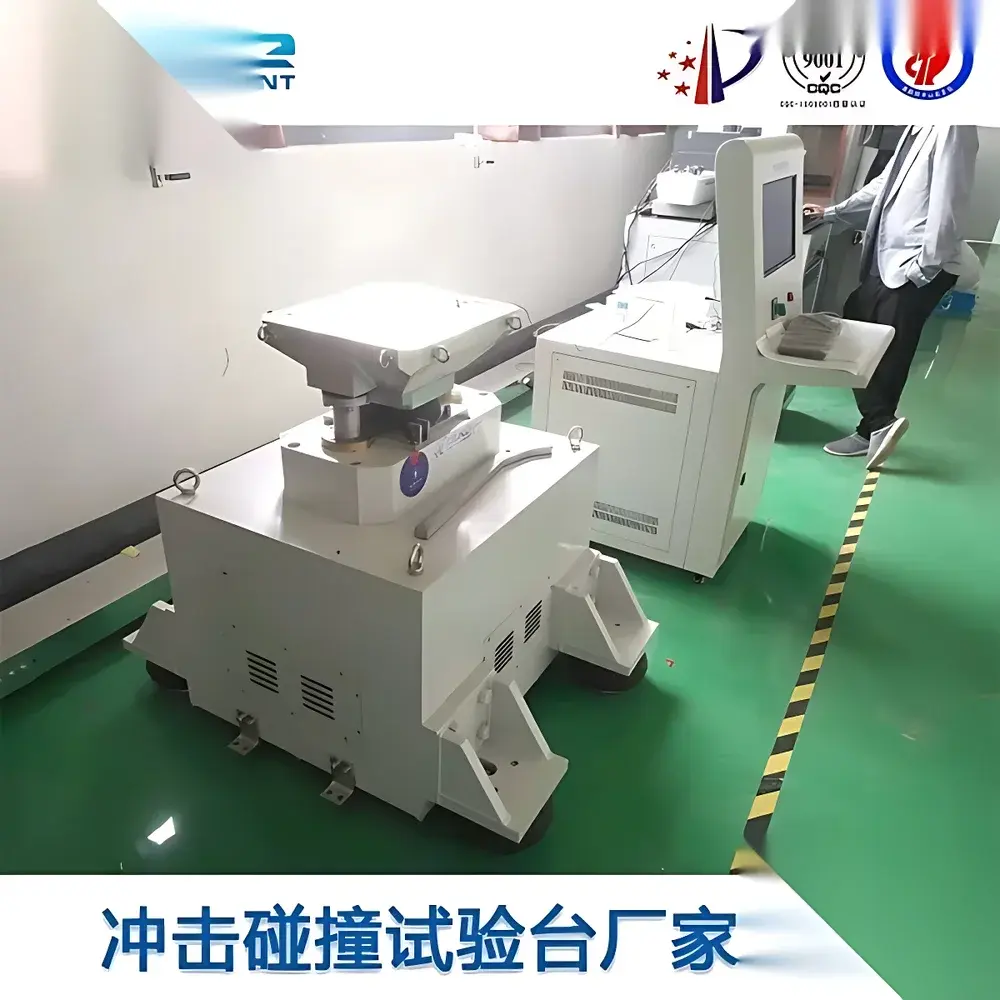
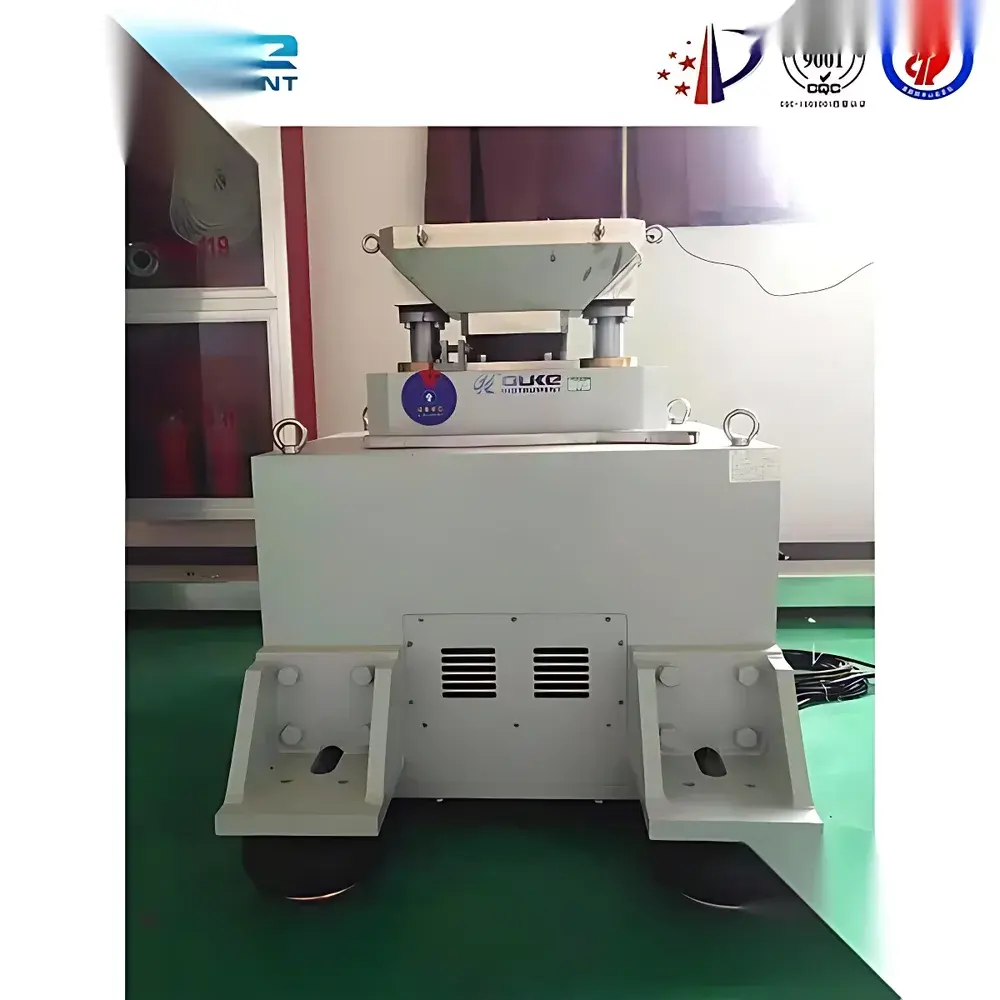
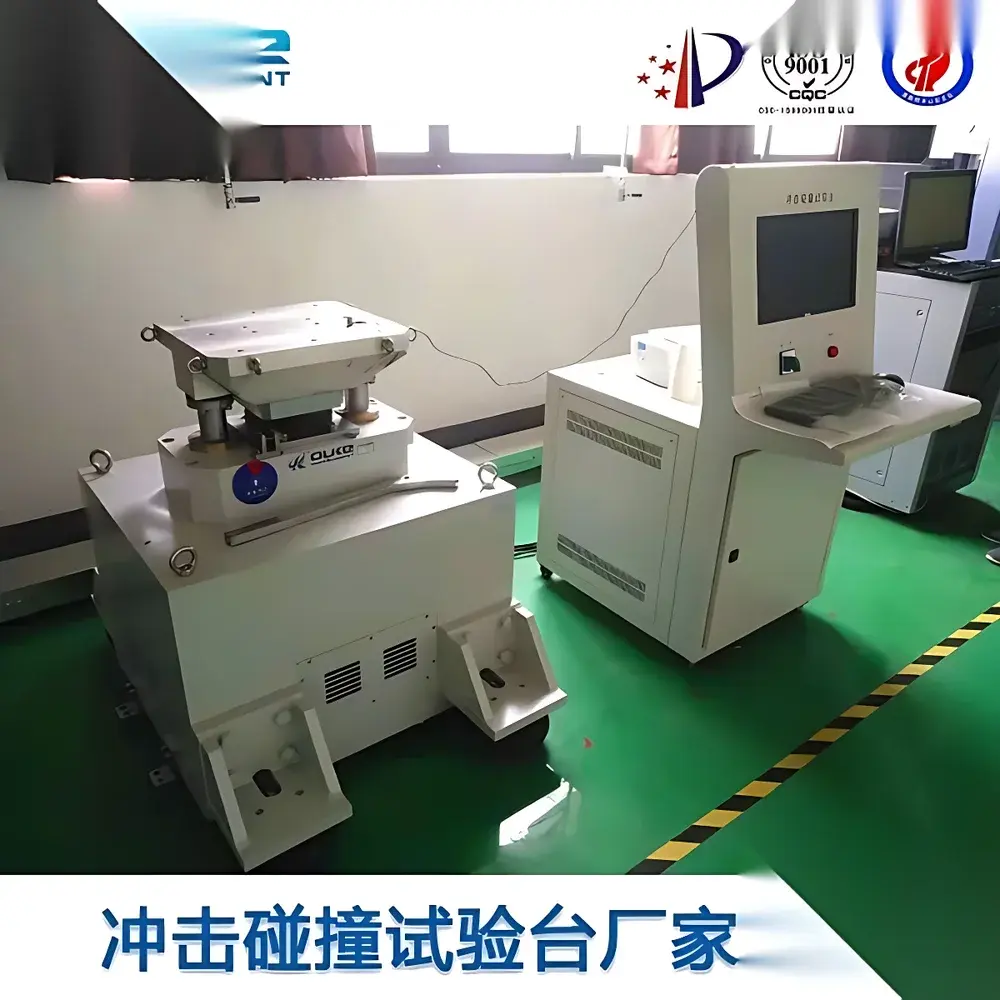
Shock Test Table – High-Performance Electrodynamic Impact & Collision Testing System
| Key | Max Load Capacity: 50–800 kg |
|---|---|
| Peak Acceleration Range | 30–1000 m/s² |
| Pulse Duration | 20–230 ms |
| Repetition Rate | 10–60 impacts/min |
| Table Surface Dimensions | 500×700 to 1000×1000 mm |
| Drop Height Range | 0–800 mm |
| Continuous Operation Time | 8 h |
| Compliance | GB/T 2423.5–1995, GB/T 2423.6–1995, IEC 60068-2-27, IEC 60068-2-29, JJG 497–2000 |
Overview
The Shock Test Table is an electrodynamic impact and collision testing system engineered for precise simulation of mechanical shock environments encountered during transportation, handling, and operational use. Based on the principle of controlled electromagnetic acceleration, it generates repeatable half-sine, trapezoidal, and post-peak sawtooth shock pulses—enabling standardized evaluation of product structural integrity under transient high-acceleration loading. Designed for laboratory and industrial QA/QC environments, this system meets the fundamental requirements of environmental stress screening (ESS) and mechanical shock qualification per international test standards. Its robust architecture supports both single-impact and repetitive collision protocols, making it suitable for pre-compliance verification prior to formal certification testing.
Key Features
- Electrodynamic actuator with closed-loop acceleration control, delivering high waveform fidelity and repeatability across pulse types (half-sine, trapezoidal, sawtooth)
- Opto-electronic feedback system ensures real-time monitoring and correction of table acceleration profile during impact execution
- High-rigidity tabletop with uniform peak acceleration distribution (±5% spatial variation across active surface)
- Comprehensive safety interlocks including door position sensing, over-travel limit switches, zero-signal verification, and emergency stop circuitry compliant with ISO 13850
- Modular design allows integration of optional waveform generation modules for customized pulse shaping and extended test profiles
- Dual-voltage power input support (220 VAC ±10% / 380 VAC ±10%, 50 Hz) with built-in surge suppression and thermal overload protection
Sample Compatibility & Compliance
The system accommodates test specimens ranging from small electronic assemblies (e.g., PCBs, sensors) to large automotive subassemblies and aerospace avionics enclosures. Mounting configurations include direct bolt-down, fixture-based clamping, and inertia-matched adapters. All operational modes conform to mandatory test specifications including GB/T 2423.5–1995 (impact), GB/T 2423.6–1995 (collision), IEC 60068-2-27 (shock), IEC 60068-2-29 (repetitive shock), and metrological verification standard JJG 497–2000. The system’s traceable calibration protocol supports GLP-compliant documentation and is compatible with audit-ready data archiving workflows required under ISO/IEC 17025 and FDA 21 CFR Part 11 when paired with validated software.
Software & Data Management
Control and analysis are performed via a Windows-based application supporting real-time waveform preview, parameter scripting, and automated test sequencing. The software logs time-acceleration data at ≥100 kS/s with hardware timestamping, stores metadata (test ID, operator, ambient conditions, calibration status), and exports CSV and MATLAB-compatible binary formats. Audit trail functionality records all user actions—including parameter changes, start/stop events, and calibration interventions—with immutable timestamps. Optional add-ons include remote monitoring APIs (RESTful JSON interface), PDF report generation with digital signature fields, and integration with LIMS platforms via ODBC or HL7.
Applications
- Transportation durability validation for consumer electronics, medical devices, and packaging systems
- Structural fatigue assessment of automotive components (brackets, housings, connectors) subjected to road-induced shocks
- Aerospace component qualification per MIL-STD-810H Method 516.7 (Shock) and DO-160 Section 7
- Design verification of industrial machinery subjected to machine-startup transients or tool engagement impacts
- Reliability growth testing in HALT/HASS chambers where shock profiles are sequenced with thermal and vibration stresses
- Evaluation of solder joint integrity and microelectromechanical system (MEMS) survivability under transient load conditions
FAQ
What shock pulse shapes does the system support out-of-the-box?
Half-sine, trapezoidal, and post-peak sawtooth waveforms are natively supported; additional shapes may be implemented via custom waveform import using IEEE 1558-compliant ASCII format.
Is the system capable of performing sequential shock tests with varying amplitudes and durations?
Yes—the software enables multi-step test programs with programmable amplitude, pulse width, repetition interval, and dwell time between sequences.
Does the system provide traceable calibration documentation?
Each unit ships with a factory calibration certificate referencing NIST-traceable accelerometers and laser vibrometers, valid for 12 months under normal operating conditions.
Can the test table be integrated into an existing environmental test chamber or automated test cell?
Standard RS-485, Ethernet/IP, and dry-contact I/O interfaces facilitate seamless integration with PLC-based control systems and environmental chamber controllers.
What maintenance intervals are recommended for long-term reliability?
Preventive maintenance is scheduled every 1,000 operating hours or annually—whichever occurs first—and includes actuator coil inspection, guide rail lubrication, sensor recalibration verification, and safety circuit functional testing.



