
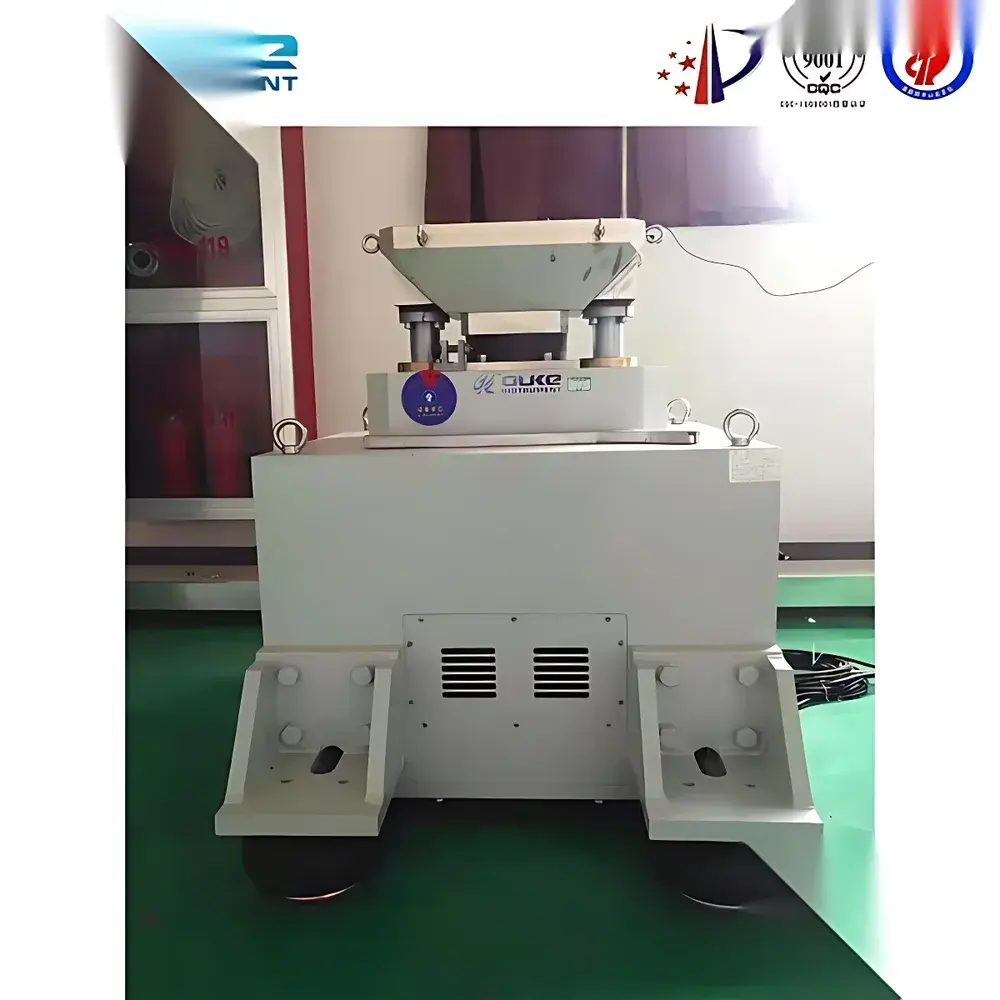
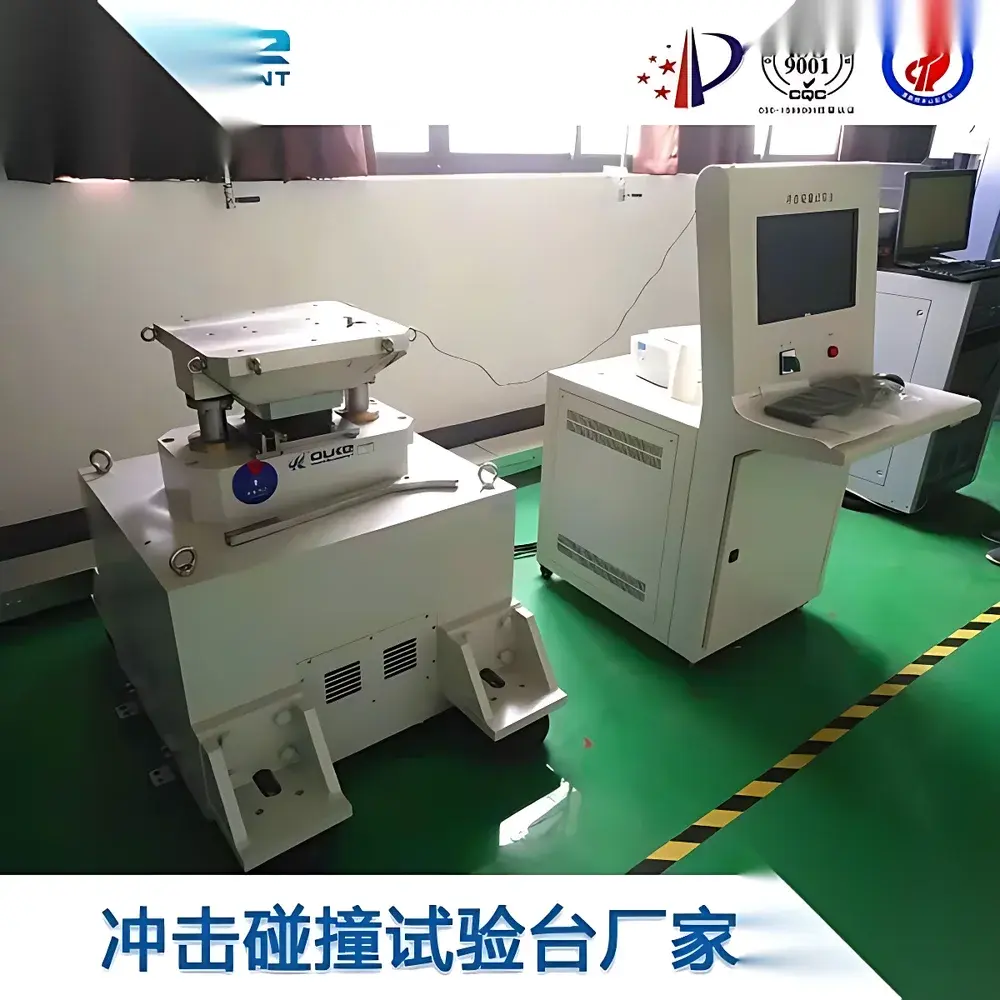
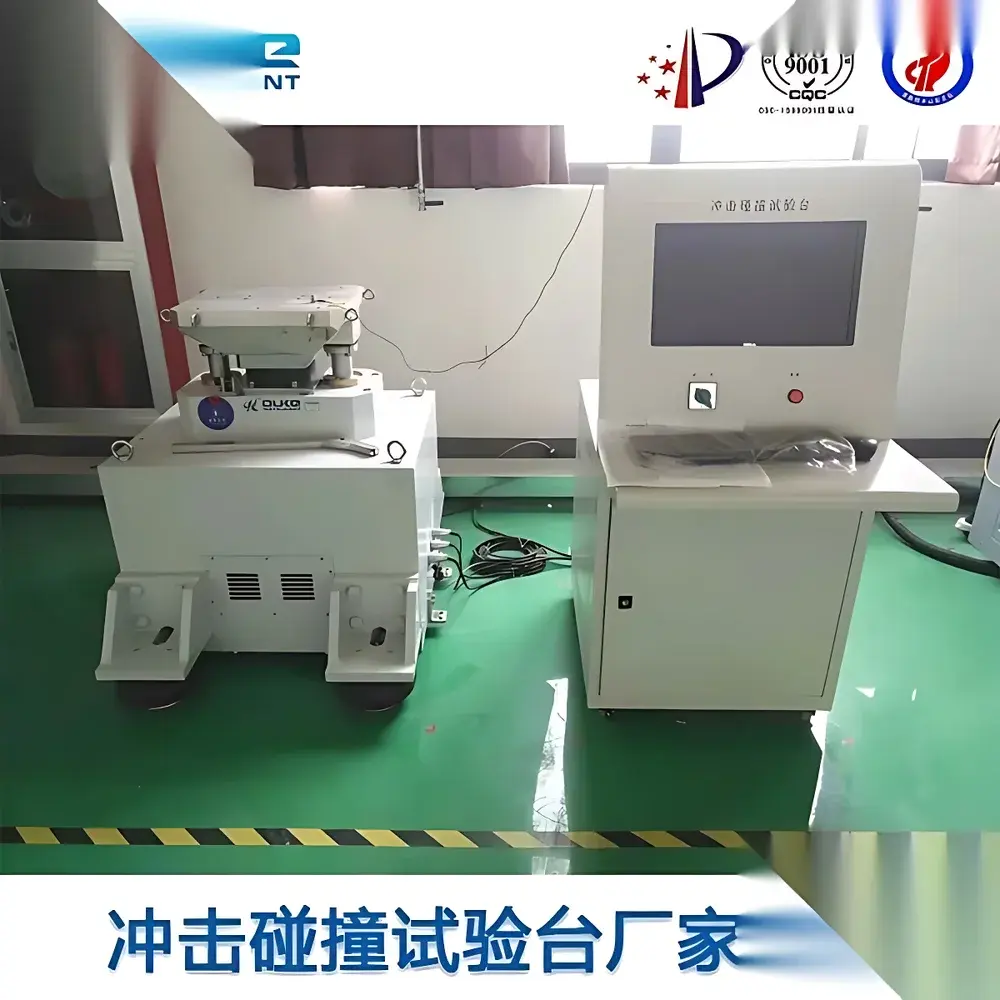
Shock Test Table Manufacturer – High-Precision Vertical Electro-Hydraulic Shock Testing System
| Key | Table Surface Dimension: 200 × 200 mm |
|---|---|
| Max Payload | 10 kg |
| Pulse Duration Range | 0.6–20 ms (programmable, auto-controlled) |
| Peak Acceleration Range | 150–20,000 m/s² |
| Pulse Waveform | Half-sine |
| Shock Direction | Vertical |
| Secondary Impact Prevention | Hydraulic-friction braking system |
| Height Control | Digital preset + hydraulic lifting |
| Control & Measurement System | Integrated |
| Table Mass | 2800 kg |
| Overall Dimensions | 750 × 2600 × 1000 mm |
| Power Supply | AC 380 V ±10%, 50 Hz, 3 kVA |
| Repetition Rate | 0–100 shocks/min (±1% accuracy) |
| Sampling Rate | 200 kHz |
| Signal Conditioning | Analog filtering + 160 dB/oct digital anti-aliasing filter |
| Compliance Standards | IEC 60068-2-27, GB/T 2423.5, GJB 150.18A, GJB 360B, JJG 497 |
| Software Platform | Windows XP-based with DAO engine, automated Word report generation, real-time display of lift height, acceleration amplitude, pulse width, and Δv |
Overview
The Vertical Electro-Hydraulic Shock Test Table is a precision-engineered physical property testing instrument designed for controlled mechanical shock simulation in compliance with international environmental stress screening (ESS) and qualification test standards. It operates on the principle of free-fall impact combined with electro-hydraulic actuation and closed-loop digital control, delivering repeatable half-sine shock pulses with high waveform fidelity. The system is calibrated to generate defined acceleration-time profiles—primarily half-sine—across a wide dynamic range (150–20,000 m/s²) and pulse durations (0.6–20 ms), enabling rigorous evaluation of product structural integrity, solder joint reliability, sensor response latency, and packaging resilience under transient mechanical loading.
Key Features
- Robust 2800 kg reinforced steel frame ensures minimal base motion coupling and high mechanical stability during high-g shock events.
- Digital height presetting with servo-controlled hydraulic lifting mechanism enables precise, reproducible drop-height selection—critical for maintaining pulse shape consistency across test series.
- Integrated hydraulic–friction dual-mode braking system eliminates secondary rebound impacts, preserving waveform integrity and protecting both test specimens and transducer calibration.
- Real-time acquisition at 200 kHz sampling rate, supported by analog pre-filtering and a 160 dB/oct digital anti-aliasing filter, guarantees accurate capture of high-frequency spectral content in shock transients.
- Programmable repetition rate (0–100 shocks/min, ±1% tolerance) supports both single-event qualification and accelerated life-cycle stress profiling.
- Full metrological traceability: acceleration amplitude (±1%), pulse width (±1%), and timing resolution are validated per ISO/IEC 17025-accredited procedures.
Sample Compatibility & Compliance
This shock test table accommodates payloads up to 10 kg on a rigid 200 × 200 mm mounting surface, compatible with standard MIL-STD-810G, IEC 60068-2-27, and automotive OEM shock protocols (e.g., VW 80101, GMW 3172). Its waveform generation meets the stringent tolerances specified in GB/T 2423.5 (half-sine, front 0.4D–rear 0.1D / 1.1D envelope), GJB 150.18A (military airborne equipment), and JJG 497 (calibration verification for shock machines). The system is engineered for integration into GLP-compliant laboratories and supports audit-ready documentation for FDA 21 CFR Part 11–aligned workflows when paired with validated software configurations.
Software & Data Management
The embedded Windows XP–based control and analysis suite utilizes Microsoft DAO data access objects for structured database logging. It provides synchronized visualization of lift height, measured peak acceleration, pulse duration (FWHM), and velocity change (Δv), with automatic alignment to user-defined tolerance bands. Post-test processing includes FFT-based spectral analysis, statistical summary (mean, SD, Cp/Cpk), and fully customizable Word report generation—including test parameters, raw waveform plots, pass/fail status against selected standards, and operator metadata. All data files are timestamped, digitally signed, and support export in CSV, MATLAB (.mat), and universal HDF5 formats for third-party correlation studies.
Applications
- Qualification testing of avionics modules, inertial measurement units (IMUs), and flight-critical PCB assemblies per DO-160 Section 8.
- Reliability screening of consumer electronics—smartphones, wearables, and IoT edge sensors—against accidental drop and transport shock.
- Validation of MEMS accelerometer and gyroscope linearity, saturation thresholds, and post-shock zero-shift behavior.
- Mechanical design verification of medical device housings (e.g., portable ultrasound units, infusion pumps) under IEC 60601-1 mechanical stress clauses.
- Calibration and inter-laboratory comparison of piezoelectric accelerometers and charge amplifiers using reference shock pulses.
FAQ
What standards does this shock test table directly support?
It is configured and verified to meet IEC 60068-2-27 (Ed. 4.0), GB/T 2423.5–2008, GJB 150.18A–2009, GJB 360B–2009, and JJG 497–2000. Custom waveform envelopes can be programmed to match proprietary OEM specifications.
Is the system suitable for production-line ESS (Environmental Stress Screening)?
Yes—its programmable repetition rate, automated reporting, and hydraulic repeatability (±0.3% pulse-to-pulse g-level variation) make it appropriate for high-throughput screening environments when integrated with MES or QMS platforms.
Can the software be validated for regulated industries (e.g., pharmaceutical or aerospace)?
The core acquisition and calculation algorithms are deterministic and documented; full 21 CFR Part 11 compliance requires site-specific IQ/OQ/PQ execution, electronic signature configuration, and audit trail activation—services available upon request.
What maintenance intervals are recommended for hydraulic and braking subsystems?
Hydraulic fluid and filter replacement every 12 months or 500 operational hours; friction brake pad inspection every 2000 shock cycles; annual metrological recalibration traceable to NIM or equivalent national metrology institute.
Does the system include vibration isolation or floor anchoring provisions?
The unit is supplied with adjustable leveling feet and pre-drilled anchor points for M20 foundation bolts; active vibration isolation is not included but may be added as an optional turnkey package.



