
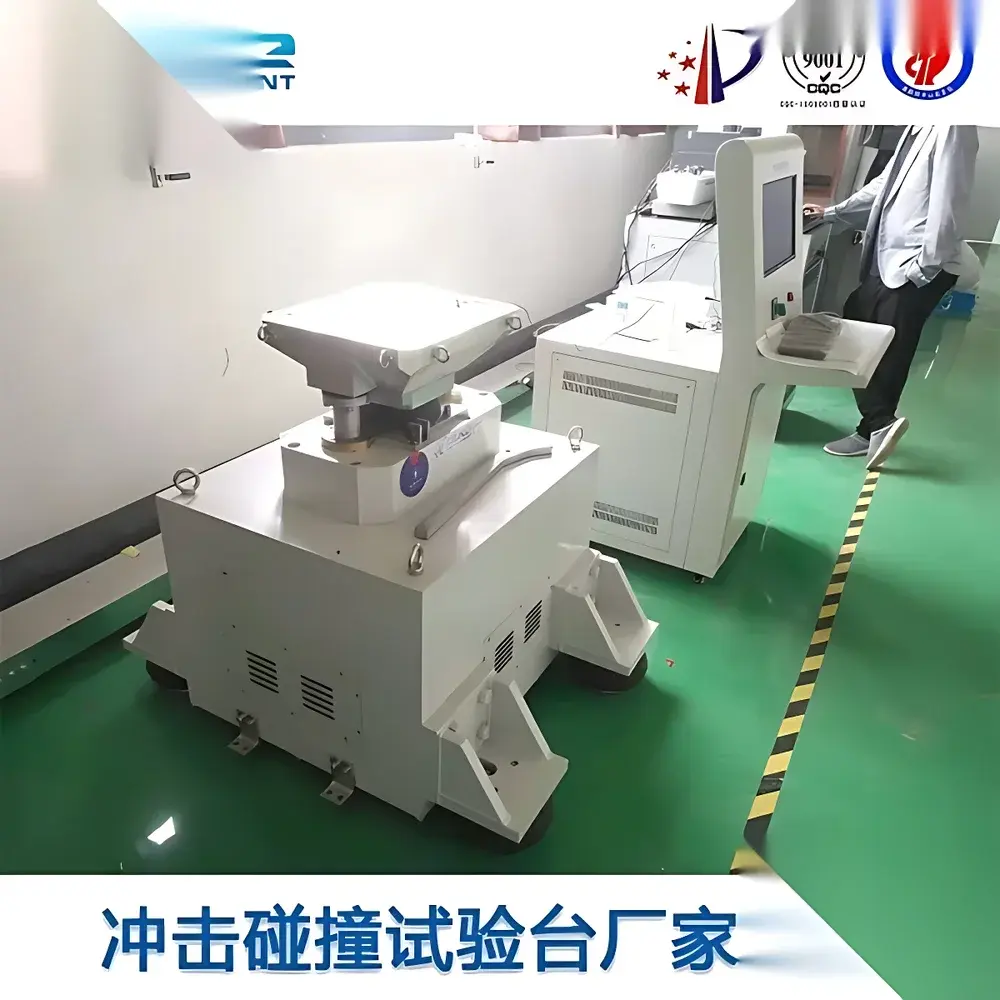
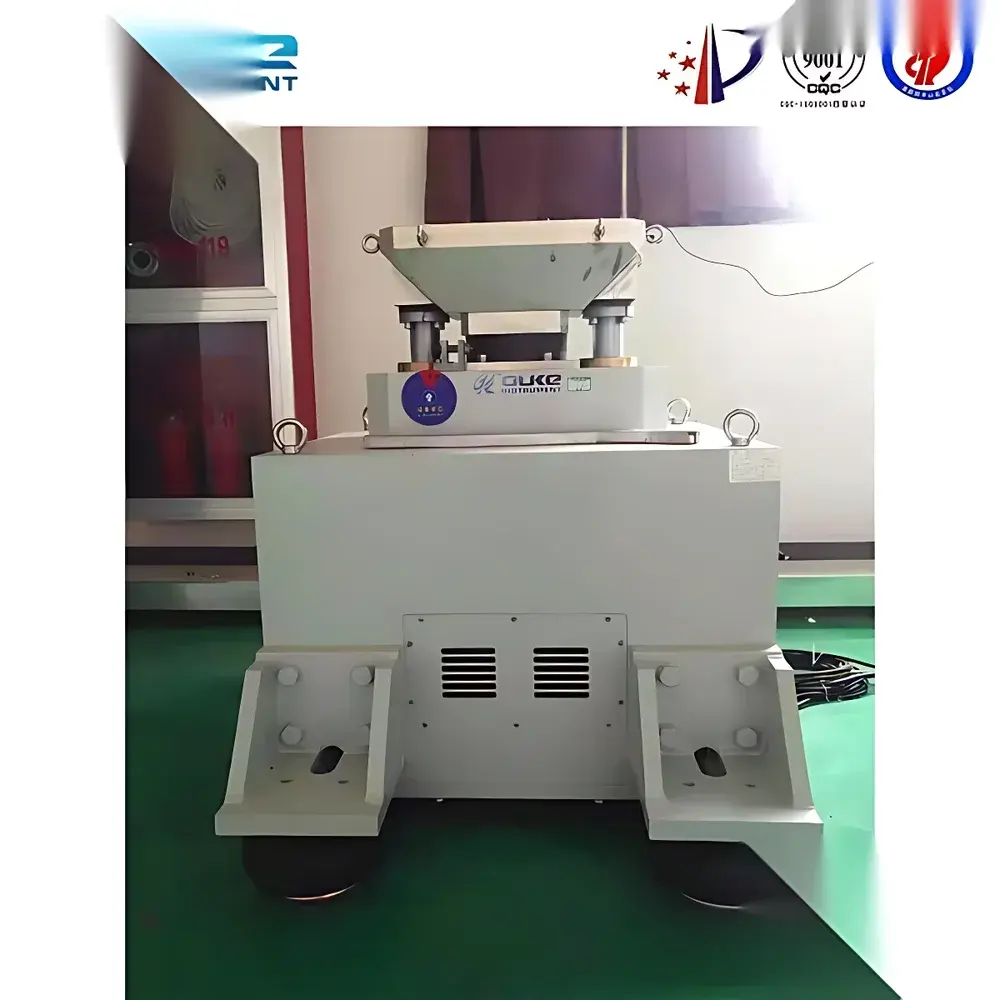
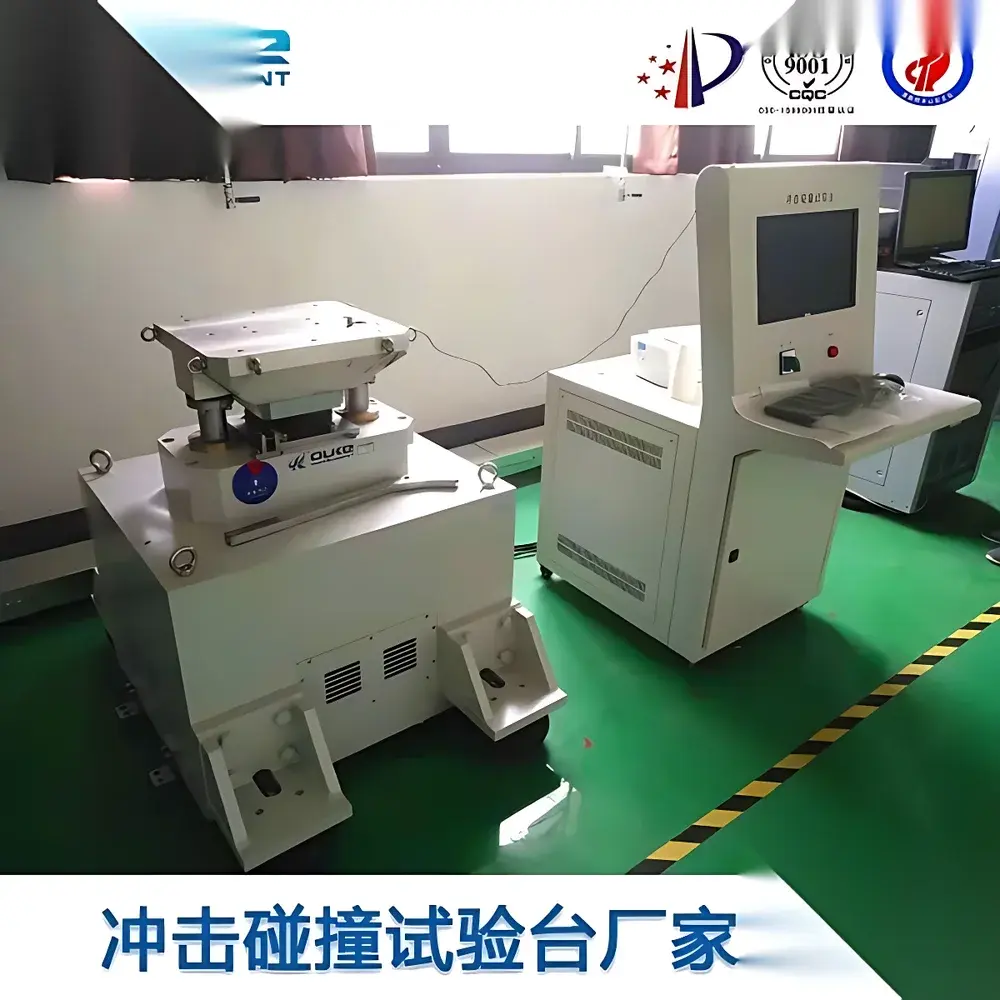
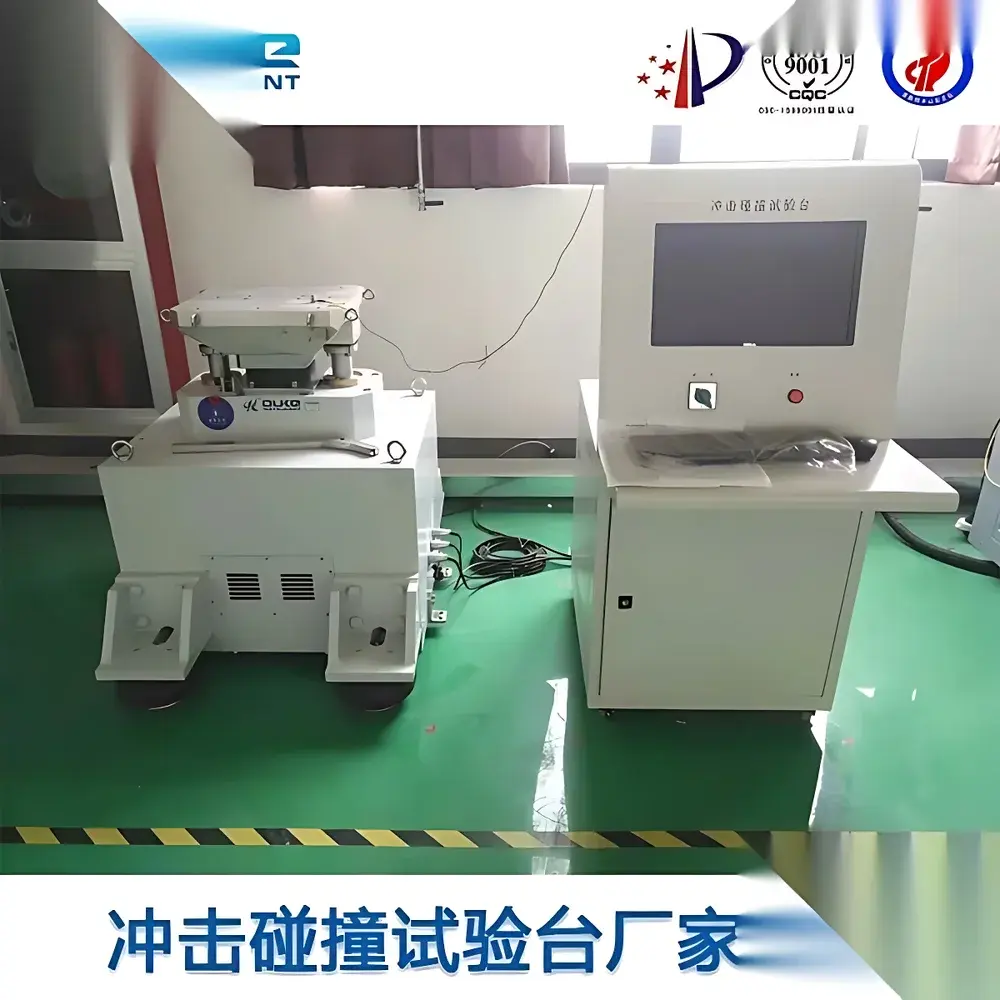
Shock Test Table OKPZ Series – Electromechanical Impact and Shock Testing System
| Brand | Other Brands |
|---|---|
| Origin | Imported |
| Manufacturer Type | Authorized Distributor |
| Price | USD 16,800 (FOB) |
| Compliance | MIL-STD-810, GJB150.18, IEC 60068-2-29, GB/T 2423.5–2022, GB/T 2423.6–2022 |
| Waveforms | Half-sine, Trapezoidal, Post-peak Sawtooth |
| Max Payload | 50–500 kg |
| Peak Acceleration Range | 25–1200 m/s² |
| Pulse Duration | 1.5–25 ms |
| Drop Height Adjustment | 0–200 mm |
| Repetition Rate | 1–120 impacts/min |
| Actuation | DC Motor + Gear Reducer + Roller Lift Mechanism |
| Control Mode | Closed-loop Acceleration Feedback for Collision Tests |
| Structural Rigidity | High-stiffness Cast-Iron Base & Reinforced Aluminum Alloy Table Surface |
| Air Supply | 7–8 kg/cm² (required for pneumatic damping & positioning) |
| Power Input | AC 220 V ±5%, 50 Hz ±0.5 Hz, Single-phase Three-wire |
Overview
The OKPZ Series Shock Test Table is an electromechanical impact and shock testing system engineered for precise, repeatable simulation of mechanical shock environments encountered during transportation, handling, and operational deployment of electronic, aerospace, automotive, and defense components. It operates on a controlled drop-and-impact principle: a DC motor drives a gear reducer and roller-lift mechanism to elevate the test table to a user-defined height; upon release, the table falls freely onto a calibrated elastomeric buffer pad, generating a half-sine acceleration pulse. The pulse shape, amplitude, and duration are deterministically controlled via three independent physical parameters—drop height (for acceleration magnitude), buffer material/thickness (for pulse width), and motor speed (for impact repetition frequency). This architecture eliminates reliance on compressed air or hydraulic accumulators, offering superior waveform repeatability, lower maintenance overhead, and intrinsic compliance with ISO/IEC 17025 traceability requirements for calibration laboratories.
Key Features
- Dual-mode operation supporting both shock testing (controlled spring-compression or drop-height initiation) and collision testing (repetitive impact under closed-loop acceleration control)
- High-rigidity structural design featuring a monolithic cast-iron base and precision-machined aluminum alloy table surface, ensuring uniform peak acceleration distribution across the entire platform (±5% spatial uniformity per GB/T 2423.5 Annex B)
- Real-time closed-loop acceleration feedback system for collision tests, achieving ≤±3% deviation from setpoint acceleration values across full operating range
- Expandable waveform generation capability: configurable mechanical interfaces support interchangeable buffer assemblies and optional auxiliary fixtures for trapezoidal and post-peak sawtooth pulse reproduction per IEC 60068-2-27 and MIL-STD-810H Method 516.8
- Integrated safety interlocks, emergency stop circuitry compliant with IEC 60204-1, and redundant mechanical limit switches prevent overtravel and unintended actuation
- Modular scalability across five standard models (OKPZ-50 to OKPZ-500), accommodating payloads from 50 kg to 500 kg and table dimensions up to 1000 mm × 1000 mm
Sample Compatibility & Compliance
The OKPZ Series accommodates rigidly mounted samples—including PCB assemblies, avionics enclosures, battery modules, and sensor housings—on flat, non-perforated mounting surfaces. All models meet electromagnetic compatibility (EMC) Class B limits per CISPR 11 and are certified for use in GLP-compliant environmental testing laboratories. Regulatory alignment includes full technical equivalence to MIL-STD-810H Method 516.8 (Shock), GJB150.18A–2019 (Chinese military standard for shock testing), IEC 60068-2-29 (Test Ea: Shock), and GB/T 2423.5–2022 and GB/T 2423.6–2022 (Chinese national standards for environmental testing of electric and electronic products). Calibration certificates are supplied with NIST-traceable accelerometer verification at three reference points per table surface.
Software & Data Management
The system integrates with optional PC-based control software supporting Windows 10/11 (64-bit), providing automated test sequencing, real-time acceleration waveform visualization, and post-test spectral analysis (FFT up to 10 kHz). All test parameters—including target acceleration, pulse width, drop height, repetition count, and pass/fail thresholds—are stored with timestamped metadata and operator ID. Audit trails comply with FDA 21 CFR Part 11 requirements when configured with electronic signature and role-based access control. Raw acceleration data is exportable in CSV and MATLAB .mat formats; reports conform to ISO/IEC 17025 documentation structure for accredited testing facilities.
Applications
- Qualification testing of airborne electronics per DO-160 Section 8 (Shock)
- Vibration and shock screening of automotive ECUs prior to road testing
- Reliability validation of lithium-ion battery packs under mechanical abuse conditions
- Design verification of packaging systems for military hardware transport
- Accelerated life testing of MEMS accelerometers and inertial measurement units (IMUs)
- Compliance verification for medical devices subject to IEC 60601-1 mechanical stress clauses
FAQ
What shock waveforms can the OKPZ Series generate natively?
The system produces half-sine pulses as standard. Trapezoidal and post-peak sawtooth waveforms require optional buffer kits and mechanical adapters—fully supported per IEC 60068-2-27 and MIL-STD-810H.
Is closed-loop acceleration control available for all models?
Yes—closed-loop collision testing is standard across OKPZ-100 through OKPZ-500. OKPZ-50 supports open-loop operation only.
Does the system require external cooling or exhaust ventilation?
No—electromechanical actuation generates negligible heat; ambient air convection suffices for thermal management.
Can the OKPZ table be integrated into an existing environmental test chamber?
Yes—custom flange-mounting options and low-profile base configurations (e.g., OKPZ-100-LP) enable integration with walk-in chambers meeting ISO 16750-4 dimensional constraints.
What calibration interval is recommended for accredited use?
Annual calibration is required per ISO/IEC 17025; interim verification using certified reference accelerometers is advised before each qualification test series.



