
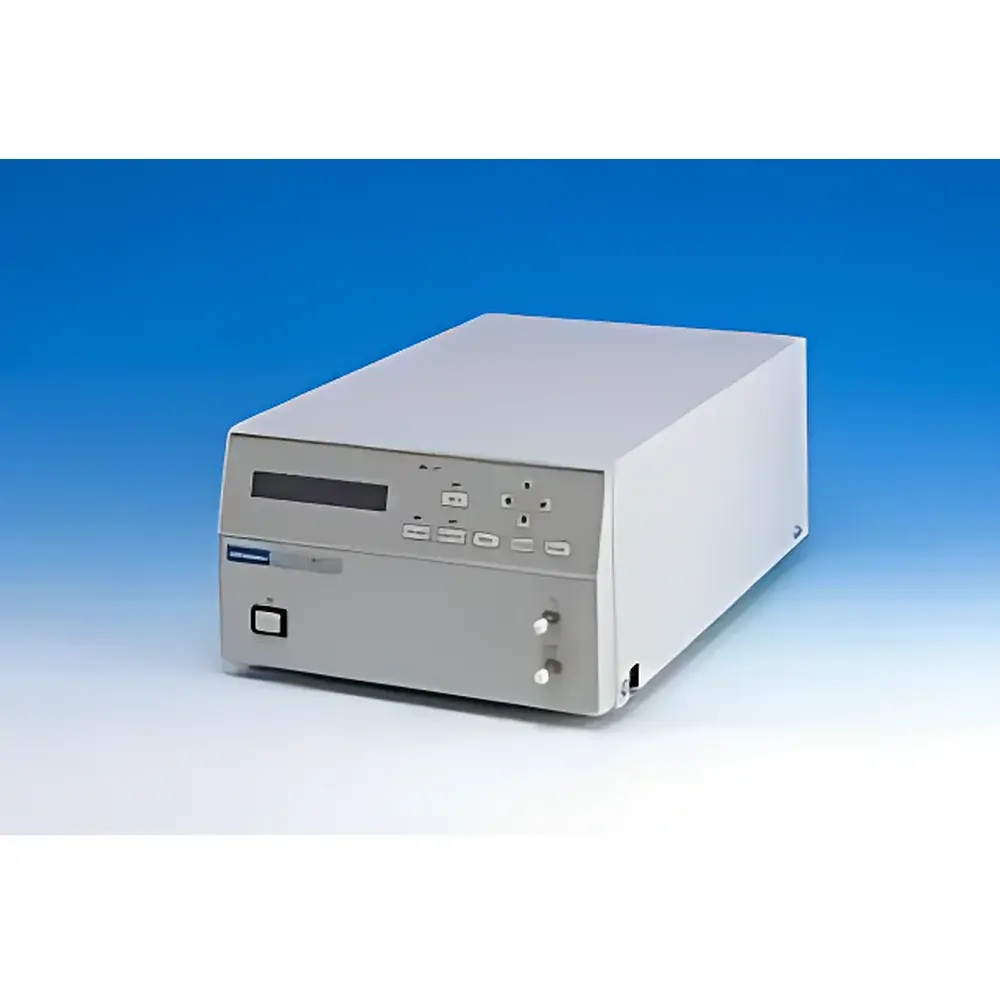
Shodex RI-201 Refractive Index Detector
| Brand | Shodex |
|---|---|
| Origin | Imported |
| Manufacturer Type | Authorized Distributor |
| Model | RI-201 |
| Instrument Type | Refractive Index Detector (RID) |
| Compatible System | HPLC |
| Refractive Index Range | 1.00–1.75 |
| Detection Range | 0.125–256 µRIU |
| Drift | ≤0.1 µRIU/h |
| Noise | ≤1 nRIU |
| Linear Range | ≥300 µRIU |
| Flow Rate (Typical) | 0.2–3.0 mL/min |
| Max Flow Rate (Water) | 10 mL/min |
| Cell Volume | 8 µL |
| Dead Volume (IN→Cell) | ~80 µL |
| Dead Volume (Cell→OUT) | ~600 µL |
| Total Dead Volume | ~690 µL |
| Temperature Control Range | 30–55 °C (1 °C increments), with dual-stage thermal regulation |
| Response Time Settings | 0.1, 0.25, 0.5, 1, 1.5, 2, 3, 6 s |
| Auto-Zero Function | Full-range, fully automatic |
| Offset Adjustment Range | ±5 µRIU |
| Offset Resolution | 25 nRIU |
| Analog Output | DC 0–1 V (4 mV/µRIU or 16 mV/µRIU selectable) |
| Recorder Output | 0–10 mV/FS |
| Communication Interface | USB |
| Wetted Materials | SUS316 Stainless Steel, PTFE, Quartz Glass |
| Power Supply | AC 100–240 V ±10%, 50/60 Hz, 150 VA |
| Dimensions & Weight | 260 × 400 × 150 mm (W×D×H), ~12 kg |
Overview
The Shodex RI-201 Refractive Index Detector is a high-stability, precision optical detector engineered for universal detection in liquid chromatography systems—particularly where analytes lack strong chromophores or ionizable functional groups. Unlike UV-Vis or fluorescence detectors, the RI-201 operates on the principle of differential refractive index measurement: it quantifies minute changes in the refractive index of the mobile phase as solutes elute from the column. This makes it indispensable for the analysis of carbohydrates, polymers, surfactants, alcohols, organic acids, and other non-absorbing compounds. Its core innovation lies in a three-chamber flow cell design that enables double light refraction—increasing optical sensitivity by over two-fold compared to conventional single-refraction RIDs. The resulting angular doubling reduces susceptibility to thermal noise and baseline drift, delivering enhanced signal-to-noise ratio and long-term stability under routine HPLC operation.
Key Features
- Triple-Chamber Flow Cell Architecture: Enables dual optical refraction within the detection path, boosting sensitivity ≥2× and reducing noise impact by up to 50% versus legacy designs.
- Dual-Stage Temperature Control: Independently regulated heating elements maintain precise cell temperature (30–55 °C, adjustable in 1 °C steps), minimizing thermal drift to ≤0.1 µRIU/h—even under ambient fluctuations.
- Ultra-Low Detection Limit: Achieves sub-nanogram detection for carbohydrates (e.g., ~2 ng glucose under optimized conditions), supporting trace-level quantification in oligosaccharide and polysaccharide profiling.
- Configurable Response Dynamics: Eight discrete response time settings (0.1–6 s) allow optimization for either high-resolution separation or rapid screening applications without hardware modification.
- Full-Range Auto-Zero Calibration: Fully automated baseline reset across the entire detection range (0.125–256 µRIU), eliminating manual offset adjustment and ensuring reproducible startup behavior.
- Robust Fluidic Design: 8 µL quartz-glass flow cell with SUS316 and PTFE wetted surfaces ensures chemical compatibility with aggressive solvents (e.g., THF, chloroform, DMF) and resistance to corrosion in aqueous and mixed-phase HPLC methods.
Sample Compatibility & Compliance
The RI-201 supports broad solvent compatibility—including water, acetonitrile, methanol, tetrahydrofuran, and chlorinated organics—making it suitable for SEC/GPC, HILIC, and normal-phase applications. Its refractive index measurement range (1.00–1.75) accommodates both aqueous and organic mobile phases. While refractive index detection is inherently non-destructive and universal, method validation must account for solvent composition gradients; therefore, the detector is routinely deployed in isocratic or shallow-gradient modes. For regulated environments, the RI-201’s stable thermal architecture and full-range auto-zero support GLP-compliant system suitability testing. Though the detector itself does not embed 21 CFR Part 11 audit trail functionality, its analog and USB outputs integrate seamlessly with validated chromatography data systems (CDS) that provide electronic record integrity, user access control, and change history logging per FDA and ISO/IEC 17025 requirements.
Software & Data Management
The RI-201 communicates via standard USB interface, enabling plug-and-play integration with major third-party chromatography software platforms (e.g., Waters Empower, Agilent OpenLab CDS, Shimadzu LabSolutions). It provides dual analog outputs: a primary DC 0–1 V signal (with selectable sensitivities of 4 or 16 mV/µRIU) for direct connection to integrators or legacy recorders, and a secondary 0–10 mV/FS output for auxiliary monitoring. Status signals—including READY (thermal stabilization achieved), LEAK (pressure anomaly detected), and ERROR (covering ROM/RAM integrity, parameter corruption, home position fault, overheat, optical balance deviation, or LED intensity loss)—are relayed through dedicated TTL-compatible digital lines. No embedded firmware-based control software is included; all operational parameters are configured externally via host CDS or optional Shodex-provided utility tools compliant with Windows OS environments.
Applications
- Quantitative analysis of mono-, di-, and oligosaccharides in food, pharmaceutical, and biotech matrices
- Molecular weight distribution profiling of synthetic and natural polymers (e.g., PEG, dextran, cellulose derivatives) via SEC/GPC
- Stability-indicating assays for non-UV-active excipients and degradation products
- Process monitoring of fermentation broths and hydrolysis reactions
- Method development support for HILIC separations of polar metabolites
- Complementary detection in multi-detector HPLC setups (e.g., RI + MALS or RI + UV)
FAQ
Is the RI-201 compatible with UHPLC systems?
Yes—though optimized for standard HPLC flow rates (0.2–3.0 mL/min), the detector accepts up to 10 mL/min with water and maintains low dead volume (<690 µL total), enabling use with low-dispersion UHPLC configurations when paired with appropriate low-volume connectors and zero-dead-volume unions.
Can the RI-201 be used with gradient elution?
Refractive index detection is highly sensitive to mobile phase composition changes; thus, gradients require careful solvent matching and post-column mixing compensation. Isocratic or very shallow gradients (<1% B/min) are recommended for optimal baseline stability.
What maintenance is required for long-term performance?
Routine maintenance includes periodic inspection of the flow cell for particulate buildup, verification of thermal calibration using certified reference standards, and replacement of inlet/outlet tubing per manufacturer-recommended intervals (typically every 6–12 months under continuous use).
Does the RI-201 support remote diagnostics or firmware updates?
No—firmware is fixed at manufacture. Diagnostic status is conveyed exclusively via hardware I/O signals (READY, LEAK, ERROR); no remote update capability or network connectivity is provided.
How does the dual-temperature control differ from single-zone systems?
The RI-201 employs independent heating elements for the optical block and flow cell housing, decoupling thermal mass effects and suppressing convective artifacts—critical for achieving sub-0.1 µRIU/h drift specifications in variable-lab environments.
Related Products





