
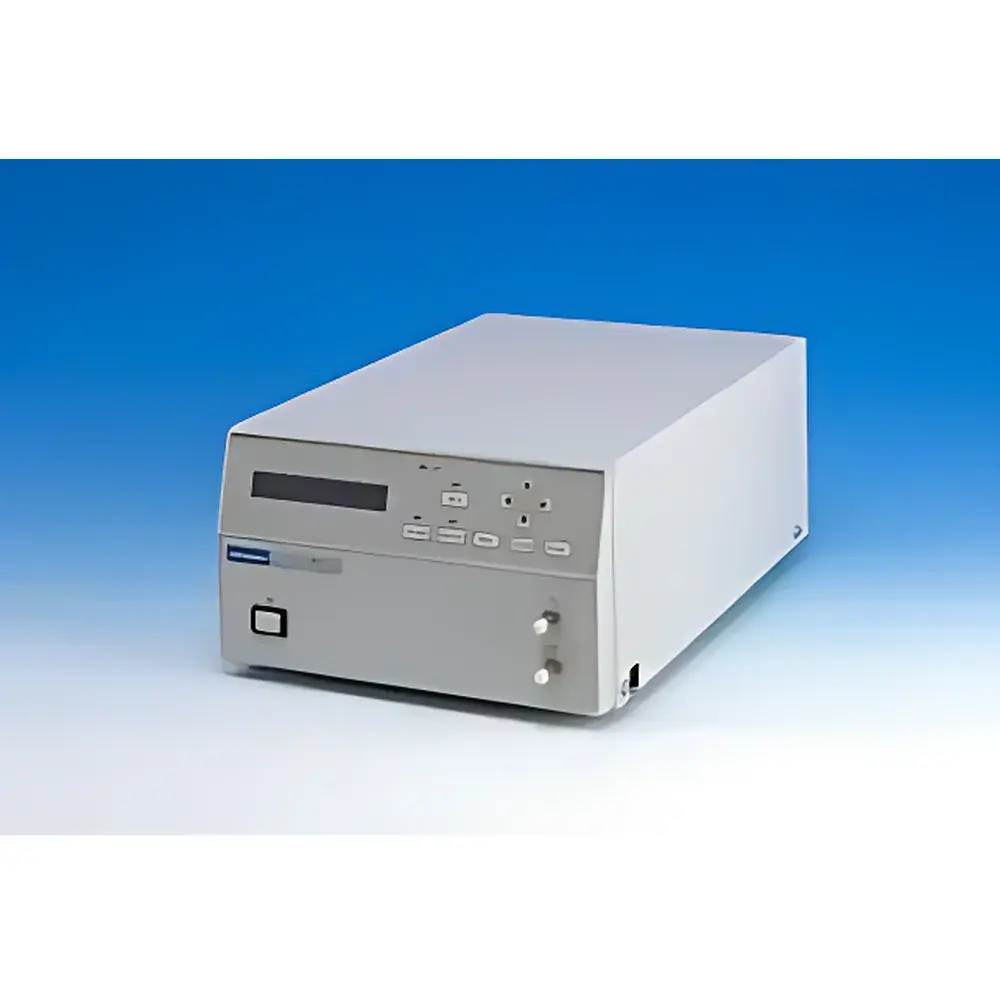
Shodex RI-201H Refractive Index Detector
| Brand | Shodex |
|---|---|
| Origin | Imported |
| Manufacturer Type | Authorized Distributor |
| Model | RI-201H |
| Instrument Type | Refractive Index Detector (RID) |
| Compatible System | High-Performance Liquid Chromatography (HPLC) |
| Refractive Index Range | 1.00–1.75 |
| Detection Range | 0.25–512 μRIU |
| Drift | ≤0.2 μRIU/h (deionized water, 1 mL/min, purge off) |
| Linearity | ≥600 μRIU |
| Noise | ≤2.5 nRIU (deionized water, 1.5 s response) |
| Response Time Settings | 0.1, 0.25, 0.5, 1, 1.5, 2, 3, 6 s |
| Auto-Zero | Full-range automatic zeroing |
| Offset Adjustment Range | ±10 μRIU |
| Offset Resolution | 50 nRIU |
| Cell Volume | 8 µL |
| Flow Rate Range | 0.2–3.0 mL/min (typical), up to 10 mL/min (water) |
| Max Backpressure | 50 kPa |
| Internal Dead Volume | IN→Cell ≈60 µL |
| Temperature Control | OFF, 30–55 °C (1 °C increments), 77 °C thermal cutoff |
| Interface | USB |
| Wetted Materials | SS316, PTFE, fused silica |
| Power | AC 100–240 V ±10%, 50/60 Hz, 150 VA |
| Dimensions & Weight | 260 × 400 × 150 mm (W×D×H), ~12 kg |
Overview
The Shodex RI-201H is a high-stability, laboratory-grade refractive index detector engineered for universal detection in liquid chromatography systems—particularly where analytes lack chromophores or UV absorbance. Operating on the principle of differential refractometry, the RI-201H measures minute changes in the refractive index of the mobile phase as eluting compounds pass through a precision-machined optical flow cell. Its three-chamber flow cell design enhances optical path stability and signal-to-noise ratio, delivering over twofold sensitivity improvement compared to conventional two-chamber RIDs. This architecture minimizes baseline drift caused by solvent composition shifts or temperature gradients, making it especially suitable for gradient-elution HPLC applications involving carbohydrates, polymers, surfactants, and other non-UV-active species.
Key Features
- Triple-chamber optical flow cell for enhanced sensitivity and reduced thermal drift
- Dual-stage thermostatic control (ambient + internal heater) ensures stable operation across ambient fluctuations
- Full-range automatic zeroing with programmable offset adjustment (±10 μRIU) and 50 nRIU resolution
- Eight selectable response times (0.1–6 s), enabling optimization for speed vs. noise performance
- Low dead volume design: total system volume ≈670 µL (IN→Cell: 60 µL; Cell→OUT: 600 µL), compatible with standard HPLC tubing and low-dispersion connections
- Robust wetted materials: 316 stainless steel, PTFE, and fused silica ensure chemical compatibility with aqueous, organic, and mildly aggressive mobile phases
- Integrated safety features including thermal fuse (77 °C cutoff), leak detection output, and comprehensive error diagnostics (ROM/RAM integrity, optical balance, intensity monitoring)
Sample Compatibility & Compliance
The RI-201H supports broad-spectrum detection of non-volatile and semi-volatile solutes—including mono-/di-/oligosaccharides, polyethylene glycols, dextrans, cellulose derivatives, and synthetic polymers—without derivatization. Its refractive index range (1.00–1.75) accommodates common HPLC solvents (water, acetonitrile, THF, DMF) and mixed-phase eluents. While refractive index detection is inherently non-destructive and universally responsive, users must maintain strict mobile phase consistency during gradient runs to avoid bulk RI shifts. The detector complies with general laboratory instrumentation safety standards (IEC 61010-1) and supports GLP/GMP-aligned workflows via deterministic output signals (0–1 V DC, 0–10 mV FS) and traceable calibration protocols. Though not FDA 21 CFR Part 11–certified out-of-the-box, its stable analog outputs and USB interface facilitate integration into validated chromatographic data systems with audit-trail capability.
Software & Data Management
The RI-201H operates as a standalone analog detector with no embedded software or touchscreen interface. It delivers calibrated voltage outputs directly to integrators, chart recorders, or modern chromatography data systems (CDS) via its 0–1 V DC analog port (configurable sensitivity: 2 or 8 mV/μRIU) and 0–10 mV FS recorder output. USB connectivity enables firmware-level status interrogation and diagnostic logging—though real-time parameter configuration or remote control requires external CDS support. All operational states (READY, LEAK, ERROR codes) are communicated via discrete TTL-level digital outputs, supporting automated system interlocks and fault logging in regulated environments. For routine QC, the unit’s low drift (≤0.2 μRIU/h) and reproducible auto-zero function reduce recalibration frequency and support long-duration unattended runs.
Applications
- Carbohydrate analysis in food, beverage, and pharmaceutical QC (e.g., glucose, sucrose, lactose, maltodextrins)
- Molecular weight distribution profiling of synthetic and natural polymers via SEC/GPC
- Surfactant quantification in cleaning formulations and personal care products
- Quality control of PEGylated biopharmaceuticals and excipient blends
- Method development for non-UV-absorbing impurities in API synthesis pathways
- Environmental analysis of glycols, alcohols, and organic acids in aqueous matrices
FAQ
Is the RI-201H compatible with gradient HPLC methods?
Yes—its triple-chamber flow cell and dual-zone temperature control significantly suppress baseline drift during solvent gradient elution, though optimal performance requires careful mobile phase degassing and temperature equilibration.
What is the minimum detectable mass for sucrose under standard conditions?
Approximately 2 ng on-column (based on 8 µL cell volume, 1 mL/min flow, and typical HPLC injection volumes), consistent with published Shodex application notes for carbohydrate analysis.
Can the detector be used with THF or chloroform-based mobile phases?
Yes—wetted components (SS316, PTFE, fused silica) are chemically resistant to common GPC solvents; however, extended exposure to halogenated solvents may require more frequent optical alignment verification.
Does the RI-201H support Ethernet or RS-232 communication?
No—only USB (for diagnostics/status) and analog/digital I/O ports are provided; networked control requires external hardware interfacing.
How often is manual recalibration recommended?
Under stable lab conditions and routine use, annual calibration verification against certified RI standards (e.g., sucrose solutions) is sufficient; auto-zero functionality maintains daily baseline fidelity without user intervention.




