
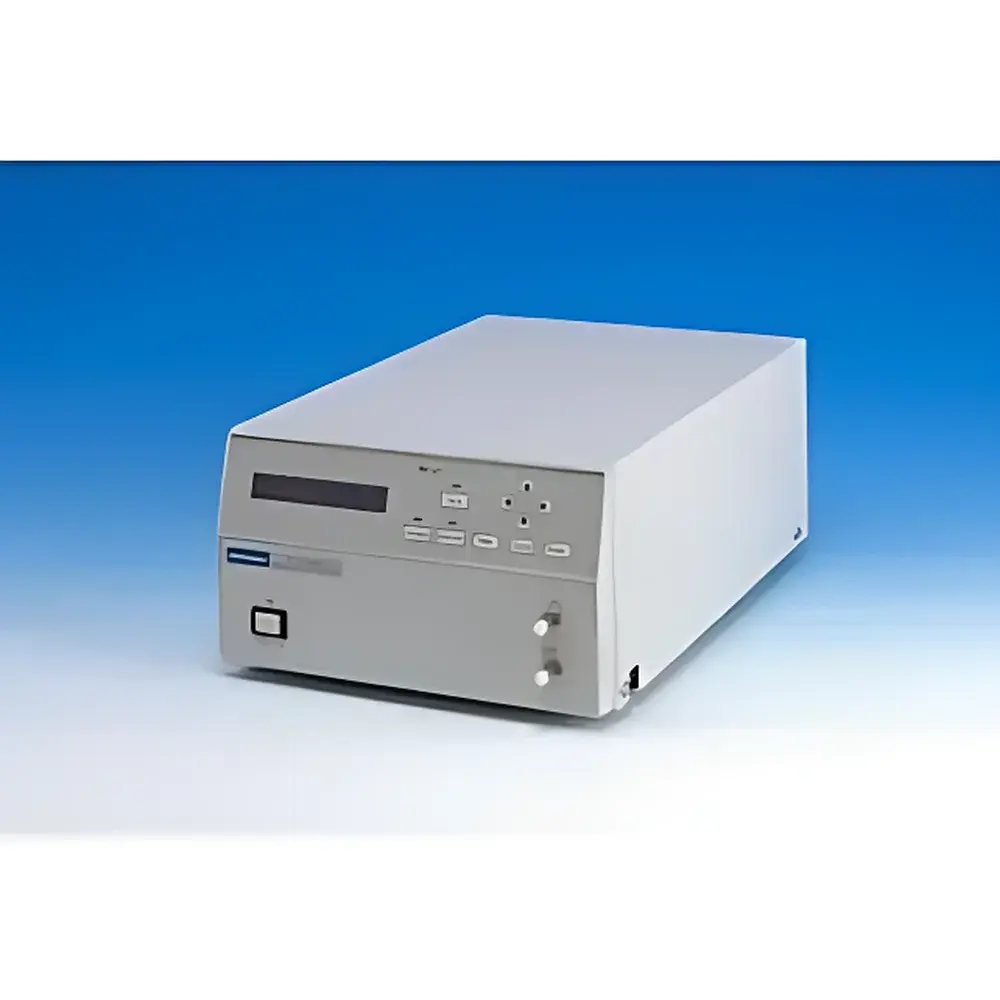
Shodex RI-201H Refractive Index Detector
| Brand | Shodex |
|---|---|
| Origin | Japan |
| Manufacturer Type | Original Equipment Manufacturer (OEM) |
| Product Category | Imported Instrument |
| Model | RI-201H |
| Detection Principle | Differential Refractive Index (dRI) |
| Compatible System | High-Performance Liquid Chromatography (HPLC) |
| Detector Type | Refractometer-Based Chromatographic Detector |
| Flow Cell Design | Dual-Chamber |
| Refractive Index Range | 1.00–1.75 |
| Detection Sensitivity Range | 0.25–512 µRIU |
| Baseline Drift | ≤0.2 µRIU/h (deionized water, 1 mL/min, purge off) |
| Linearity | ≥600 µRIU |
| Noise Level | ≤2.5 nRIU (deionized water, 1.5 s response time) |
| Response Time Settings | 0.1, 0.25, 0.5, 1, 1.5, 2, 3, 6 s |
| Auto-Zero Function | Full-range automatic zeroing |
| Offset Adjustment Range | ±10 µRIU |
| Offset Resolution | 50 nRIU |
| Analog Output | DC 0–1 V (2 mV/µRIU or 8 mV/µRIU selectable) |
| Flow Cell Volume | 8 µL |
| Recommended Flow Rate | 0.2–3.0 mL/min |
| Maximum Flow Rate | 10 mL/min (water) |
| Maximum Backpressure | 50 kPa |
| Dead Volume | IN→Cell ≈ 60 µL |
| Recorder Output | 0–10 mV full scale |
| External I/O Signals | READY, LEAK, ERROR (ROM/RAM/Parameter/Home Position/Overheat/Optical Balance/Intensity) |
| Temperature Control | Off, 30–55 °C (1 °C increments), thermal fuse at 77 °C |
| Interface | USB |
| Wetted Materials | ASTM F899 stainless steel 316, PTFE, fused silica quartz |
| Power Supply | AC 100–240 V ±10%, 50/60 Hz, max. 150 VA |
| Dimensions & Weight | 260 × 400 × 150 mm (W×D×H), approx. 12 kg |
Overview
The Shodex RI-201H is a high-stability differential refractive index (dRI) detector engineered for integration into analytical and preparative liquid chromatography systems. Operating on the principle of Snell’s law, it measures minute changes in the refractive index of eluent streams induced by solute concentration gradients—enabling universal, non-destructive detection of compounds lacking chromophores or electrochemical activity. Unlike UV-Vis or fluorescence detectors, the RI-201H delivers consistent response across a broad range of organic and inorganic analytes—including sugars, polymers, alcohols, glycols, and surfactants—without requiring derivatization or specialized mobile phase conditions. Its dual-chamber flow cell design ensures robust baseline stability by actively compensating for solvent composition drift and temperature-induced refractive index fluctuations. The detector supports isocratic and gradient HPLC methods, with optimized thermal management and low-noise optical electronics to meet the reproducibility requirements of quantitative analysis in regulated environments.
Key Features
- Dual-chamber flow cell with 8 µL detection volume, fabricated from fused silica quartz, PTFE, and ASTM F899 stainless steel 316 for chemical inertness and long-term reliability.
- Adjustable response time (0.1–6 s) with eight discrete settings to balance signal resolution and peak fidelity across diverse separation speeds.
- Full-range automatic zeroing algorithm that recalibrates baseline without manual intervention, minimizing downtime during method development or routine operation.
- Thermostatic control (30–55 °C, 1 °C step resolution) with integrated thermal fuse (77 °C cutoff) to stabilize optical path length and suppress thermal noise.
- Low intrinsic noise (≤2.5 nRIU) and high sensitivity (down to 0.25 µRIU) achieved via precision-aligned LED light source and balanced photodiode detection architecture.
- USB interface compliant with standard HID protocols for seamless integration with third-party chromatography data systems (CDS) and LIMS platforms.
- Comprehensive hardware-level fault monitoring: real-time diagnostics for leak, overtemperature, optical imbalance, memory integrity (ROM/RAM), parameter corruption, and home-position verification.
Sample Compatibility & Compliance
The RI-201H is compatible with common HPLC mobile phases—including aqueous buffers, alcohols, acetonitrile, THF, and chlorinated solvents—provided system backpressure remains below 50 kPa. Its wetted-path materials comply with ISO 8536-4 (glass containers for pharmaceuticals) and USP for polymeric components. While not intrinsically GMP-certified, the detector supports GLP/GMP workflows through audit-ready operational logs (when paired with compliant CDS software), traceable calibration records, and configurable electronic signatures per FDA 21 CFR Part 11 requirements. It meets IEC 61010-1 safety standards for laboratory electrical equipment and conforms to electromagnetic compatibility (EMC) directives EN 61326-1 and EN 61000-6-3.
Software & Data Management
The RI-201H operates as a plug-and-play analog detector: no proprietary driver installation is required. Its DC 0–1 V analog output (scalable at 2 or 8 mV/µRIU) interfaces directly with legacy integrators and modern CDS platforms supporting analog input channels. Digital status signals (READY, LEAK, ERROR) enable automated system interlock logic—for example, halting pump operation upon leak detection or pausing acquisition during thermal fault events. When used with compliant chromatography software, raw dRI signals can be timestamped, archived with full metadata (flow rate, temperature setpoint, response time), and subjected to second-derivative smoothing or baseline correction algorithms without loss of traceability. All configuration parameters are stored in non-volatile memory with checksum validation to prevent corruption.
Applications
- Quantitative analysis of carbohydrates (e.g., glucose, sucrose, oligosaccharides) in food, beverage, and biofuel matrices per AOAC 982.21 and ISO 16654.
- Molecular weight distribution profiling of synthetic and natural polymers (e.g., polystyrene, PEG, cellulose derivatives) via SEC/GPC using universal calibration.
- Residual solvent quantification in pharmaceutical intermediates under ICH Q3C guidelines.
- Quality control of surfactant formulations where UV transparency precludes conventional detection.
- Process analytical technology (PAT) applications requiring real-time, non-invasive concentration monitoring in continuous chromatography or simulated moving bed (SMB) systems.
FAQ
Is the RI-201H compatible with UHPLC systems?
Yes, provided the system operates within its maximum backpressure limit (50 kPa) and flow rate range (0.2–3.0 mL/min typical; up to 10 mL/min with water). Note that dead volume (≈670 µL) may broaden peaks at sub-2 µm particle separations.
Can the detector operate without temperature control?
Yes—the thermostat can be disabled (OFF mode), but uncontrolled ambient fluctuations will increase baseline drift and compromise quantitative precision. ISO 21748 recommends active temperature stabilization for dRI measurements requiring ≤1% RSD.
What maintenance is required for long-term stability?
Annual verification of optical alignment and zero-point repeatability is recommended. Flow cell cleaning with appropriate solvents (e.g., 50% isopropanol/water for carbohydrate residues) should follow each use with viscous or high-molecular-weight samples.
Does the RI-201H support data export in CSV or ASCII format?
The detector itself does not store or export data; however, when connected to compliant CDS software (e.g., Empower, Chromeleon, OpenLab), raw analog signals are digitized and exportable in standard formats including .csv, .txt, and .cdf.
How is calibration performed?
Calibration is conducted using certified sucrose or sodium chloride solutions of known refractive index increment (dn/dc). A minimum of three concentrations spanning the linear range (≥600 µRIU) is recommended per ASTM D5296 and ISO 16014-4 protocols.




