
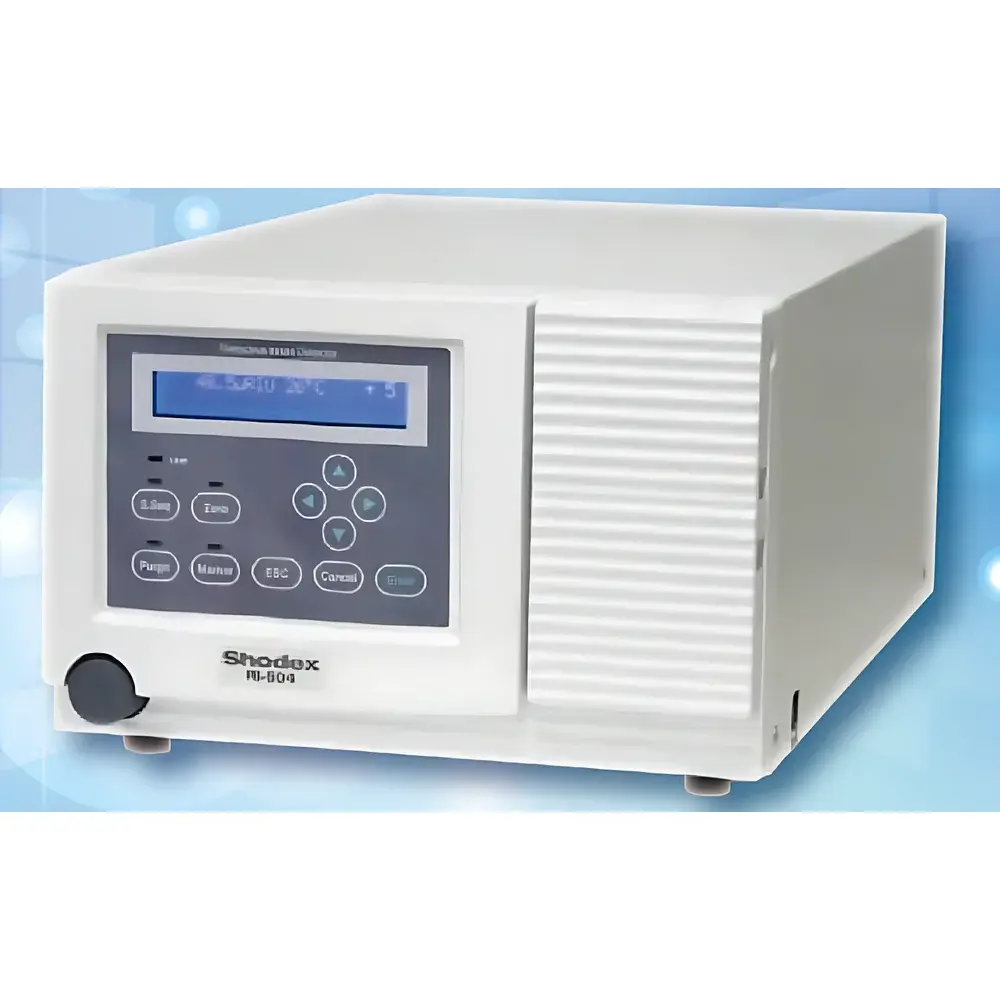
Shodex RI-500 Series Differential Refractometer
| Brand | Shodex |
|---|---|
| Origin | Japan |
| Manufacturer Type | Original Equipment Manufacturer (OEM) |
| Product Category | Imported Instrument |
| Models | RI-501, RI-502, RI-504 |
| Detection Principle | Differential Refractive Index (dRI) |
| Light Source | Deuterium Lamp |
| Temperature Control | Dual-zone thermostatic control (30–55 °C) |
| Flow Rate Range | 0.2–3.0 mL/min (RI-501/RI-504), 1–50 mL/min (RI-502) |
| Cell Volume | 8 μL (RI-501/RI-502), 2.5 μL (RI-504) |
| Noise Level | ≤2.5 nRIU (RI-501), ≤25 nRIU (RI-502), ≤5 nRIU (RI-504) |
| Drift | ≤0.2 μRIU/h (RI-501/RI-504), ≤2 μRIU/h (RI-502) |
| Response Time | Adjustable from 0.1 to 6 s |
| Output Interface | LAN, Analog (0–1 V, 0–10 mV/FS), Digital I/O (READY/LEAK/ERROR) |
| Wetted Materials | SUS316 Stainless Steel, PTFE, Fused Silica |
| Compliance | CE Marked, RoHS Compliant |
Overview
The Shodex RI-500 Series Differential Refractometer is a high-stability, precision optical detector engineered for universal detection in liquid chromatography systems—particularly gel permeation chromatography (GPC), size-exclusion chromatography (SEC), and preparative HPLC applications. Operating on the principle of differential refractive index measurement, the instrument detects solute concentration changes by comparing the refractive index of the eluent stream against a reference stream within a dual-chamber flow cell. This label-free, non-destructive detection method provides consistent response across all analytes lacking strong UV absorbance—including polysaccharides, polymers, surfactants, and small-molecule alcohols—making it indispensable for molecular weight distribution analysis and formulation QC where UV-inactive compounds dominate.
Key Features
- Dual-zone temperature control system ensures rapid thermal equilibration (<15 min) and exceptional baseline stability (drift ≤0.2 μRIU/h), critical for extended GPC runs and multi-hour preparative fraction collection.
- Integrated safety pressure relief valve protects the optical cell from overpressure events during pump startup or column blockage; leak detection sensor triggers immediate system alert via dedicated digital output (LEAK signal).
- Automated optical + computational zeroing routine performs real-time baseline correction at user-defined intervals or upon system initialization, eliminating manual drift compensation and enhancing inter-run reproducibility.
- Liquid-cooled, fused silica flow cells (8 μL standard, 2.5 μL micro-cell option) deliver low dispersion, minimal band broadening, and compatibility with both analytical and semi-preparative flow regimes (0.2–50 mL/min).
- Leverages deuterium lamp illumination for stable, low-noise broadband light output across the visible–near-UV spectrum (190–400 nm), ensuring consistent sensitivity independent of solvent UV cutoff limitations.
- Native Ethernet (LAN) interface enables seamless integration into modern chromatography data systems (CDS), supporting remote configuration, real-time status monitoring, and audit-trail-capable firmware logging per GLP/GMP requirements.
Sample Compatibility & Compliance
The RI-500 Series accommodates a broad range of mobile phases—including aqueous buffers, THF, chloroform, DMF, and mixed organic/aqueous systems—without requiring derivatization or post-column reaction. All wetted surfaces are constructed from chemically inert materials: ASTM F519-grade SUS316 stainless steel, PTFE tubing, and fused silica optical windows—ensuring long-term resistance to hydrolysis, oxidation, and halogenated solvent attack. The instrument complies with EU Directive 2014/30/EU (EMC), 2014/35/EU (LVD), and RoHS 2011/65/EU. CE marking confirms conformity with essential health and safety requirements for laboratory instrumentation deployed in regulated environments under ISO/IEC 17025 and FDA 21 CFR Part 11–aligned workflows.
Software & Data Management
Control and acquisition are managed via Shodex’s proprietary ChromNAV-compatible driver suite, supporting bidirectional communication with major CDS platforms (e.g., Waters Empower, Agilent OpenLab, Thermo Chromeleon). Raw dRI signals are digitized at 100 Hz with 16-bit resolution and timestamped to ±1 ms accuracy. All analog outputs (0–1 V, 0–10 mV/FS) and discrete I/O states (READY/LEAK/ERROR) are logged with full traceability—including operator ID, method name, and firmware revision—in encrypted binary archives compliant with ALCOA+ data integrity principles. Audit trails record parameter changes, zeroing events, and calibration history, satisfying GLP audit requirements for QC laboratories operating under USP , ISO 13877, and ASTM D5296 protocols.
Applications
- Molecular weight distribution analysis of synthetic polymers (PS, PMMA, PE, PEO) and natural biopolymers (cellulose, chitosan, hyaluronic acid) via SEC/GPC.
- Quantitative determination of non-UV-absorbing excipients (e.g., glycerol, propylene glycol, polysorbates) in pharmaceutical formulations.
- Process monitoring of carbohydrate hydrolysis, enzymatic synthesis, and fermentation broths in bioprocessing R&D.
- Preparative LC fraction verification where UV detection fails due to low extinction coefficients or solvent interference.
- Stability-indicating assays for degradation products lacking chromophores—complementing UV and MS detection in forced degradation studies.
FAQ
What is the minimum detectable refractive index change (Δn) for the RI-501 model?
The RI-501 achieves a noise floor of ≤2.5 nRIU (rms, water, 1.5 s response), corresponding to a typical minimum detectable Δn of ~5 × 10⁻⁹ under optimized flow and temperature conditions.
Can the RI-504 micro-cell be used with standard analytical HPLC systems?
Yes—the 2.5 μL flow cell is compatible with conventional 4.6 mm ID columns at flow rates of 0.2–1.0 mL/min; dead volume (IN→CELL: 10 μL) is minimized to preserve peak resolution without requiring specialized low-dispersion interfaces.
Does the instrument support 21 CFR Part 11 compliance out-of-the-box?
While the hardware includes secure user authentication, electronic signatures, and immutable audit trails, full 21 CFR Part 11 compliance requires deployment within a validated CDS environment (e.g., Empower 3 with Security Pack) and documented site-specific SOPs.
Is the deuterium lamp field-replaceable, and what is its rated lifetime?
Yes—the lamp module is user-serviceable without optical realignment; typical operational lifetime exceeds 2,000 hours at nominal intensity settings.
How does dual-zone temperature control improve chromatographic reproducibility?
Independent regulation of detector body and flow cell zones eliminates thermal gradients across the optical path, reducing refractive index fluctuations caused by ambient drafts or column oven heat bleed—directly improving retention time stability and peak area RSDs in multi-day sequences.




