
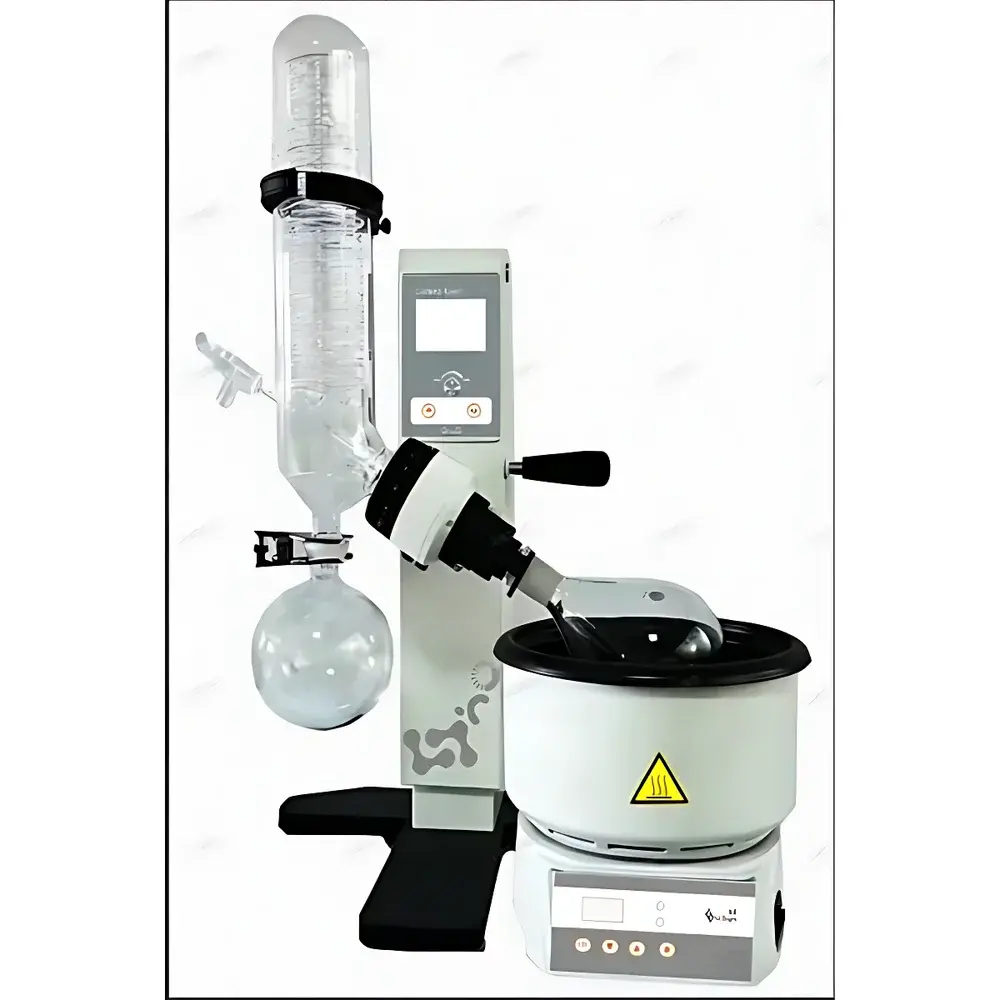
ShoLyn LynVap Basic Rotary Evaporator
| Brand | ShoLyn |
|---|---|
| Origin | Shanghai, China |
| Model | LynVap Basic |
| Capacity | 1 L |
| Ultimate Vacuum | 8–10 mbar (dependent on paired vacuum pump) |
| Rotation Speed | 0–300 rpm |
| Bath Temperature Range | Ambient to 99 °C (optional ambient to 180 °C) |
| Temperature Control Accuracy | ±1 °C |
| Condenser Surface Area | 0.15 m² |
Overview
The ShoLyn LynVap Basic Rotary Evaporator is an engineered solution for efficient, reproducible solvent removal under reduced pressure in research and quality control laboratories. Based on the fundamental principle of rotary evaporation—where reduced pressure lowers the boiling point of solvents while controlled bath heating and continuous rotation increase surface area and mass transfer—the LynVap Basic delivers consistent performance in standard distillation, concentration of heat-sensitive compounds, crystallization initiation, powder drying, and multi-solvent separation. Its design prioritizes operational safety, mechanical stability, and compatibility with routine analytical workflows, including sample preparation for GC, HPLC, and LC-MS analysis. The system operates within a robust aluminum alloy frame and stainless-steel water/oil bath (230 × 135 mm), supporting GG-17 borosilicate glassware assemblies—including a 1 L pear-shaped rotating flask (Φ131 mm, standard 29/35 joints) and a 1 L spherical receiving flask.
Key Features
- Stable base architecture with reinforced aluminum alloy support structure, minimizing vibration during extended operation at variable rotational speeds (0–300 rpm).
- Patented Teflon- and fluororubber-sealed bottle ejection mechanism enabling rapid, tool-free removal of the rotating flask without compromising vacuum integrity.
- Motor-driven vertical lift system with 130 mm travel range; enables single-hand operation and automatic flask elevation upon rotation stop—preventing post-evaporation thermal degradation of residues.
- Rotation shaft with mechanical damping buffer to suppress abrupt acceleration/deceleration effects, reducing seal wear and axial misalignment over time.
- Superior temperature regulation via adaptive fuzzy PID algorithm, maintaining bath setpoints within ±1 °C across the full ambient-to-99 °C range (optionally ambient-to-180 °C with high-temp oil bath).
- Vertical condenser (80 × 450 mm) constructed from GG-17 glass, delivering 0.15 m² effective cooling surface area and optimized vapor path geometry for high condensation efficiency.
- Dual-mode control interface: 5-inch resistive touchscreen display with real-time dual-parameter readout (vacuum level and rotation speed), supplemented by physical rotary knobs for tactile precision during critical adjustments.
Sample Compatibility & Compliance
The LynVap Basic accommodates standard GG-17 glassware configurations compliant with ISO 385 and DIN 12350 specifications. Its sealed condenser assembly and fluoropolymer–fluoroelastomer dual gasket system ensure leak-tight operation under sustained vacuum conditions down to 8 mbar. While not certified to IEC 61010-1 or UL 61010B as a standalone unit, the system meets general laboratory equipment safety requirements when used with CE-marked auxiliary devices (e.g., LynVac-20/40 diaphragm pumps, LynCool-320R recirculating chillers). All electrical components adhere to 220 V / 50 Hz input standards. The absence of built-in vacuum programming or audit trail functionality means the system is suitable for non-GxP environments; users requiring 21 CFR Part 11 compliance must integrate external validated vacuum controllers and data logging systems.
Software & Data Management
The LynVap Basic operates without embedded software or network connectivity. All parameters—rotation speed, bath temperature, and real-time vacuum indication (when paired with an analog vacuum gauge)—are displayed locally on the 5-inch resistive touchscreen. No firmware updates, cloud synchronization, or remote configuration are supported. Data recording requires manual entry or external instrumentation interfacing (e.g., digital vacuum transducers with analog output connected to a DAQ system). For labs requiring traceability, third-party SCADA or LabVantage integration is feasible via 4–20 mA or 0–10 V analog signal outputs (available on optional upgraded models only).
Applications
- Routine concentration of organic extracts in natural product isolation and phytochemical screening.
- Removal of low-boiling solvents (e.g., dichloromethane, ethyl acetate, hexane) prior to NMR or MS analysis.
- Preparative-scale solvent exchange in polymer synthesis and nanoparticle formulation.
- Controlled crystallization of APIs under gentle thermal conditions to preserve polymorphic integrity.
- Dehydration of hygroscopic intermediates without thermal decomposition.
- Parallel evaporation support when integrated into modular lab automation platforms using standardized mounting interfaces.
FAQ
What is the maximum recommended operating vacuum for the LynVap Basic?
The system achieves stable operation at 8–10 mbar when paired with a compatible vacuum source such as the LynVac-20 diaphragm pump; ultimate vacuum is limited by pump performance and system seal integrity.
Can the bath temperature exceed 100 °C?
Yes—upon selection of the high-temperature oil bath option, the control range extends to 180 °C; standard configuration is limited to 99 °C with aqueous or low-viscosity silicone oil media.
Is the rotating flask capable of bidirectional rotation?
Yes, the drive motor supports both clockwise and counterclockwise rotation, facilitating uniform film formation across heterogeneous or viscous samples.
Does the LynVap Basic include programmable vacuum control?
No—vacuum regulation requires external hardware; the Basic model lacks integrated vacuum sensors or automated valve actuation.
What type of cooling fluid is recommended for the condenser?
Chilled water (5–15 °C) or 30% ethylene glycol/water mixture circulated via the LynCool-320R chiller ensures optimal condensation efficiency across volatile solvent classes.



