
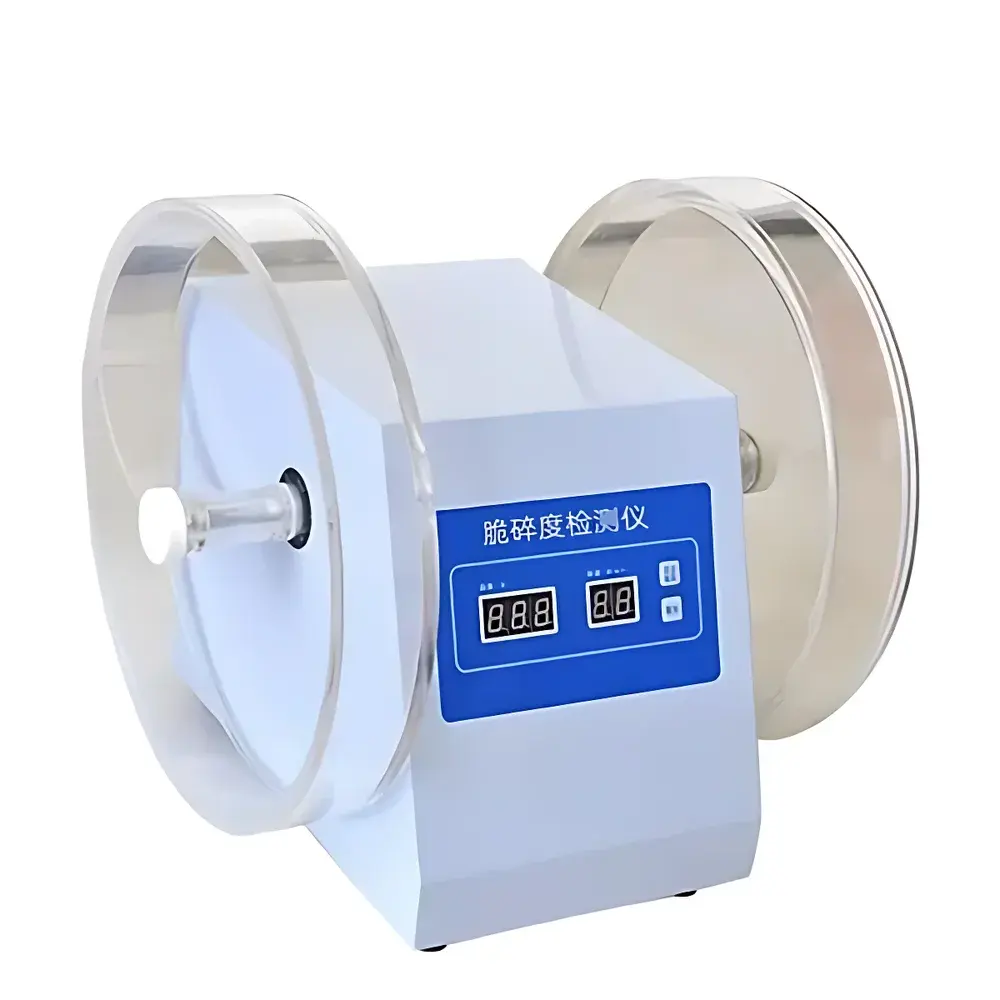
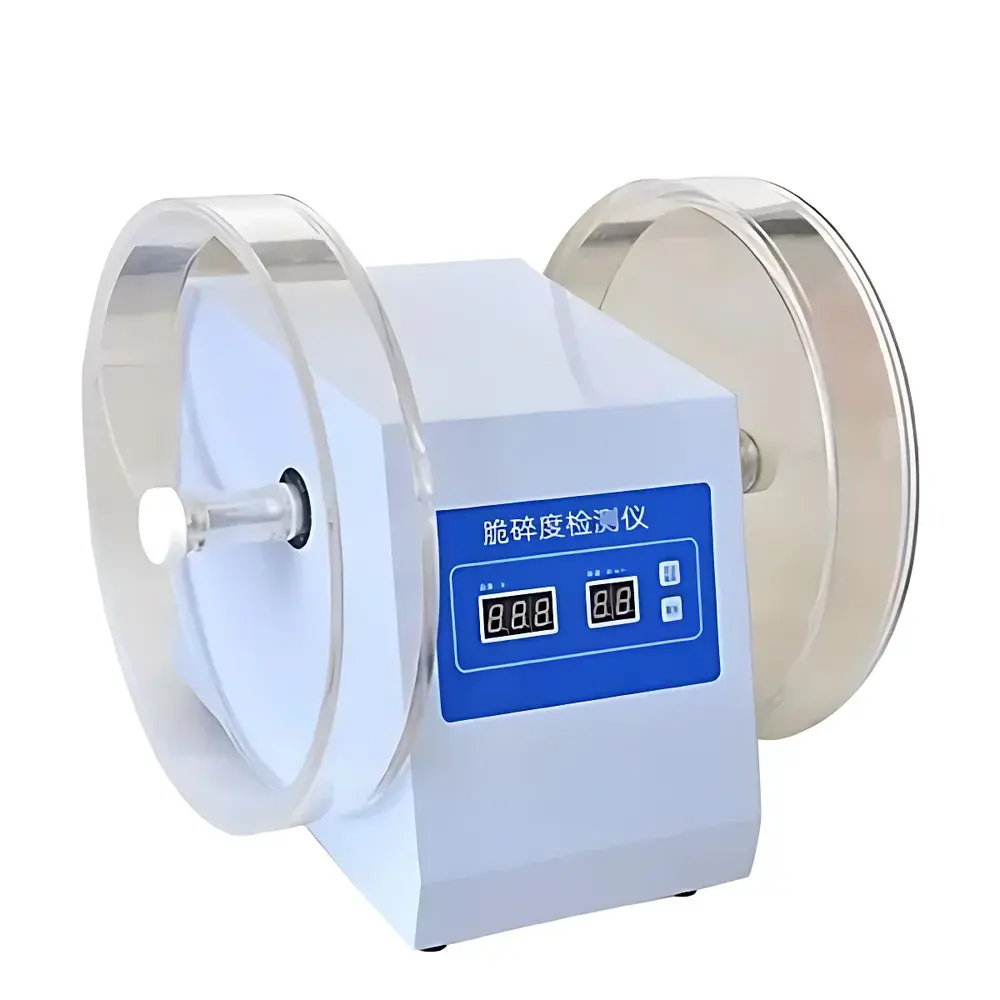
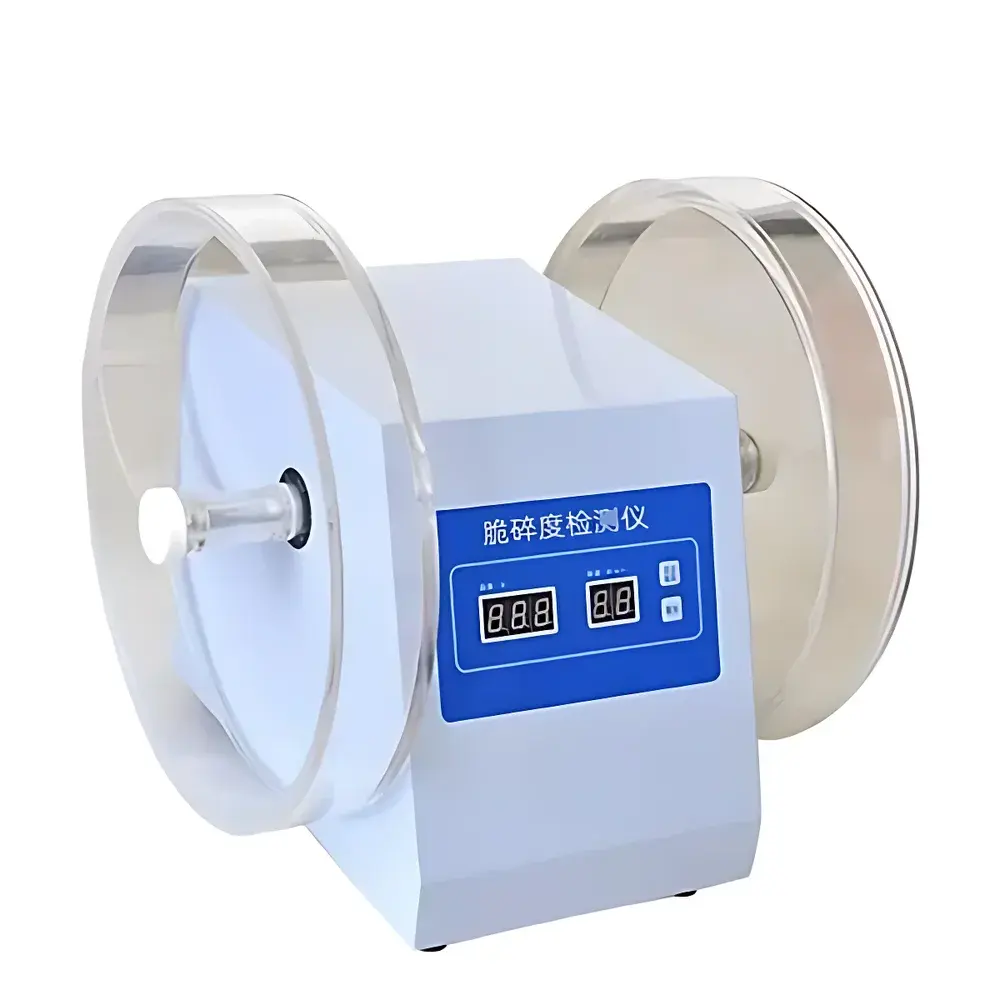
Shqigao HSY-0923C-1 Friability Tester
| Brand | Shqigao |
|---|---|
| Origin | Shanghai, China |
| Manufacturer Type | Direct Manufacturer |
| Country of Origin | China |
| Model | HSY-0923C-1 |
| Drum Diameter | 286 mm |
| Drum Depth | 39 mm |
| Tablet Drop Height | 156 mm |
| Rotation Count Range | 10–990 revolutions (default: 100) |
| Rotation Speed | 25 rpm ±1 rpm |
| Power Supply | 220 V / 50 Hz / 20 W |
| Dimensions (W×D×H) | 370 × 300 × 340 mm |
| Weight | 15 kg |
Overview
The Shqigao HSY-0923C-1 Friability Tester is a precision-engineered laboratory instrument designed to quantitatively assess the mechanical durability of uncoated and film-coated tablets under standardized tumbling stress. It operates on the principle of controlled rotational abrasion, in strict accordance with pharmacopoeial requirements including USP <1216>, Ph. Eur. 2.9.7, and ChP 0923. The device features a robust all-gear mechanical transmission system—eliminating belts, friction drives, or consumable drive components—to ensure long-term dimensional stability, minimal maintenance, and high inter-unit reproducibility across extended operational lifecycles. Its microcontroller-based control architecture delivers precise regulation of rotation count and speed, enabling consistent, repeatable test conditions essential for quality control laboratories operating under GLP and GMP frameworks.
Key Features
- True gear-driven drum mechanism: No belts, no slippage, no wear-related calibration drift—engineered for >10,000 test cycles without performance degradation.
- High-precision programmable rotation control: Adjustable revolution count from 10 to 990 (in 1-revolution increments), factory-defaulted to 100 revolutions per test per USP guidelines.
- Stable 25 rpm rotation speed with ±1 rpm accuracy, maintained independently of load variation or ambient temperature fluctuations (15–30 °C).
- Optimized drum geometry: 286 mm internal diameter and 39 mm depth provide uniform tablet distribution and predictable impact dynamics during tumbling.
- Fixed 156 mm drop height ensures consistent kinetic energy transfer per tablet tumble event, critical for inter-laboratory comparability.
- Low-power, high-reliability design: 20 W nominal consumption enables continuous operation without thermal buildup or voltage sensitivity issues.
- Compact footprint (370 × 300 × 340 mm) and lightweight construction (15 kg) facilitate integration into QC benchtop workflows and regulated cleanroom environments.
Sample Compatibility & Compliance
The HSY-0923C-1 accommodates standard pharmaceutical tablet sizes ranging from 4 mm to 18 mm in diameter and up to 8 mm in thickness, supporting both single-layer and bilayer formulations. It is compatible with friability test protocols requiring pre- and post-test mass measurement using analytical balances (0.1 mg resolution recommended). The instrument meets the physical design and operational criteria specified in USP <1216> for apparatus qualification, including drum dimensional tolerances, rotational consistency, and mechanical repeatability. It supports full audit trail documentation when paired with compliant balance interfaces and LIMS-integrated data capture systems, satisfying FDA 21 CFR Part 11 requirements for electronic records where validated software workflows are implemented.
Software & Data Management
While the HSY-0923C-1 operates via embedded microcontroller logic without proprietary PC software, its digital control interface supports external logging via TTL-level pulse output (optional accessory) synchronized to revolution completion. Laboratories may integrate the unit into automated QC data pipelines using programmable logic controllers (PLCs) or custom LabVIEW/Python scripts that monitor status signals and timestamp test initiation/completion events. All parameter settings—including target revolutions and speed—are retained through power cycling, and the control firmware includes built-in self-diagnostic routines for motor response verification and encoder feedback validation. For full regulatory traceability, users are advised to record instrument ID, operator ID, batch number, initial/final mass, and environmental conditions (temperature/humidity) in a controlled electronic log aligned with site-specific SOPs.
Applications
- Pre-release QC testing of solid oral dosage forms prior to stability and dissolution studies.
- Formulation development support: evaluating excipient effects on tablet cohesion and surface integrity.
- Process validation of compression parameters (e.g., punch force, dwell time) and coating process robustness.
- Comparative assessment of generic versus reference listed drug (RLD) tablet durability.
- Investigation of storage-induced physical degradation (e.g., moisture uptake leading to increased friability).
- Supporting ANDA submissions with documented apparatus qualification and method verification data.
FAQ
Does the HSY-0923C-1 comply with USP <1216> apparatus qualification requirements?
Yes—the drum dimensions, rotation speed tolerance, and mechanical construction meet all physical and performance criteria defined in USP <1216> for Type I friability testers.
Can the rotation speed be adjusted beyond 25 rpm?
No—25 rpm is fixed per pharmacopoeial standards; only revolution count is user-programmable (10–990 rev).
Is calibration certification included with shipment?
A factory-issued calibration report verifying drum dimensions and rotational accuracy is provided; user-performed periodic verification per USP <1216> is required.
What maintenance is required for long-term reliability?
Annual inspection of gear meshing integrity and encoder alignment is recommended; no lubrication or belt replacement is necessary due to the all-metal gear train design.
Is the unit suitable for use in ISO Class 7 cleanrooms?
Yes—its sealed electronics, low particulate generation, and absence of moving belts or brushes make it compatible with controlled environment operation when installed on stainless steel lab benches.



