
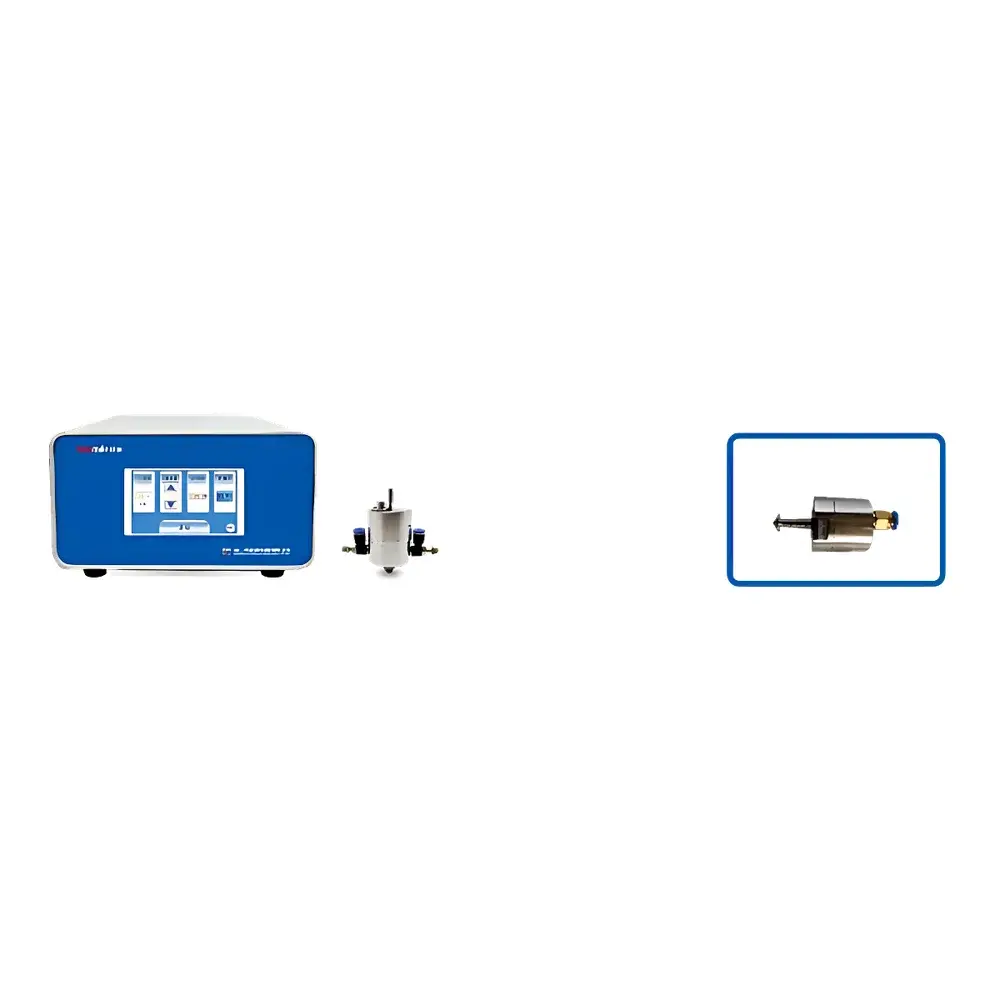
SHUMEI KBC-200WH High-Frequency Ultrasonic Nebulizer
| Brand | SHUMEI |
|---|---|
| Origin | Jiangsu, China |
| Manufacturer Type | Direct Manufacturer |
| Product Category | Domestic |
| Model | KBC-200WH |
| Instrument Type | General-Purpose |
| Ultrasonic Frequency | 110 kHz |
| Ultrasonic Power | 200 W |
| Timer Range | 1 min – 99 h 59 min |
| Display | 4.3-inch TFT Touchscreen |
| Operating Temperature Stability | Up to 50 °C |
| Nebulization Particle Size | 2–10 µm |
| Flow Rate | 0.02–20 mL/min |
| Nebulizer Head Diameter | Φ39 × 60 mm |
| Transducer Material | CV33 PZT (Lead Zirconate Titanate) Ceramic |
| Horn Material | Ti-6Al-4V Titanium Alloy |
| Automatic Frequency Tracking | Yes |
| Automatic Energy Compensation | Yes |
| Probe Design | 3D Exponential Ultrasonic Horn |
Overview
The SHUMEI KBC-200WH High-Frequency Ultrasonic Nebulizer is an engineered solution for precision aerosol generation in research, industrial R&D, and controlled process environments. Unlike conventional ultrasonic cleaners or humidifiers, this device operates on the principle of high-frequency piezoelectric micro-orifice nebulization—where a 110 kHz acoustic wave induces capillary instability at the liquid–air interface of a micromachined aperture, resulting in consistent, monodisperse droplet formation. Its core function is not cleaning or humidification, but reproducible, low-thermal-load atomization suitable for sensitive applications such as thin-film deposition, functional coating, nanoparticle synthesis, and inhalation formulation development. The system integrates a robust Ti-6Al-4V exponential horn and CV33-grade PZT transducer to ensure stable energy transfer across variable fluid viscosities and surface tensions—critical for applications requiring batch-to-batch consistency under GLP-aligned workflows.
Key Features
- 110 kHz operating frequency enables sub-10 µm median droplet diameter (Dv50), optimized for fine particulate delivery and high surface-area-to-volume ratio applications
- 200 W adjustable ultrasonic power with real-time automatic energy compensation—dynamically maintains optimal resonance point despite changes in liquid level, temperature, or viscosity
- 4.3-inch capacitive TFT touchscreen interface with intuitive parameter navigation, multi-step program storage, and timestamped operation logging
- Thermally stable design validated for continuous operation up to 50 °C ambient—suitable for integration into climate-controlled enclosures or inline processing lines
- 3D exponential ultrasonic horn geometry enhances acoustic efficiency by >35% compared to linear stepped horns, reducing mechanical fatigue and extending service life
- Programmable timer with 1-minute to 99-hour 59-minute resolution supports unattended long-duration experiments and scheduled nebulization protocols
Sample Compatibility & Compliance
The KBC-200WH accommodates aqueous solutions, low-viscosity organic solvents (e.g., ethanol, isopropanol, acetone), and water-based polymer dispersions (e.g., PVP, PVA, alginate) within the recommended flow rate range of 0.02–20 mL/min. It is not intended for highly corrosive media (e.g., concentrated acids/bases), suspensions with particles >1 µm, or viscous liquids exceeding 20 cP at operating temperature. While not certified to IEC 61000-6-3 or UL 61010-1 as a standalone medical device, its electrical architecture complies with CE marking requirements for laboratory equipment (EMC Directive 2014/30/EU and LVD Directive 2014/35/EU). For GMP-regulated use, the device supports audit-ready operation when paired with external data acquisition systems that provide 21 CFR Part 11–compliant electronic records.
Software & Data Management
The onboard firmware includes non-volatile memory for storing up to 16 user-defined protocols, each with independent settings for power ramping, dwell time, and pulse modulation (1 s – 59 min 59 s). All operational events—including start/stop timestamps, total runtime, and fault codes—are logged internally and exportable via USB-C to CSV format. No proprietary software is required; however, SHUMEI provides optional Python SDK documentation for API-level integration with LabVIEW, MATLAB, or custom LIMS platforms—enabling automated synchronization with environmental sensors, mass flow controllers, or deposition chamber triggers.
Applications
- Semiconductor manufacturing: Precise precursor delivery for atomic layer deposition (ALD) and aerosol-assisted chemical vapor deposition (AACVD)
- Pharmaceutical R&D: Generation of respirable aerosols for in vitro lung deposition studies (e.g., NGI, ACI testing per USP & ISO 27427)
- Advanced materials synthesis: Sol-gel nebulization for metal oxide nanoparticle production (e.g., TiO₂, SiO₂, ZnO)
- Functional coating development: Uniform mist application for anti-fog, hydrophobic, or conductive thin films on flexible substrates
- Agricultural biotechnology: Controlled delivery of bioactive nanoemulsions in plant tissue culture and vertical farming misting systems
- Academic microfluidics labs: On-demand droplet generation for microreactor seeding and single-cell encapsulation studies
FAQ
Is the KBC-200WH suitable for sterile applications?
It can be used in cleanroom environments (ISO Class 5–7) when equipped with sterilizable stainless-steel or quartz nebulizer heads and validated using VHP or autoclave-compatible protocols. However, the base unit itself is not autoclavable.
Can it operate continuously for 24 hours?
Yes—provided ambient temperature remains ≤50 °C and coolant flow (if externally integrated) is maintained. Thermal derating begins above 45 °C cabinet temperature.
What maintenance intervals are recommended?
Horn tip inspection every 200 operational hours; transducer impedance verification annually; full calibration traceable to NIST standards recommended biannually for regulated use.
Does it support pulse-mode operation?
Yes—programmable pulse width (1 s – 59 min 59 s) and duty cycle enable precise control over cumulative aerosol dose, critical for dose-response toxicology assays.
Is remote monitoring possible?
Via optional RS-485 Modbus RTU interface (hardware add-on), enabling integration into SCADA or building management systems for centralized status reporting and alarm triggering.



