
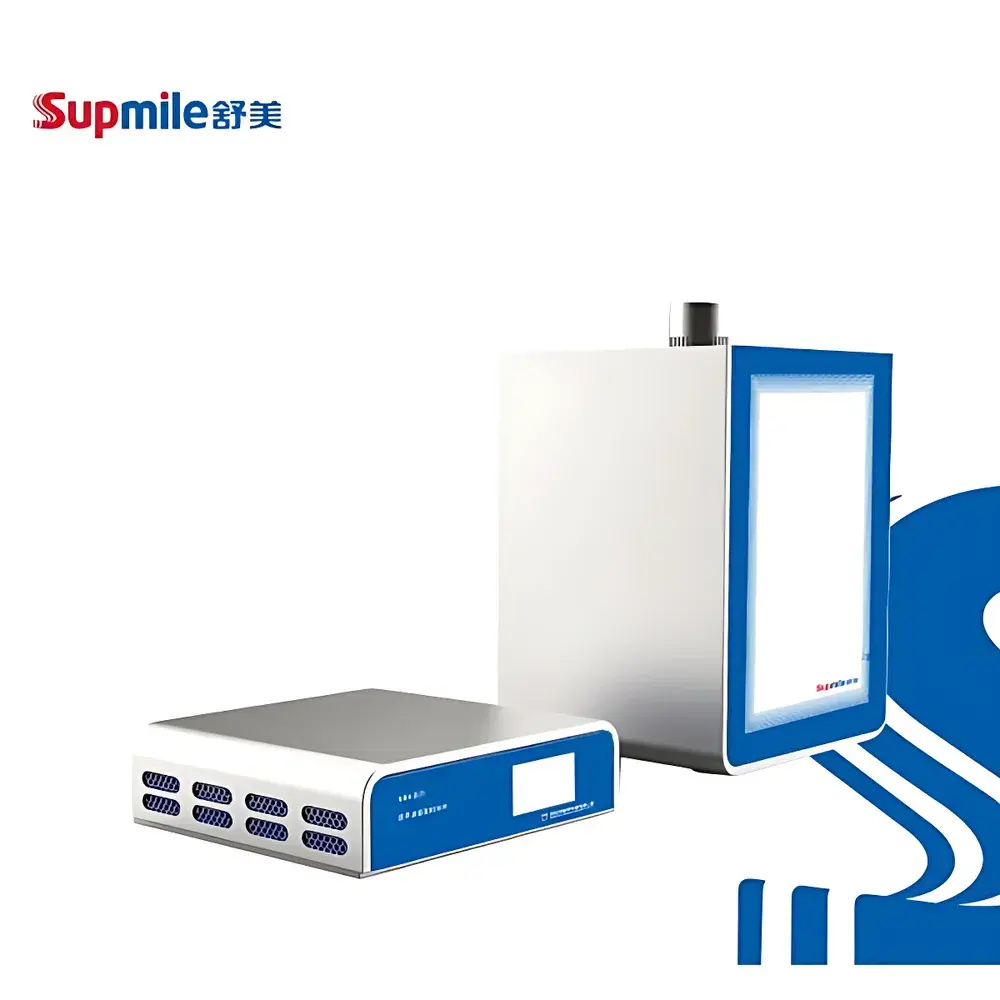
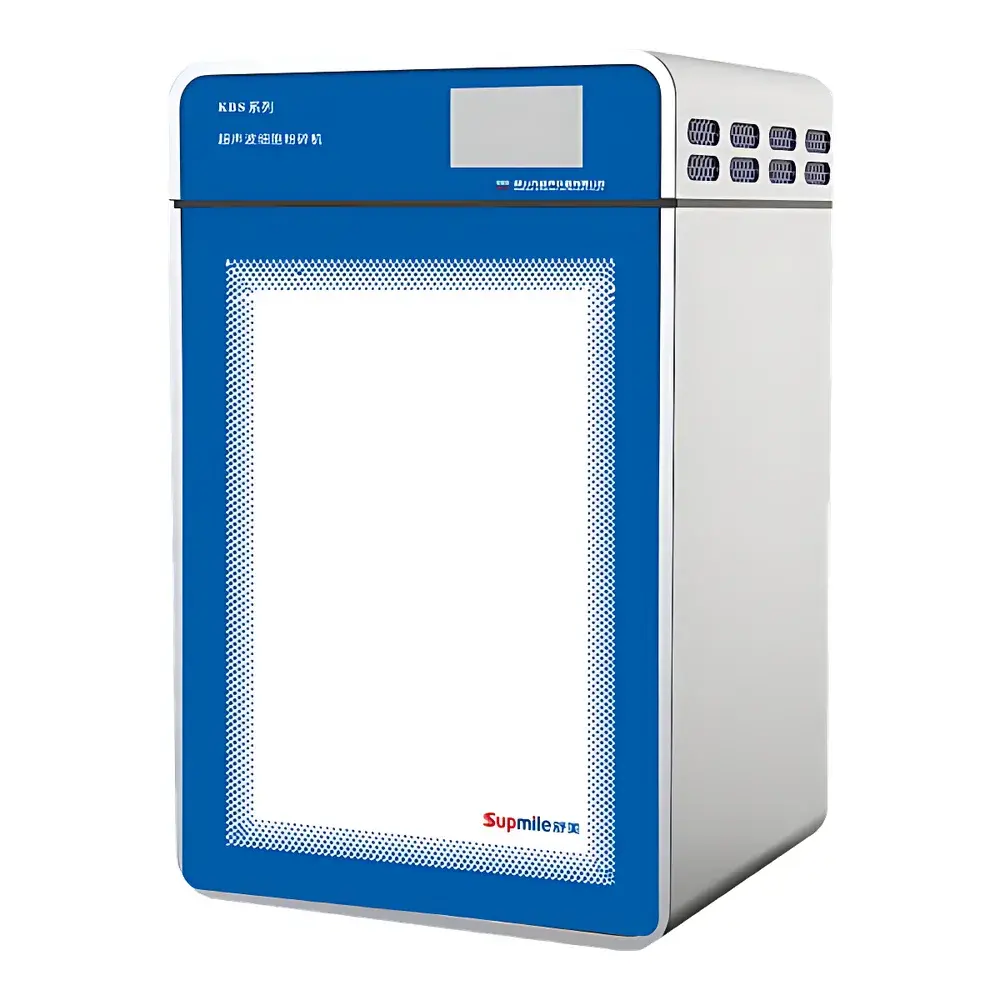
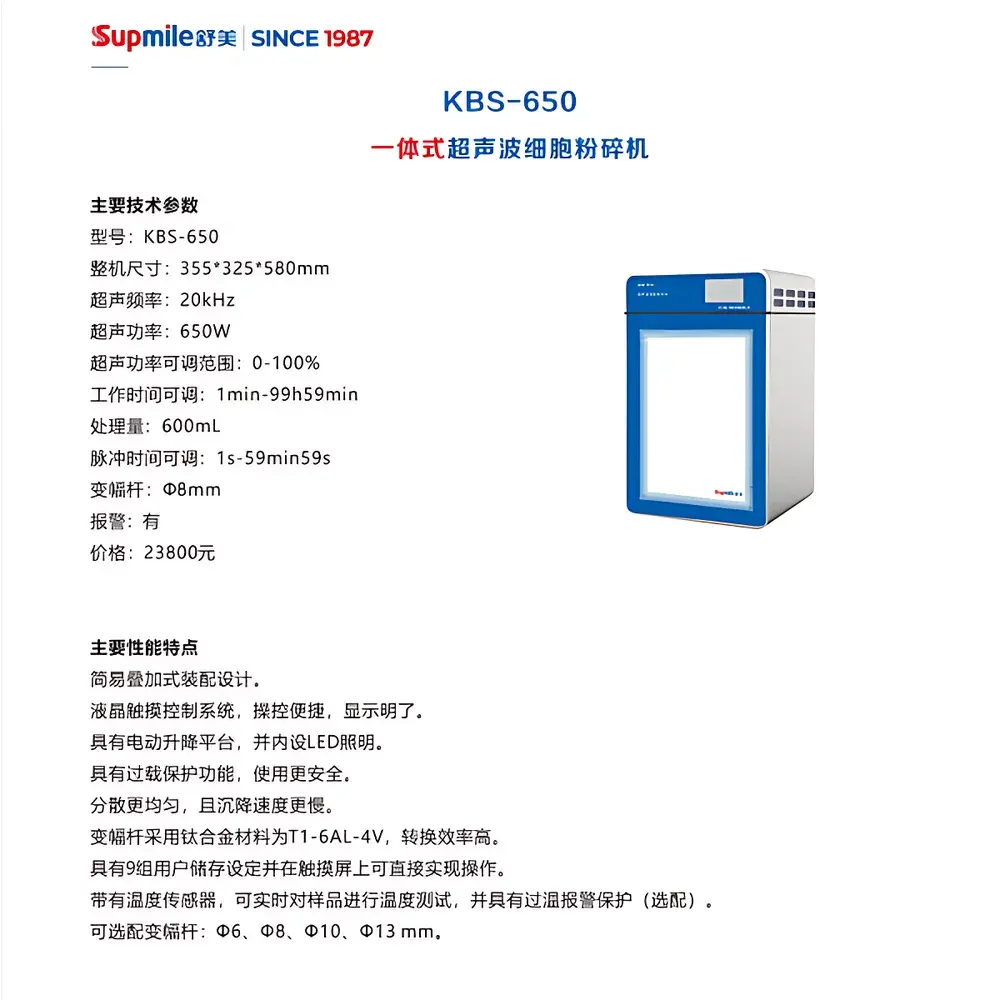
Shumei KBS-650 Integrated Ultrasonic Cell Disruptor
| Brand | Shumei |
|---|---|
| Origin | Jiangsu, China |
| Manufacturer Type | Direct Manufacturer |
| Product Category | Domestic |
| Model | KBS-650 |
| Instrument Type | Ultrasonic Cell Disruptor |
| Operating Frequency | 20 kHz |
| Ultrasonic Power Output | 650 W |
| Adjustable Power Range | 0–100% |
| Time Setting Range | 1 min – 99 h 59 min |
| Pulse Duration Adjustment | 1 s – 59 min 59 s |
| Maximum Sample Volume | 600 mL |
| Probe Diameter (Standard) | Φ8 mm |
| Probe Material | Ti-6Al-4V Titanium Alloy |
| Safety Features | Overload Protection, Overtemperature Alarm (Optional), LED Illumination, Motorized Vertical Lift Stage |
| User Memory Slots | 9 |
| Display | LCD Touchscreen Interface |
| Dimensions (W×D×H) | 355 × 325 × 580 mm |
| Temperature Monitoring | Real-time Sensor with Threshold Alert (Optional) |
Overview
The Shumei KBS-650 Integrated Ultrasonic Cell Disruptor is a laboratory-grade benchtop instrument engineered for efficient and reproducible cell lysis, tissue homogenization, nanoparticle dispersion, and emulsification. It operates on the principle of high-intensity ultrasonic cavitation—where rapid pressure fluctuations in liquid media generate transient microbubbles that collapse violently, producing localized shear forces, shockwaves, and microstreaming. This physical mechanism enables mechanical disruption of cellular membranes and subcellular structures without chemical or thermal denaturation, preserving biomolecular integrity for downstream applications such as protein extraction, genomic DNA isolation, and organelle purification. Designed for routine use in academic research labs, biopharmaceutical QC environments, and contract development organizations, the KBS-650 integrates transducer, generator, and ergonomic sample handling into a single compact chassis—eliminating external cables, alignment complexities, and vibration coupling issues common in modular systems.
Key Features
- Integrated architecture with built-in 20 kHz piezoelectric transducer and digital power amplifier—ensuring stable frequency output and minimal harmonic drift over extended operation.
- 650 W nominal ultrasonic power output, continuously adjustable from 0% to 100% in 1% increments for precise energy delivery control across diverse sample viscosities and volumes.
- Motorized vertical lift stage with fine-positioning capability and integrated LED illumination—facilitating accurate probe immersion depth control and real-time visual monitoring of sonication effects.
- Ti-6Al-4V titanium alloy probe (standard Φ8 mm) offering superior acoustic impedance matching, corrosion resistance, and fatigue strength; optional probes available in Φ6, Φ10, and Φ13 mm diameters to accommodate varying vessel geometries and throughput requirements.
- Intelligent touchscreen interface with 9 programmable user profiles—each storing independent settings for power level, total duration, pulse-on/pulse-off timing, and temperature alarm threshold (when sensor-equipped).
- Comprehensive safety system including automatic overload shutdown, thermal cutoff for transducer housing, and optional real-time sample temperature monitoring with configurable upper-limit alert and auto-halt functionality.
Sample Compatibility & Compliance
The KBS-650 supports aqueous and organic solvent-based suspensions, including bacterial cultures (E. coli, Bacillus spp.), yeast (S. cerevisiae), mammalian cell lines (HEK293, CHO), plant tissues, and soft animal tissues. Compatible vessels include standard glass beakers (50–600 mL), ice-jacketed cups, and custom sonication horns. The instrument complies with IEC 61000-6-3 (EMC emission standards) and IEC 61000-6-2 (immunity requirements). While not certified under ISO 13485 or FDA 21 CFR Part 11 by default, its programmable memory, audit-ready parameter logging (via optional USB export), and deterministic pulse timing support GLP/GMP-aligned documentation practices when deployed within validated workflows.
Software & Data Management
No proprietary PC software is required for basic operation—the full control suite resides within the embedded Linux-based touchscreen controller. All operational parameters—including timestamped start/stop events, cumulative energy delivery (J), and probe duty cycle—are retained in non-volatile memory for up to 1,000 cycles. Data export is supported via USB flash drive in CSV format, enabling traceability for quality records. Optional firmware upgrades maintain backward compatibility and introduce enhanced calibration diagnostics. For integration into LIMS or ELN platforms, ASCII command protocol (RS-232 or TTL-level UART) is available upon request—supporting remote initiation, status polling, and fault reporting.
Applications
- Preparative-scale lysis of Gram-negative and Gram-positive bacteria for recombinant protein recovery.
- Chromatin shearing in ChIP-seq protocols requiring consistent fragment size distribution (200–500 bp).
- Nanoparticle deagglomeration and uniform dispersion in colloidal formulations (e.g., liposomes, polymeric micelles).
- Extraction of intracellular metabolites and labile enzymes under chilled conditions (with optional cooling jacket or ice bath).
- Homogenization of fibrous or lipid-rich tissues (liver, adipose) prior to RNA isolation or lipidomics analysis.
- Routine cleaning and degassing of HPLC mobile phase solvents and filtration assemblies.
FAQ
What is the recommended maintenance interval for the ultrasonic probe?
Probe surface inspection and acoustic coupling verification should be performed before each use; full calibration and transducer impedance check are advised every 500 operating hours or annually—whichever occurs first.
Can the KBS-650 be used for continuous operation?
Yes—continuous mode is supported for durations up to 99 hours 59 minutes, provided adequate sample cooling and probe thermal management are maintained.
Is the temperature sensor included by default?
No—the PT100-compatible temperature probe and associated firmware module are optional accessories; installation requires factory configuration.
Does the instrument support external triggering or synchronization?
Yes—TTL-compatible trigger input/output ports enable synchronization with centrifuges, fraction collectors, or imaging systems for time-resolved lysis studies.
How is acoustic output power verified during qualification?
Power output is validated using calorimetric measurement per ASTM E2887-13, with ±3% repeatability across the 0–650 W range when operated at 20 kHz with standardized load conditions.




