
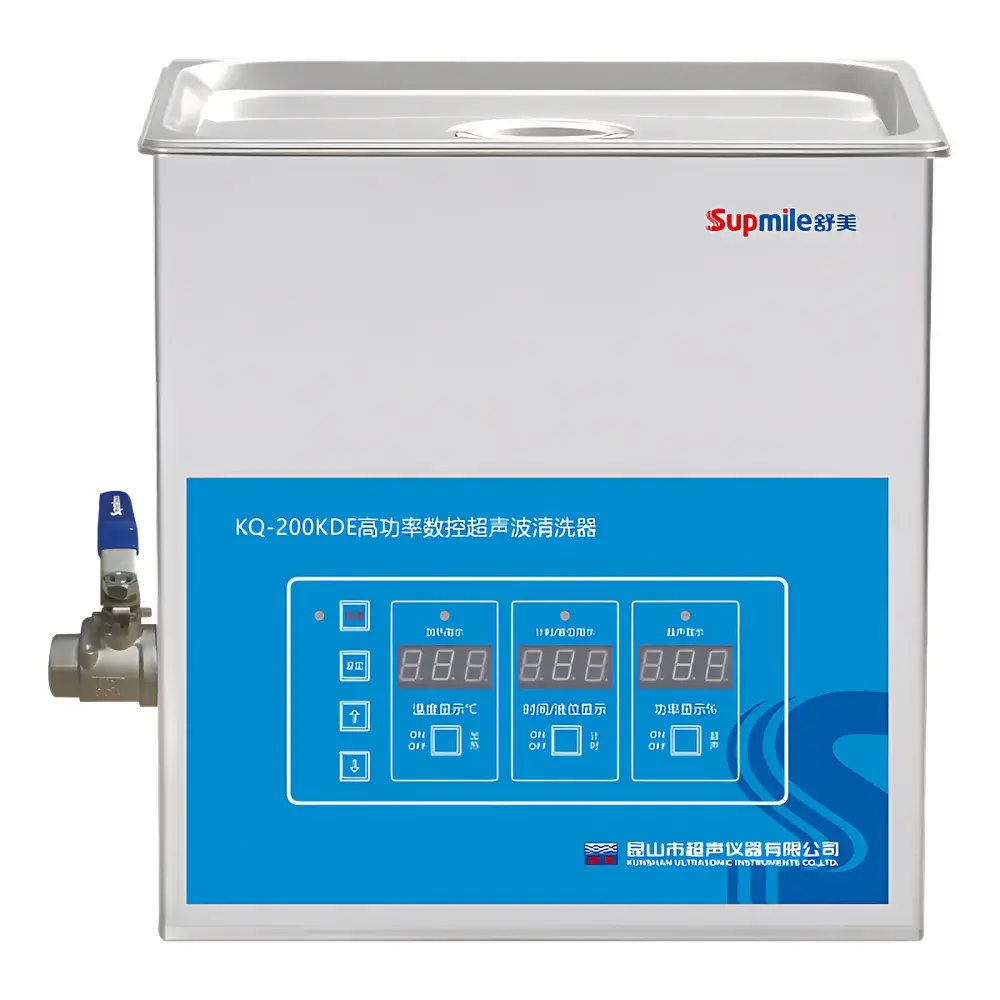
Shumei KQ-200KDE Benchtop High-Power Digital Ultrasonic Cleaner
| Brand | Shumei |
|---|---|
| Origin | Jiangsu, China |
| Manufacturer Type | Direct Manufacturer |
| Instrument Type | General-Purpose |
| Tank Capacity | 6 L |
| Ultrasonic Frequency | 40 kHz |
| Ultrasonic Power Output | 200 W |
| Adjustable Ultrasonic Power Range | 40–100% |
| Heating Power | 400 W |
| Temperature Control Range | Ambient to 80 °C |
| Timer Range | 1–480 min |
| Sound-Dampening Lid | Included |
| Drain/Inlet | Manual |
| Power Supply | AC 220 V / 50 Hz |
| Tank Interior Dimensions | 300 × 150 × 150 mm |
| External Dimensions | 325 × 177 × 335 mm |
| Construction Material | 304 Stainless Steel |
| Safety Protections | Low-level liquid detection, over-temperature, over-voltage, over-current, and dry-run protection |
| Display | Digital LED showing real-time temperature, power level, elapsed time, and set parameters |
Overview
The Shumei KQ-200KDE is a benchtop digital ultrasonic cleaner engineered for precision cleaning of laboratory components, optical elements, precision mechanical parts, and analytical instrumentation accessories. It operates on the principle of cavitation—where high-frequency acoustic energy (40 kHz) generates microscopic vacuum bubbles in the cleaning solution that collapse violently upon contact with submerged surfaces, dislodging particulate contaminants, organic residues, and thin films without mechanical abrasion. Designed for consistent performance across routine and demanding cleaning protocols, the unit integrates a robust 200 W ultrasonic transducer array with intelligent digital control logic, enabling repeatable, traceable, and operator-independent operation. Its sealed 304 stainless steel tank (6 L capacity) ensures chemical compatibility with aqueous, mild alkaline, and low-concentration solvent-based cleaning media while maintaining structural integrity under thermal and acoustic stress.
Key Features
- Digital microcontroller-based interface with LED display for real-time monitoring and precise setting of ultrasonic power (40–100%), heating temperature (ambient to 80 °C), and cleaning duration (1–480 minutes).
- Integrated safety architecture including automatic shutdown for low liquid level, over-temperature, over-voltage, over-current, and dry-run conditions—compliant with IEC 61010-1 requirements for laboratory electrical equipment.
- High-efficiency piezoelectric transducers mounted directly to the tank bottom, delivering uniform energy distribution and minimizing standing-wave interference across the entire bath volume.
- Thermally insulated stainless steel housing with sound-dampening lid reduces ambient noise to ≤55 dB(A) at 1 m distance—meeting occupational health guidelines for continuous lab use.
- Heating system rated at 400 W provides rapid, stable thermal ramping and maintenance; temperature accuracy is ±2 °C across the full operating range.
- Standard accessories include a 304 stainless steel mesh basket, support rack, manual inlet/outlet valves, and integrated liquid level sensor with visual indicator.
Sample Compatibility & Compliance
The KQ-200KDE accommodates a broad range of sample geometries—including glassware (vials, cuvettes, pipette tips), metal tools (tweezers, forceps, surgical instruments), ceramic substrates, and small electronic assemblies—provided they are compatible with aqueous or low-solvent cleaning chemistries. Its 300 × 150 × 150 mm internal tank allows immersion of objects up to 140 mm in height. The unit conforms to general-purpose laboratory equipment standards per ISO/IEC 17025 supporting documentation requirements and supports GLP-compliant workflows when paired with external logbooks or validated cleaning SOPs. While not certified for sterile processing under ISO 13485 or FDA 21 CFR Part 820, it serves as a critical pre-sterilization cleaning step aligned with AAMI ST79 and USP guidelines for analytical instrument preparation.
Software & Data Management
This model operates via embedded firmware without external PC dependency. All operational parameters—including power level, temperature setpoint, timer value, and real-time status—are retained in non-volatile memory after power cycling. The digital display logs current and set values simultaneously, facilitating manual audit trails. Although no USB or Ethernet connectivity is provided, the deterministic behavior of its timing and power regulation enables reproducible cleaning cycles suitable for inclusion in validated methods (e.g., ASTM D2603, ISO 11553-1). For regulated environments, users may document cycle execution manually or integrate the device into broader lab management systems using timestamped operator logs.
Applications
- Cleaning of HPLC, GC, and ICP-MS sample introduction components (injector needles, autosampler vials, nebulizer caps) prior to analysis.
- Removal of polishing compounds and organic adhesives from optical lenses, mirrors, and semiconductor wafers.
- Decontamination of reusable labware (glass flasks, burettes, volumetric pipettes) in teaching and research laboratories.
- Preparation of electron microscopy grids and TEM specimen holders requiring particle-free surfaces.
- Supporting ASTM E1914 and ISO 14644-1 cleanroom component maintenance where non-contact cleaning is mandated.
FAQ
Is the KQ-200KDE suitable for cleaning delicate MEMS devices or microfluidic chips?
Yes—when operated at reduced power (40–60%) and with degassed, low-surface-tension cleaning solutions, it effectively removes sub-micron particles without damaging fragile microstructures.
Can this unit be used with flammable solvents such as acetone or ethanol?
No. The KQ-200KDE lacks explosion-proof certification and should only be used with aqueous or water-miscible, non-flammable cleaning agents.
Does the device support automatic fill or drain functions?
No—fluid handling is manual via front-panel inlet and drain valves; automated fluid management requires external peristaltic pumps or integrated lab automation systems.
What is the expected service life of the transducers under continuous daily use?
With proper maintenance (avoiding dry operation, regular descaling, and adherence to recommended duty cycles), the transducers maintain >90% nominal output efficiency for ≥5,000 operational hours.
Is calibration documentation available for quality assurance purposes?
Factory calibration certificates are provided upon request; periodic verification of temperature and timer accuracy can be performed using NIST-traceable thermometers and stopwatch standards per ISO/IEC 17025 Clause 6.5.



