
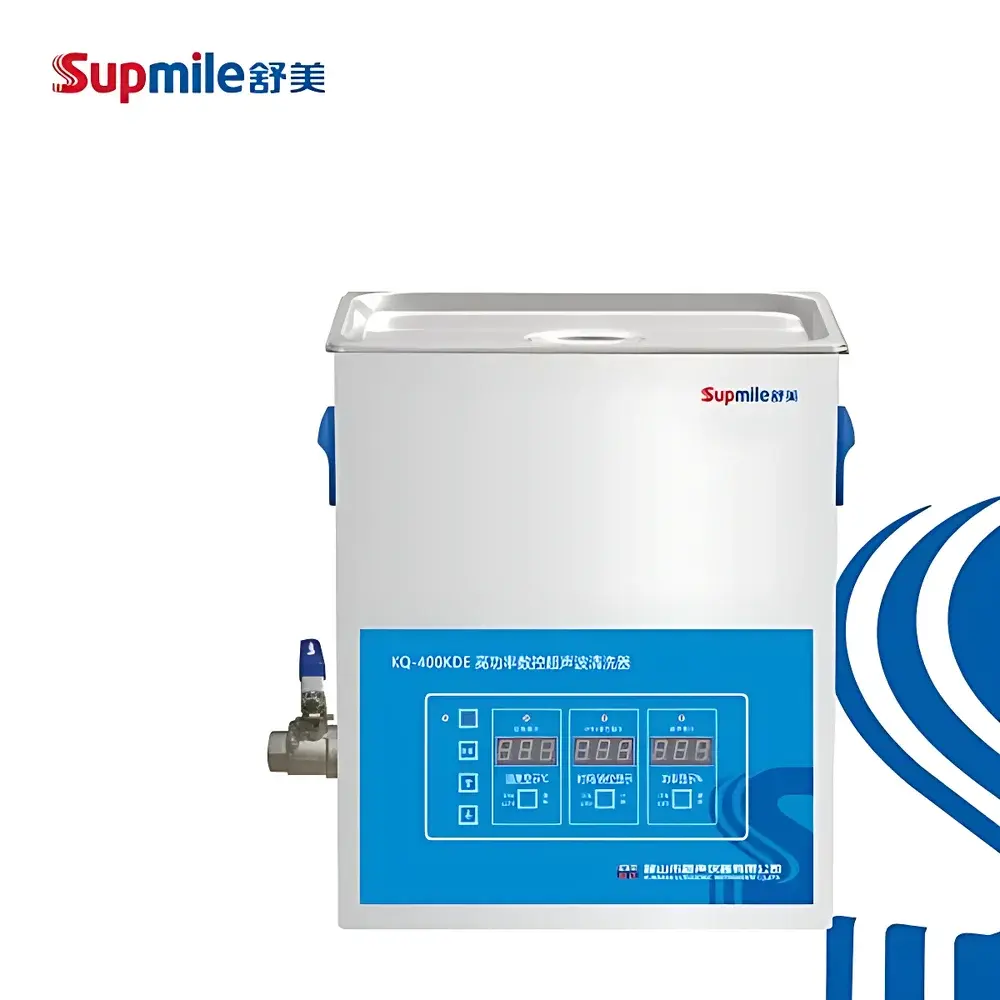
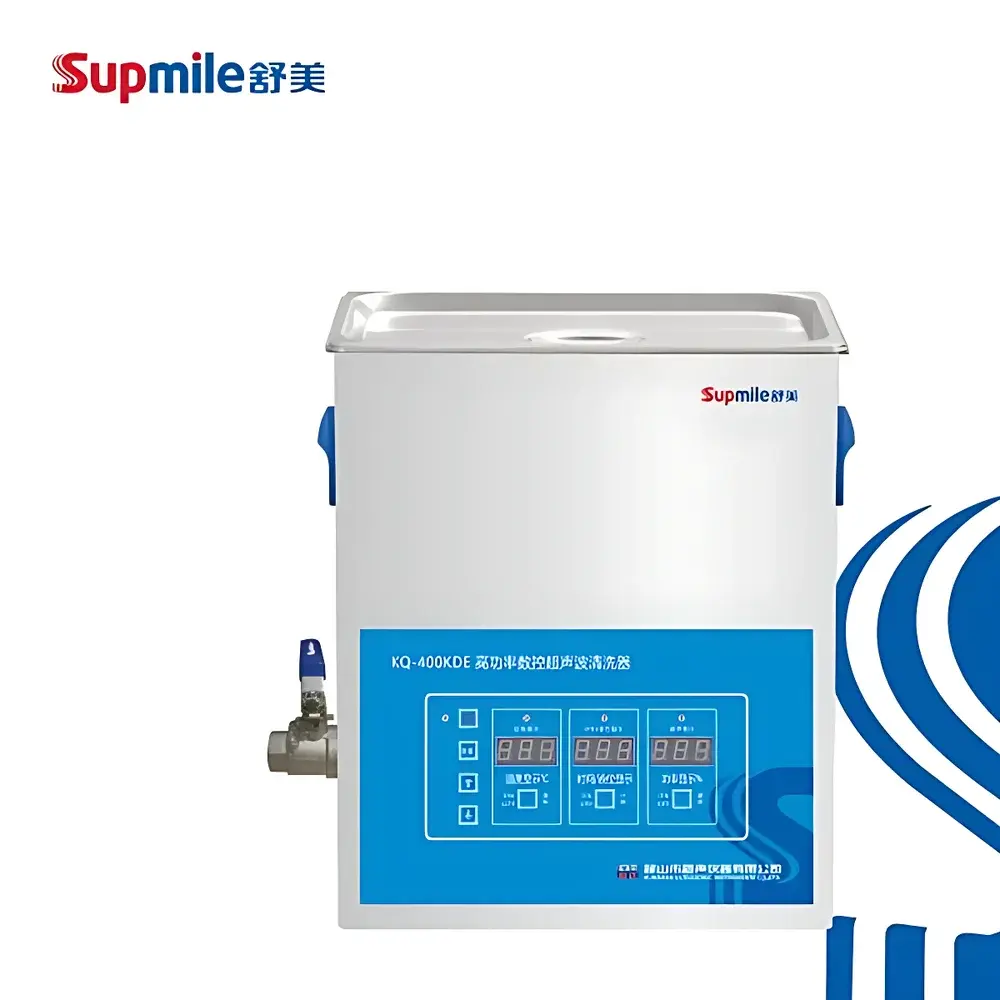
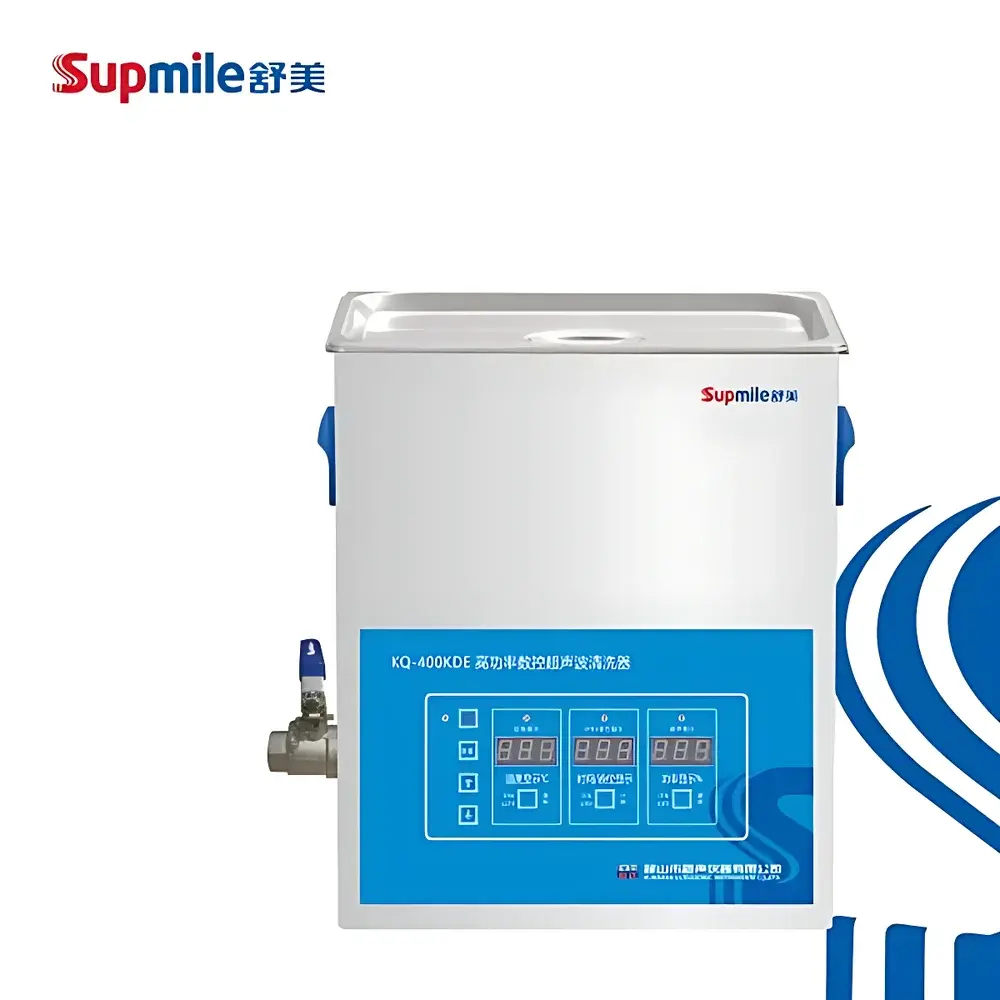
Shumei KQ-400KDE High-Power Digital Ultrasonic Cleaner
| Brand | Shumei |
|---|---|
| Origin | Jiangsu, China |
| Model | KQ-400KDE |
| Capacity | 10 L |
| Ultrasonic Frequency | 40 kHz |
| Ultrasonic Power | 400 W (adjustable 40–100%) |
| Heating Power | 400 W |
| Temperature Range | Ambient to 80 °C (adjustable) |
| Timer Range | 1–480 min |
| Lid with Sound-Dampening Design | Yes |
| Manual Fill/Drain | Yes |
| Tank Dimensions (L×W×H) | 300 × 240 × 150 mm |
| External Dimensions (L×W×H) | 325 × 265 × 375 mm |
| Power Supply | 220 V AC, 50/60 Hz |
| Construction Material | 304 Stainless Steel |
Overview
The Shumei KQ-400KDE is a high-power, microprocessor-controlled ultrasonic cleaner engineered for precision cleaning in regulated laboratory, biomedical device manufacturing, electronics assembly, and precision engineering environments. It operates on the principle of cavitation—generating controlled acoustic pressure waves at 40 kHz to induce microscopic bubble formation and collapse within a liquid medium. This transient cavitation delivers localized mechanical energy that effectively dislodges particulate contaminants, organic residues, oils, oxides, and biofilms from complex geometries—including blind holes, crevices, and microstructured surfaces—without mechanical abrasion or surface damage. Designed for reproducible, traceable cleaning processes, the KQ-400KDE supports method development and validation under GLP and GMP-aligned workflows, particularly where solvent compatibility, thermal stability, and operational consistency are critical.
Key Features
- 400 W ultrasonic output with continuous 40–100% power adjustment—enabling optimization for delicate optics or robust industrial parts
- Digital temperature control from ambient up to 80 °C, with 400 W heating capacity to enhance solubilization of waxes, greases, and polymer-based residues
- Precision timer with 1–480 minute range (1-minute increments), supporting both rapid rinse cycles and extended soak protocols
- 304 stainless steel tank (300 × 240 × 150 mm) and housing—resistant to corrosion from aqueous, acidic, alkaline, and mild organic cleaning solutions
- Integrated sound-dampening lid to reduce operational noise levels below 65 dB(A) at 1 m distance—improving laboratory ergonomics
- Microcontroller-based interface with real-time digital display of temperature, elapsed time, and active power level
- Parameter memory function stores up to three user-defined cleaning profiles—reducing setup variability across repeated batches
- Multi-layer safety architecture: automatic dry-run shutdown, low-level fluid detection, over-voltage and over-current protection, and thermal cutoff at ≥90 °C
Sample Compatibility & Compliance
The KQ-400KDE accommodates a broad range of sample types—including glassware, metal components, surgical instruments, printed circuit boards (PCBs), ceramic substrates, and polymer molds—provided they are compatible with aqueous or low-toxicity solvent systems. Its 10 L working volume allows simultaneous processing of multiple items using optional stainless steel mesh baskets or rack-mounted fixtures. While not certified to IEC 61000-6-3 or UL 61010-1 out-of-the-box, the unit meets baseline electrical safety requirements for Class I equipment operating at 220 V AC. Users implementing this system in regulated settings may document operational parameters (power %, temp °C, duration min, solution type) to support ISO 13485 cleaning validations or ASTM F3127 residue removal assessments. The absence of automated fluid handling limits direct integration into fully automated cleanroom workflows but supports semi-automated batch processing with manual intervention.
Software & Data Management
The KQ-400KDE features an embedded microcontroller with non-volatile memory for storing user-defined cleaning protocols. Though it lacks Ethernet, USB, or RS-232 connectivity, its digital interface provides timestamp-independent parameter logging visible during operation. For auditability, laboratories routinely pair the unit with external data loggers or integrate it into broader facility monitoring systems via analog signal taps (e.g., PT100 output for temperature verification). All operational settings—including power level, setpoint temperature, and timer value—are retained after power cycling. No firmware updates or cloud-based software are provided; configuration remains local and deterministic—aligning with environments prioritizing system stability over remote feature expansion.
Applications
- Pre-analytical preparation of HPLC vials, pipette tips, and filtration membranes
- Cleaning of reusable surgical tools prior to sterilization per AAMI ST79 guidelines
- Removal of flux residues and solder paste from SMT assemblies before AOI inspection
- Decontamination of optical lenses, laser mirrors, and interferometric components
- Surface preparation of metallic test coupons for ASTM B117 salt-spray testing
- Routine maintenance of analytical balances, weighing boats, and volumetric glassware
FAQ
Is the KQ-400KDE suitable for cleaning heat-sensitive polymers?
Yes—temperature can be set as low as ambient and held precisely; combined with reduced ultrasonic power, it enables gentle cleaning of acrylics, polycarbonates, and silicone elastomers.
Can it be used with flammable solvents?
No. The unit is not explosion-proof and lacks solvent vapor containment or ignition safeguards; only aqueous or flash-point >60 °C solutions are recommended.
Does it support validation documentation per FDA 21 CFR Part 11?
Not natively—the system does not provide electronic signatures, audit trails, or user access controls. However, procedural SOPs and manual logbooks may be used to fulfill basic traceability requirements.
What maintenance is required for long-term reliability?
Annual inspection of transducer bonding integrity, periodic descaling of the heater element using dilute citric acid, and visual verification of tank weld integrity are advised.
Is the stainless steel tank electropolished?
No—it features standard mill-finish 304 stainless steel, sufficient for general lab use but not optimized for ultra-low particle retention in semiconductor applications.



