
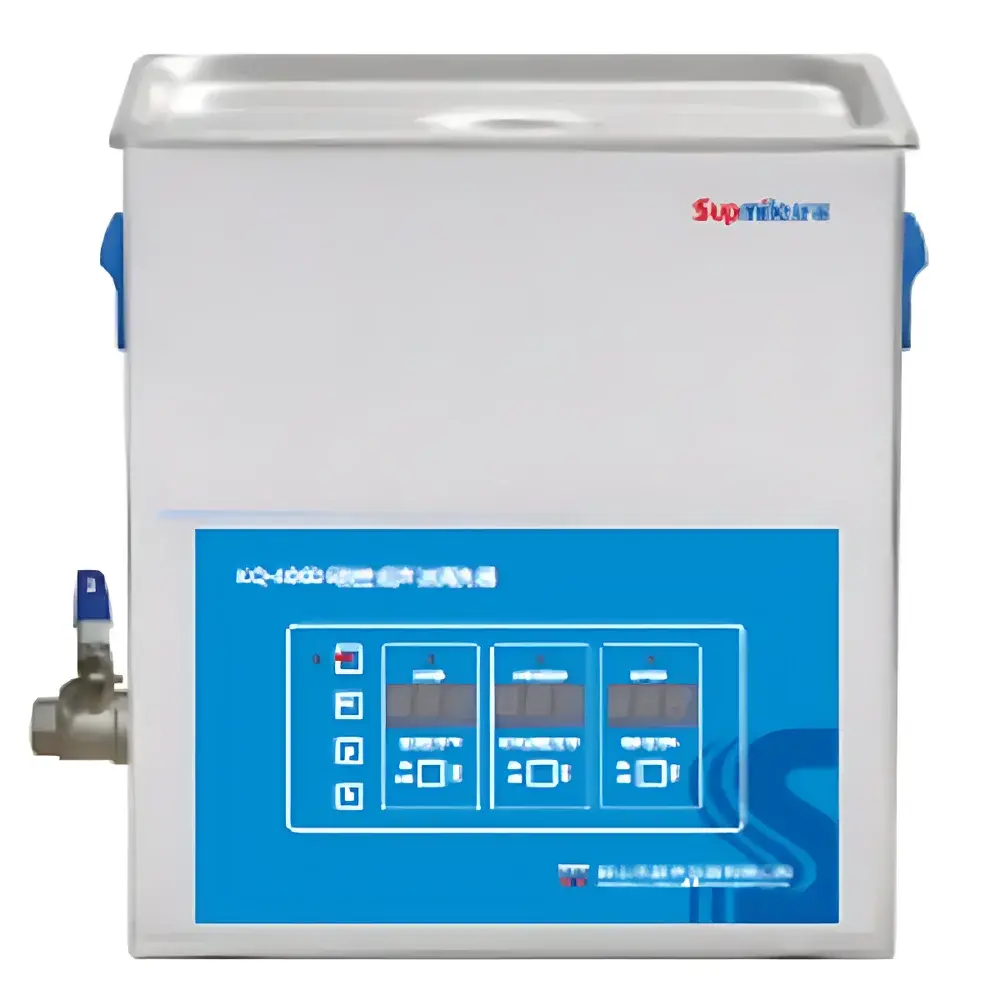
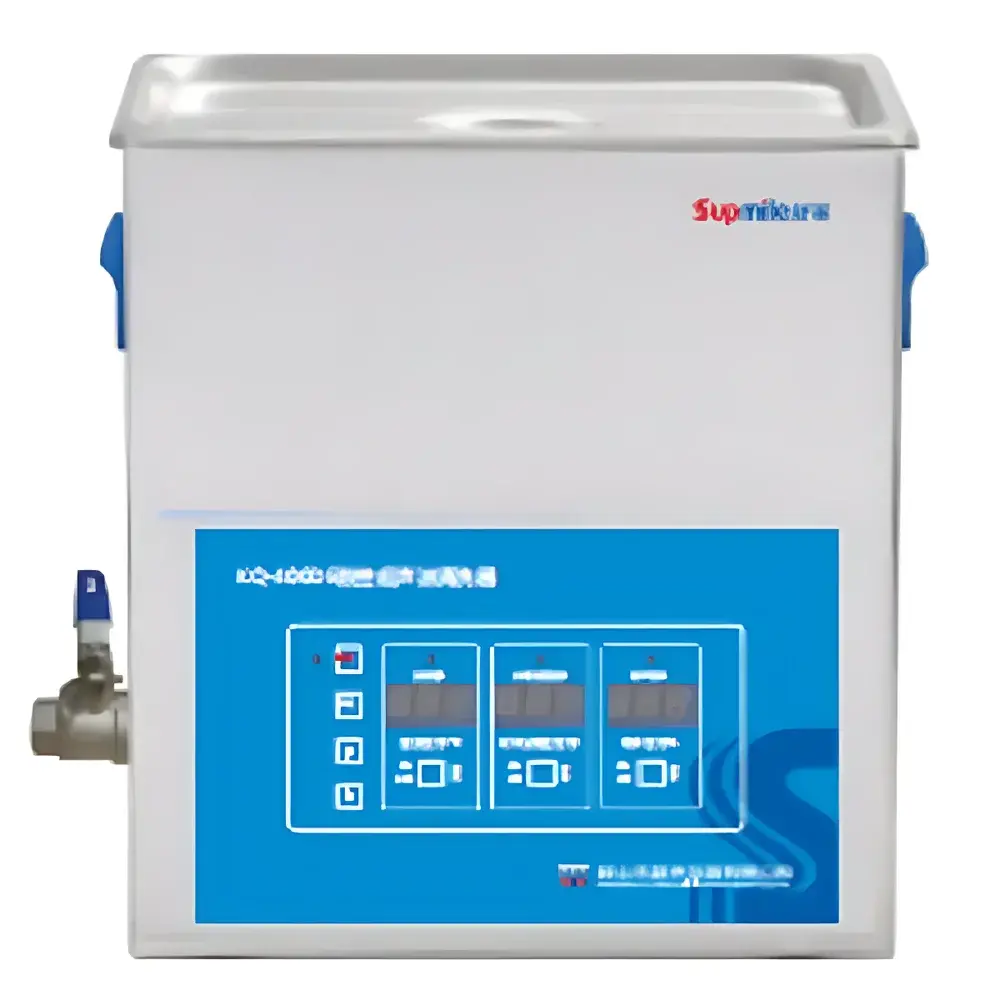
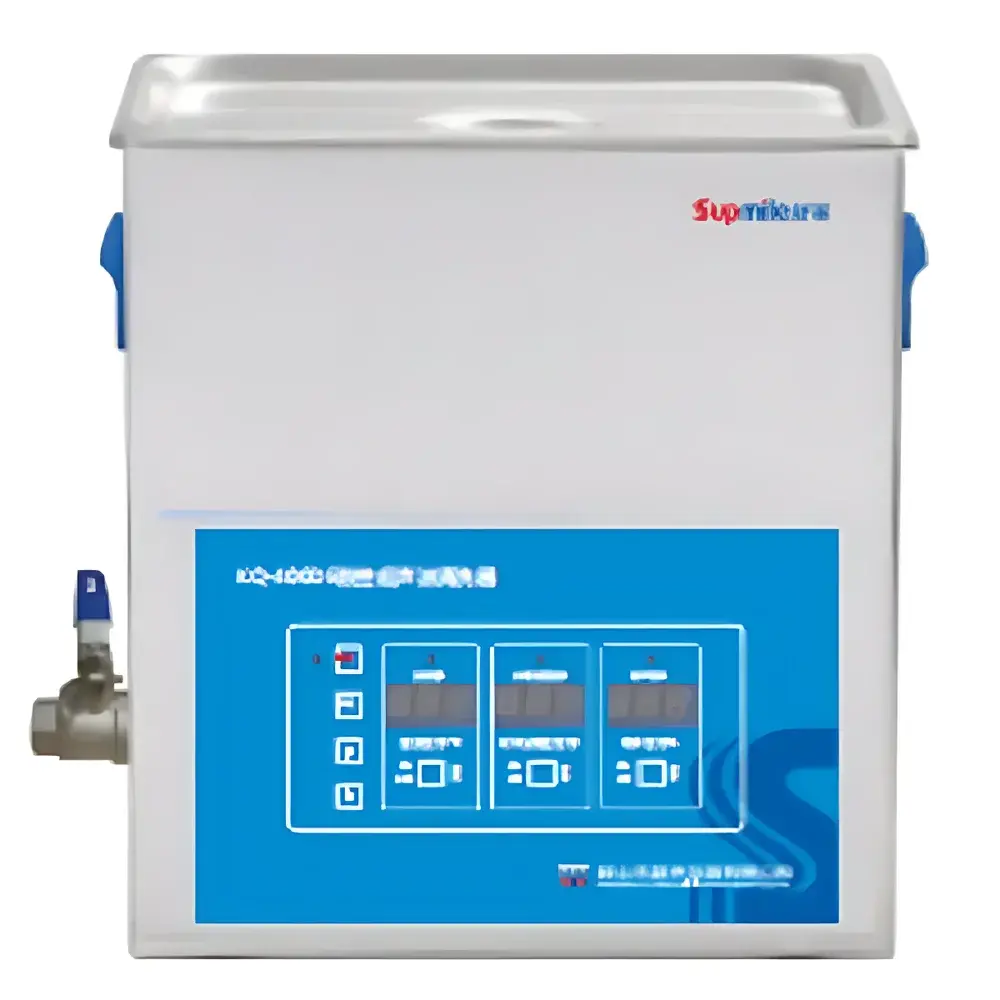
Shumei KQ-500DE Digital Ultrasonic Cleaner
| Brand | Shumei |
|---|---|
| Origin | Jiangsu, China |
| Model | KQ-500DE |
| Capacity | 22.5 L |
| Ultrasonic Frequency | 45/80/100 kHz (selectable) |
| Ultrasonic Power | 500 W |
| Power Adjustment Range | 40–100% |
| Heating Power | 800 W |
| Temperature Control Range | Ambient to 80 °C |
| Timer Range | 1–480 min |
| Frequency Sweep Interval | 1–999 s |
| Tank Dimensions (L×W×H) | 500 × 300 × 150 mm |
| Construction Material | 304 Stainless Steel |
| Included Accessories | Drain Valve (manual), Mesh Basket, Sound-Dampening Lid |
| Safety Features | Over-Temperature & Over-Voltage Protection |
| Control System | Microcontroller-Based Digital Interface with LED Display |
Overview
The Shumei KQ-500DE Digital Ultrasonic Cleaner is a benchtop laboratory-grade cleaning system engineered for precision, reproducibility, and operational flexibility in routine and demanding sample preparation workflows. It operates on the principle of cavitation—generating high-frequency acoustic pressure waves (45, 80, or 100 kHz) within a liquid medium to induce microbubble formation and collapse, delivering mechanical energy at the microscopic level to dislodge particulate contaminants, organic residues, and loosely adhered biofilms from surfaces. Unlike basic cleaners relying on fixed frequency operation, the KQ-500DE incorporates automatic frequency sweeping—a dynamic modulation of ultrasonic output across its selected band—which minimizes standing wave formation and ensures uniform energy distribution throughout the tank volume. This architecture significantly improves cleaning consistency across heterogeneous loads and complex geometries, such as pipette tips, filtration membranes, optical components, and microfluidic devices.
Key Features
- Triple-frequency selection (45 / 80 / 100 kHz) enables method optimization for diverse substrate materials and contaminant types—lower frequencies favor macro-particle removal; higher frequencies improve resolution for fine particulates and delicate surfaces.
- Adjustable ultrasonic power output (40–100% of 500 W nominal) allows precise energy dosing to prevent erosion of sensitive substrates while maintaining efficacy on robust instrumentation parts.
- Integrated heating system (800 W, ambient to 80 °C) supports temperature-assisted cleaning protocols—particularly effective for lipid, wax, or polymer residue removal—and enhances cavitation efficiency in aqueous and mild solvent-based media.
- Extended timer range (1–480 minutes) accommodates both rapid pre-rinse cycles and extended soak-and-clean procedures required for heavily soiled or passivated components.
- 304 stainless steel tank (500 × 300 × 150 mm internal dimensions, 22.5 L capacity) provides corrosion resistance, structural integrity, and compatibility with common cleaning agents including alkaline detergents, enzymatic solutions, and low-concentration isopropanol/water mixtures.
- Digital microcontroller interface with LED display delivers real-time visibility of setpoints and operating status; includes over-temperature and over-voltage fault detection with visual alarm indication for GLP-compliant documentation traceability.
Sample Compatibility & Compliance
The KQ-500DE is routinely deployed in analytical laboratories, quality control environments, and R&D facilities handling glassware (volumetric flasks, cuvettes, chromatography vials), metal components (syringe needles, surgical instruments), ceramic substrates (chromatography plates), and polymeric parts (microtiter plates, sensor housings). Its design conforms to general safety requirements outlined in IEC 61010-1 for electrical equipment used in laboratory settings. While not certified to ISO 13485 or FDA 21 CFR Part 11 out-of-the-box, the unit’s deterministic control logic, non-volatile parameter storage, and auditable fault logging support integration into GMP/GLP workflows when validated per site-specific SOPs. The inclusion of a sound-dampening lid reduces ambient noise to ≤55 dB(A) at 1 m—meeting occupational health guidelines for continuous operation in shared lab spaces.
Software & Data Management
The KQ-500DE operates via embedded firmware without external PC dependency. All user-defined parameters—including frequency mode, power level, temperature setpoint, and duration—are retained in non-volatile memory after power cycling. While no proprietary software or USB/RS-232 connectivity is provided, the digital interface supports manual protocol replication with high inter-run repeatability (±1.5% power output stability, ±0.8 °C thermal accuracy). For regulated environments, users may document operational logs manually or integrate the unit into broader facility monitoring systems using external data loggers connected to the heater and timer status outputs (where available via optional I/O modules).
Applications
- Cleaning of HPLC/GC autosampler vials and injection syringes prior to trace-level analysis.
- Preparation of electron microscopy grids and TEM sample holders to eliminate hydrocarbon contamination.
- Removal of solder flux residues from PCB prototypes in electronics development labs.
- Routine decontamination of reusable labware in clinical microbiology and cell culture facilities.
- Surface activation of PDMS microfluidic chips prior to plasma bonding or protein coating.
- Supporting ASTM D2247 (standard practice for testing water resistance of coatings) and ISO 15528 (paints and varnishes—sampling) through standardized cleaning validation steps.
FAQ
Is the KQ-500DE suitable for cleaning delicate optical lenses or quartz cuvettes?
Yes—when operated at 100 kHz with reduced power (40–60%) and non-aggressive aqueous detergents, it effectively removes sub-micron particles without surface pitting. Avoid prolonged exposure (>10 min) or high-temperature cycles above 45 °C for coated optics.
Can the unit be used with organic solvents such as acetone or chloroform?
No—this model is rated exclusively for aqueous and water-miscible solutions. Use of flammable or halogenated solvents poses fire, explosion, and material compatibility risks and voids warranty.
Does the frequency sweep function require manual activation?
No—the sweep interval (1–999 seconds) is automatically engaged upon frequency selection and runs continuously during ultrasonic operation to maintain spatial homogeneity.
What maintenance is required to ensure long-term performance?
Routine draining and wiping of the tank interior after each use; periodic inspection of the transducer mounting seal and drain valve integrity; annual verification of temperature sensor calibration using a NIST-traceable thermometer.



