
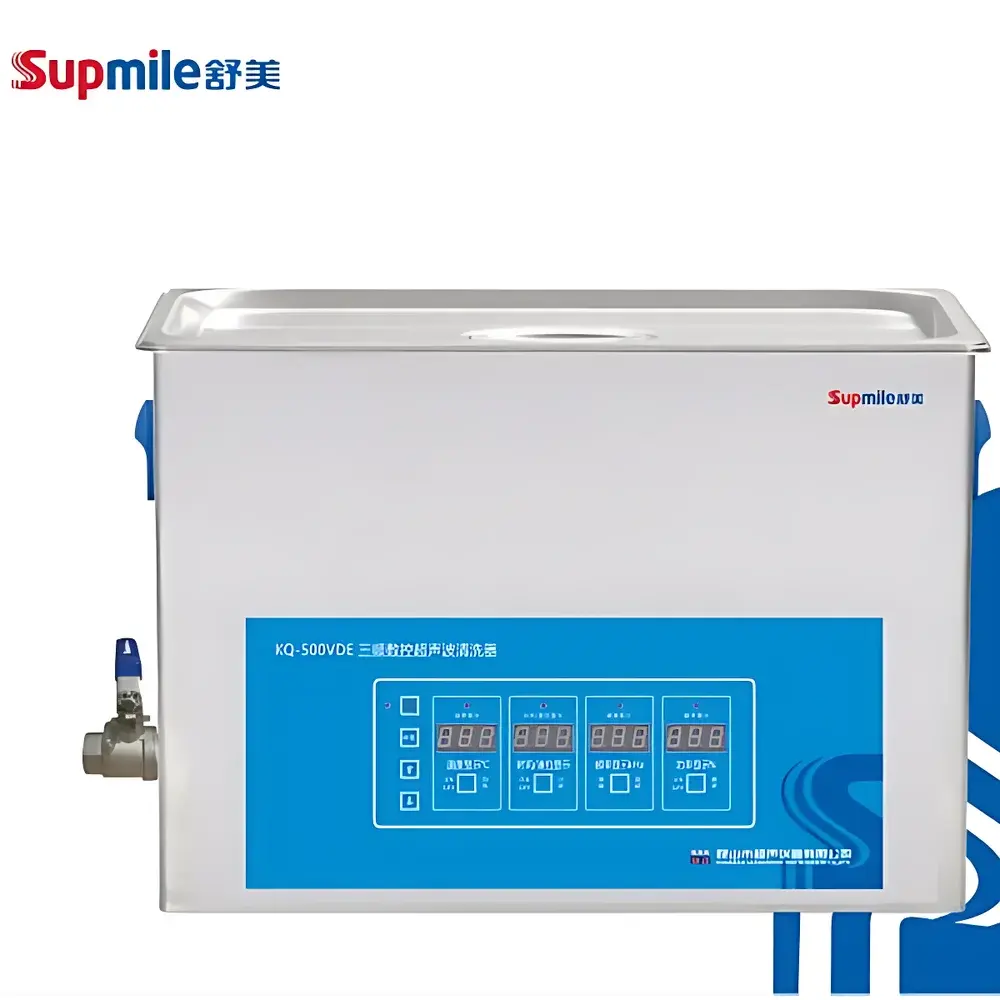
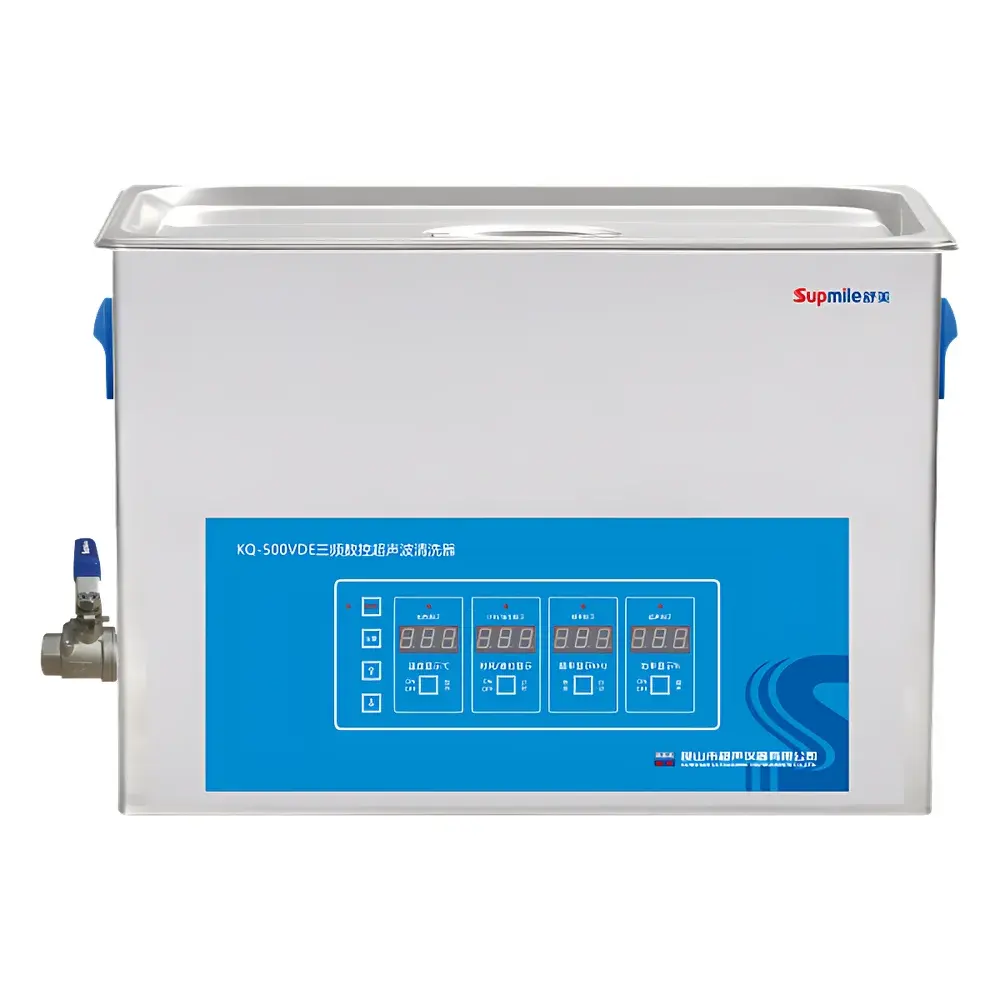
Shumei KQ-500VDE Benchtop Tri-Frequency Digital Ultrasonic Cleaner
| Brand | Shumei |
|---|---|
| Origin | Jiangsu, China |
| Manufacturer Type | Direct Manufacturer |
| Product Category | Domestic |
| Model | KQ-500VDE Tri-Frequency |
| Instrument Type | General-Purpose |
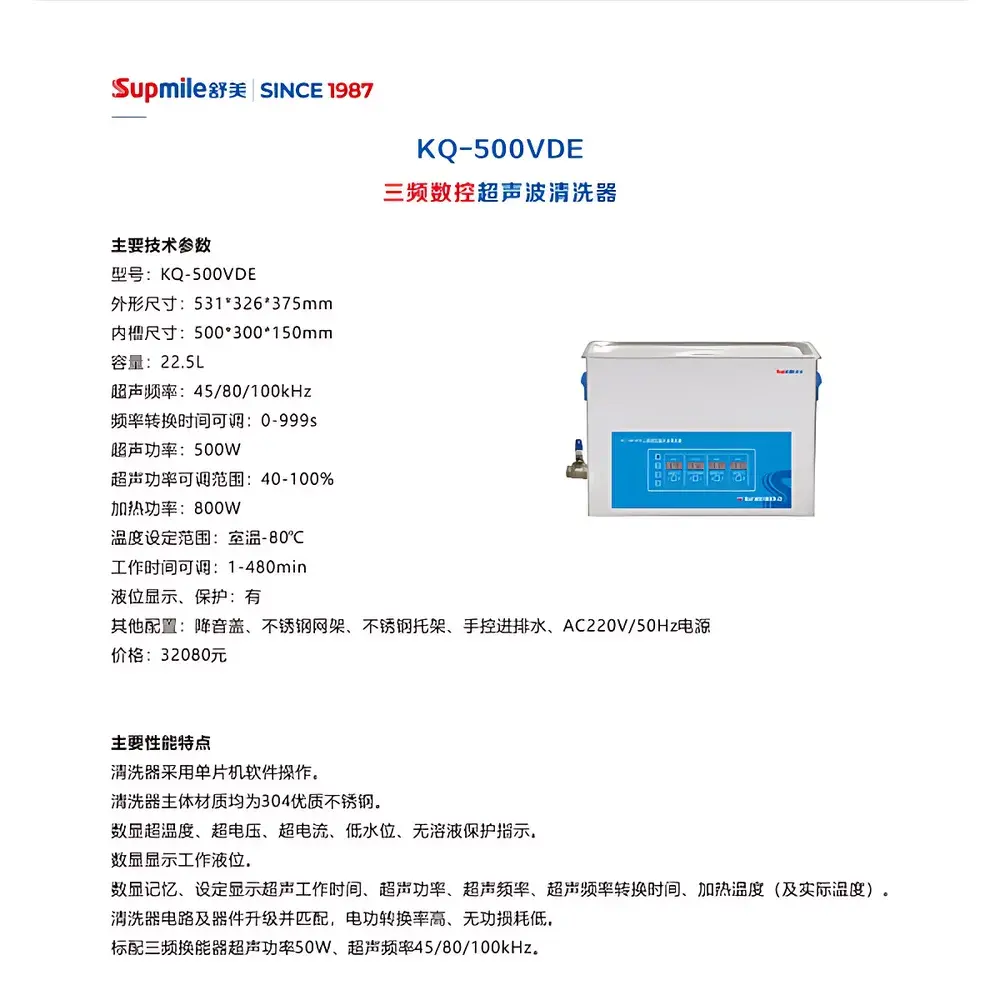
| Tank Capacity | 22.5 L |
| Ultrasonic Frequencies | 45 / 80 / 100 kHz |
| Ultrasonic Power Output | 500 W |
| Power Adjustment Range | 40–100% |
| Temperature Control Range | Ambient to 80 °C |
| Timer Range | 1–480 min |
| Sound-Dampening Lid | Included |
| Drain/Inlet | Manual Control |
| Heating Power | 800 W |
| Frequency Switching Interval | 0–999 s |
| Tank Dimensions (L×W×H) | 500 × 300 × 150 mm |
| External Dimensions (L×W×H) | 531 × 326 × 375 mm |
| Power Supply | AC 220 V, 50 Hz |
Overview
The Shumei KQ-500VDE Benchtop Tri-Frequency Digital Ultrasonic Cleaner is engineered for precision cleaning of delicate laboratory components—including glassware, pipette tips, microplates, optical lenses, semiconductor wafers, and precision mechanical parts—where consistent cavitation intensity and frequency-selective removal of contaminants are critical. It operates on the principle of high-frequency acoustic cavitation: ultrasonic transducers generate pressure waves in aqueous or solvent-based cleaning media, inducing controlled microbubble formation and collapse that dislodge particulate, organic, and thin-film residues from surfaces without mechanical abrasion. Unlike single-frequency cleaners, the KQ-500VDE integrates three discrete ultrasonic frequencies (45 kHz, 80 kHz, and 100 kHz), enabling users to match resonant response to sample geometry, contaminant adhesion strength, and substrate material sensitivity—e.g., lower frequencies (45 kHz) deliver higher energy for robust particulate removal, while higher frequencies (80–100 kHz) provide finer, gentler cleaning for microstructures and fragile substrates.
Key Features
- Tri-frequency ultrasonic generation with independent selection and programmable switching intervals (0–999 s) for adaptive cleaning protocols.
- Digital microcontroller-based operation with real-time display of ultrasonic power (%), selected frequency, elapsed/remaining time, set and actual bath temperature, and liquid level status.
- Full-range ultrasonic power adjustment (40–100% of 500 W nominal output) for process optimization across diverse load conditions and media viscosities.
- Precise thermostatic control (ambient to 80 °C) via integrated 800 W heating element, supporting warm-water and heated solvent cleaning applications.
- Stainless steel 304 construction for tank, lid, basket, and support frame—resistant to corrosion, thermal cycling, and repeated chemical exposure.
- Comprehensive safety protection suite: automatic shutdown on low liquid level, overtemperature, overcurrent, overvoltage, and dry-run conditions.
- Integrated sound-dampening lid reduces ambient noise to ≤65 dB(A) at 1 m distance, meeting occupational health guidelines for continuous lab use.
- Manual fill/drain system with ergonomic valve placement; no external plumbing required.
Sample Compatibility & Compliance
The KQ-500VDE accommodates a broad range of sample types, including but not limited to borosilicate glassware, quartz cuvettes, stainless steel tools, ceramic substrates, and polymer-based microfluidic devices. Its tri-frequency architecture allows method development aligned with ASTM D2295 (cleaning verification of metal parts), ISO 13485 Annex C (cleaning validation for medical device manufacturing), and USP (ultrasonic cleaning of pharmaceutical equipment). The unit complies with IEC 61000-6-3 (EMC emissions) and IEC 61000-6-2 (immunity), and its electrical design meets GB 4793.1 (equivalent to IEC 61010-1) for laboratory electrical safety. While not certified for Class A/B cleanroom integration, it supports GLP/GMP-aligned cleaning SOPs when paired with documented calibration, maintenance logs, and operator training records.
Software & Data Management
The KQ-500VDE employs embedded firmware—not PC-dependent software—to manage all operational parameters. All settings—including frequency selection, power level, timer duration, temperature setpoint, and frequency-switching interval—are stored in non-volatile memory and recalled at power-up. The digital interface provides audit-ready visual feedback: numeric displays update in real time, and fault codes (e.g., “E1” for low water, “E3” for overtemperature) are logged with timestamped event history accessible via front-panel navigation. Though lacking Ethernet or USB data export, the unit supports traceability through manual logbook entries or integration into facility-wide LIMS via external timers and calibrated thermometers used in parallel validation studies.
Applications
- Pre-analytical preparation of HPLC vials, GC autosampler trays, and ICP-MS sample introduction components.
- Cleaning of electron microscopy grids and TEM specimen holders prior to coating or imaging.
- Removal of photoresist residue and etch byproducts from silicon wafers in R&D cleanrooms.
- Decontamination of reusable surgical instruments and dental handpieces under validated protocols.
- Restoration of vintage optical components and museum-grade instrumentation without surface pitting.
- Support of ISO/IEC 17025-accredited testing labs requiring repeatable, parameter-controlled cleaning steps in method validation packages.
FAQ
Is the KQ-500VDE suitable for cleaning delicate MEMS devices?
Yes—when operated at 80 or 100 kHz with reduced power (40–60%) and deaerated DI water or low-surface-tension solvents, it delivers controlled cavitation suitable for microelectromechanical systems.
Can the unit be used with flammable solvents?
No—this model is designed exclusively for aqueous or water-miscible, non-flammable cleaning solutions. Flammable solvent use requires explosion-proof certification (ATEX/IECEx), which the KQ-500VDE does not hold.
Does it support automated data logging or remote monitoring?
No—the unit lacks network interfaces or analog outputs. For regulatory environments requiring electronic records, external data loggers must be deployed for temperature and timer verification.
What maintenance is required for long-term reliability?
Monthly inspection of transducer coupling integrity, quarterly descaling of the heater element (if using hard water), and annual verification of safety interlocks and temperature sensor accuracy per internal QA procedures.
Is the stainless steel tank electropolished?
No—the interior features standard #4 brushed finish 304 stainless steel, sufficient for routine lab use; electropolishing is available as a custom option upon request.



