
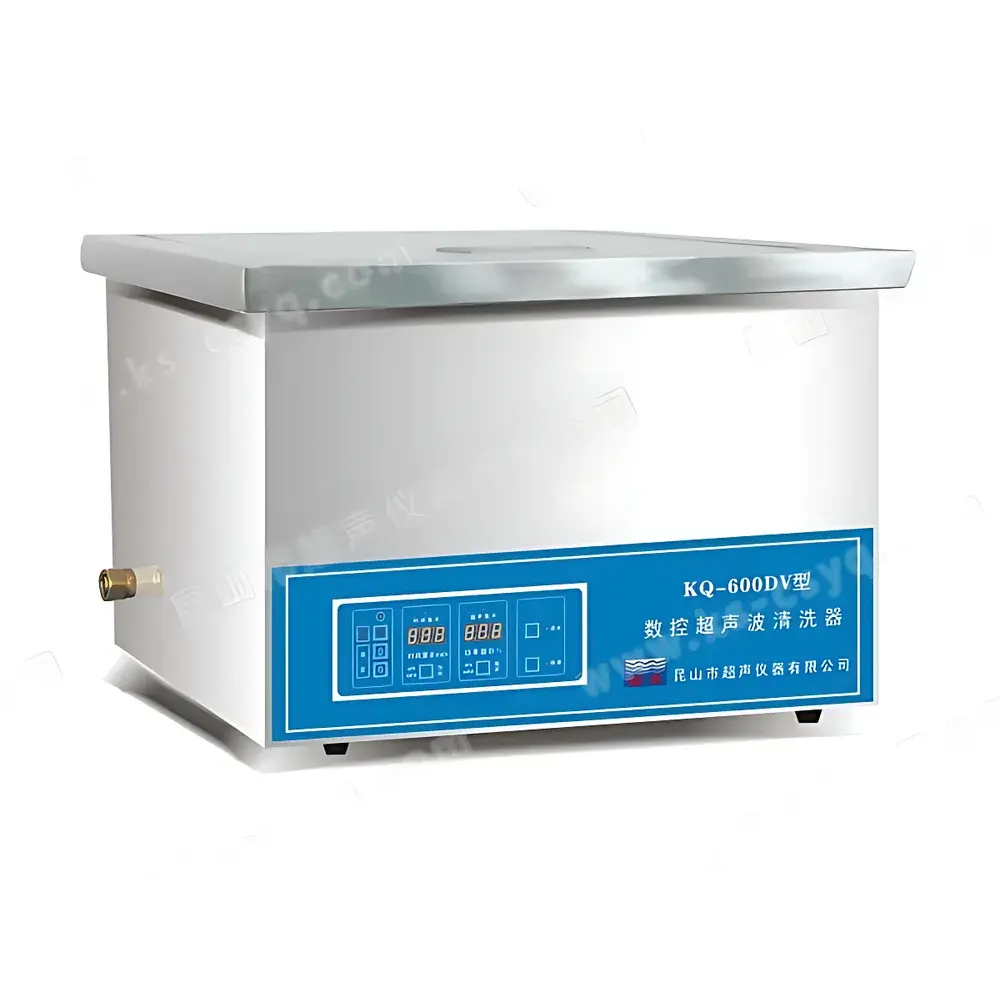
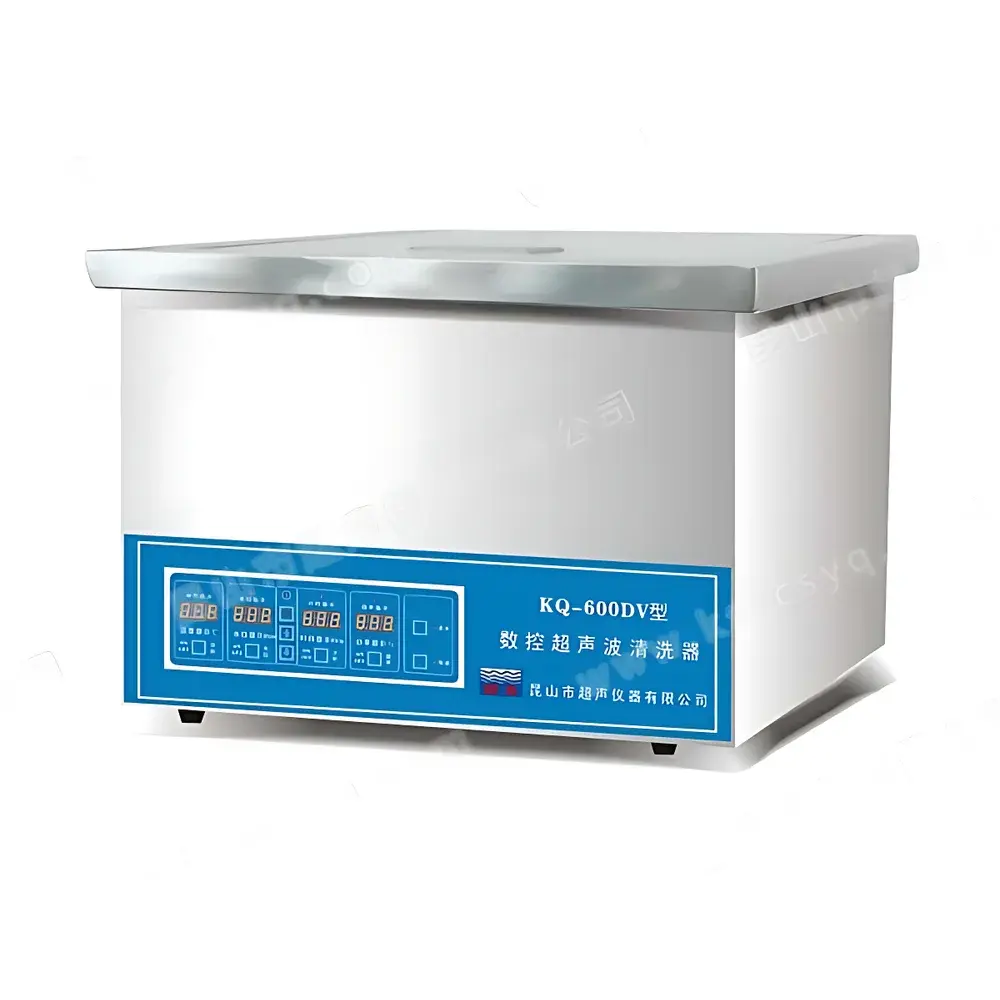
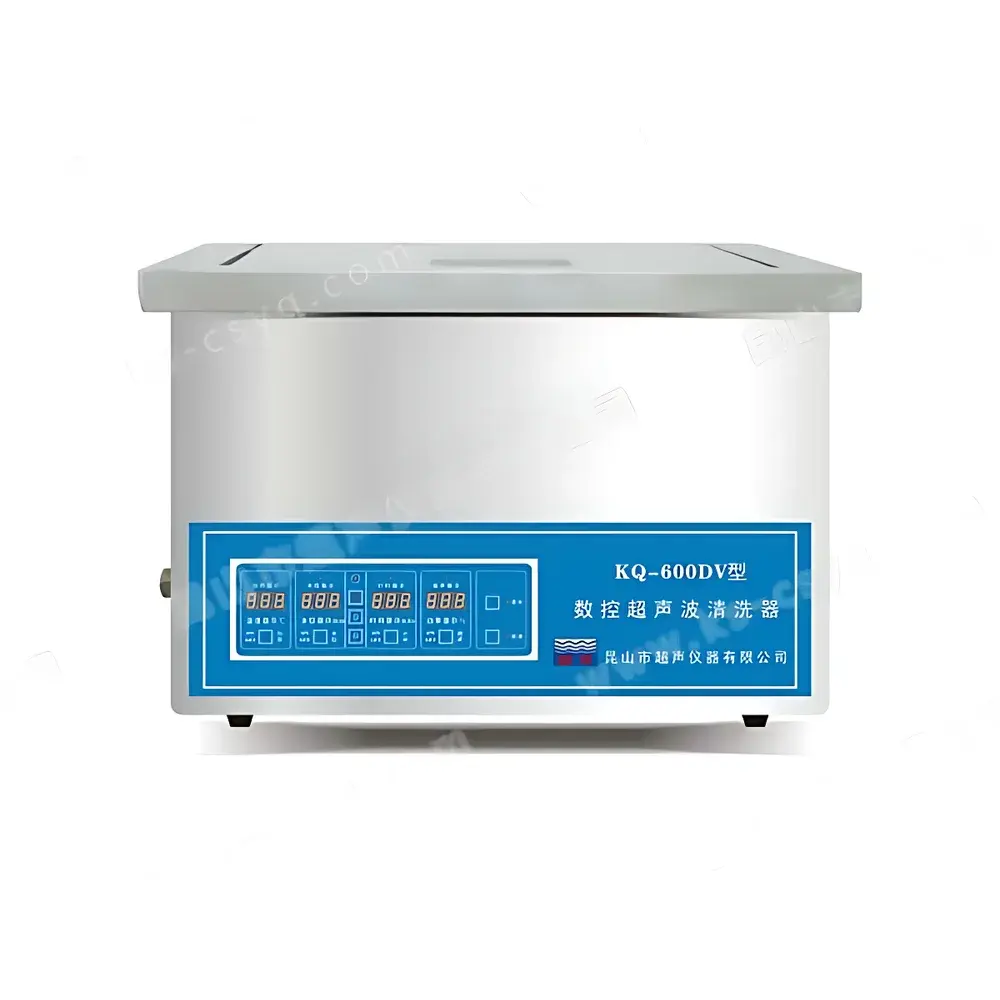
SHUMEI KQ-600DV Benchtop Digital Ultrasonic Cleaner
| Brand | SHUMEI |
|---|---|
| Origin | Jiangsu, China |
| Manufacturer Type | Direct Manufacturer |
| Equipment Type | General-Purpose Ultrasonic Cleaner |
| Model | KQ-600DV |
| Capacity | 27 L |
| Ultrasonic Frequency | 40 kHz |
| Ultrasonic Power Output | 600 W |
| Adjustable Power Range | 40–100% |
| Temperature Control Range | 10–80 °C |
| Timer Range | 1–480 min |
| Sound-Dampening Lid | Yes |
| Electronic Inlet/Drain Control | Yes |
| Heating Power | 1000 W |
| Tank Dimensions (L×W×H) | 500 × 300 × 180 mm |
| External Dimensions (L×W×H) | 638 × 460 × 395 mm |
| Water Level Display Range | 1–140 mm |
| Protection Features | Over-Temperature, Over-Voltage, Over-Current, Low-Water-Level Indication |
| Heating Method | PTC Surface-Mount Heater |
| Auto-Frequency Sweeping | Yes |
| Transducer Specification | Standard 50 W per element, 40 kHz |
| Construction Material | 304 Stainless Steel |
| Power Supply | 220 V / 50 Hz |
Overview
The SHUMEI KQ-600DV is a benchtop digital ultrasonic cleaner engineered for precision cleaning of laboratory glassware, precision components, optical elements, medical instruments, and electronic assemblies. It operates on the principle of cavitation—generated by high-frequency mechanical vibrations transmitted through a liquid medium at 40 kHz—to dislodge particulate contaminants, organic residues, and biofilms from surfaces with micron-level reach. Its 27 L stainless steel tank (500 × 300 × 180 mm internal) provides ample volume for batch processing of flasks, cuvettes, pipette tips, surgical tools, and small mechanical parts. Designed for routine QC/QA labs, R&D facilities, and clinical support environments, the KQ-600DV integrates microprocessor-based control logic with real-time parameter monitoring to ensure repeatable cleaning performance across diverse sample geometries and soil types.
Key Features
- Microcontroller-driven digital interface with independent adjustment of ultrasonic power (40–100%), temperature (10–80 °C), and timer (1–480 min)
- Robust 304 stainless steel tank and housing, resistant to corrosion from aqueous and mild solvent-based cleaning solutions
- PTC surface-mount heating system enabling rapid, uniform temperature ramping and stable thermal maintenance within ±2 °C accuracy
- Integrated sound-dampening lid with ergonomic latch mechanism—reduces ambient noise to ≤65 dB(A) during operation
- Electronic inlet and drain control with automatic low-water cutoff and visual water-level indication (1–140 mm range)
- Comprehensive safety architecture: over-temperature, over-voltage, over-current, and low-water-level protection with on-screen fault codes
- Auto-frequency sweeping function minimizes standing wave formation and ensures uniform energy distribution across the tank volume
- Factory-calibrated transducers (50 W each, 40 kHz nominal) mounted on the tank bottom for optimal acoustic coupling and long-term stability
Sample Compatibility & Compliance
The KQ-600DV accommodates a broad range of sample formats—including volumetric flasks, centrifuge tubes, Petri dishes, syringe filters, fiber optic connectors, and dental handpieces—without requiring custom fixtures. Its non-aggressive, non-abrasive cleaning mechanism preserves dimensional integrity and surface finish of delicate substrates such as borosilicate glass, anodized aluminum, and coated optics. While not certified for sterile reprocessing under ISO 17664 or AAMI ST79, the unit supports GLP-aligned cleaning validation protocols when used with documented parameters (time, temperature, frequency, solution composition). Its electrical design complies with IEC 61010-1:2010 for laboratory equipment safety; electromagnetic compatibility meets EN 61326-1:2013 Class B requirements.
Software & Data Management
The KQ-600DV features embedded firmware with non-volatile memory capable of storing up to 10 user-defined cleaning programs, including recallable settings for power, temperature, duration, and sweep mode. All operational parameters—including cumulative runtime, last-used configuration, and date-of-manufacture—are displayed and retained without external software dependency. Though it lacks Ethernet or USB connectivity, its digital display logs real-time status indicators (e.g., “HEATING”, “ULTRASOUND ON”, “LOW WATER”) and error flags (E01–E04) for traceable troubleshooting. For regulated environments, users may document cycle execution manually or integrate the unit into broader lab management systems via time-stamped operator logs and SOP-driven procedural checklists.
Applications
- Routine decontamination of analytical glassware prior to HPLC, ICP-MS, or titration workflows
- Removal of polishing compounds and oxide layers from metallurgical specimens before SEM/EDS analysis
- Cleaning of reusable surgical instruments in veterinary or academic biomedical labs (as a pre-sterilization step)
- Deposition residue removal from semiconductor wafers and MEMS devices during prototyping
- Extraction aid for solid-phase microextraction (SPME) probe conditioning and filter membrane preparation
- Restoration of antique optical lenses and precision measurement tools where manual scrubbing risks micro-scratching
FAQ
Is the KQ-600DV suitable for cleaning delicate optics or coated lenses?
Yes—when operated at reduced power (40–60%) and moderate temperature (30–45 °C) with low-surface-tension, non-ionic detergents, it effectively removes fingerprints and dust without damaging anti-reflective or hydrophobic coatings.
Can the unit be used with solvents other than water?
It is compatible with aqueous solutions, alcohols (e.g., isopropanol), and mild aqueous-organic blends; however, flammable or highly volatile solvents (e.g., acetone, ether) are strictly prohibited due to ignition risk and transducer degradation.
Does the KQ-600DV meet FDA 21 CFR Part 11 requirements?
No—it does not provide electronic audit trails, user authentication, or data export capabilities required for Part 11 compliance; it is intended for non-GMP research and preparatory use only.
What maintenance is required for long-term reliability?
Monthly inspection of transducer adhesion, quarterly descaling of the heater surface using 5% citric acid solution, and annual verification of timer and temperature calibration against NIST-traceable references are recommended.
Is remote monitoring or network integration possible?
Not natively—the device has no communication ports or API; integration into centralized lab monitoring systems requires third-party hardware-based signal logging (e.g., relay-triggered data loggers).



