
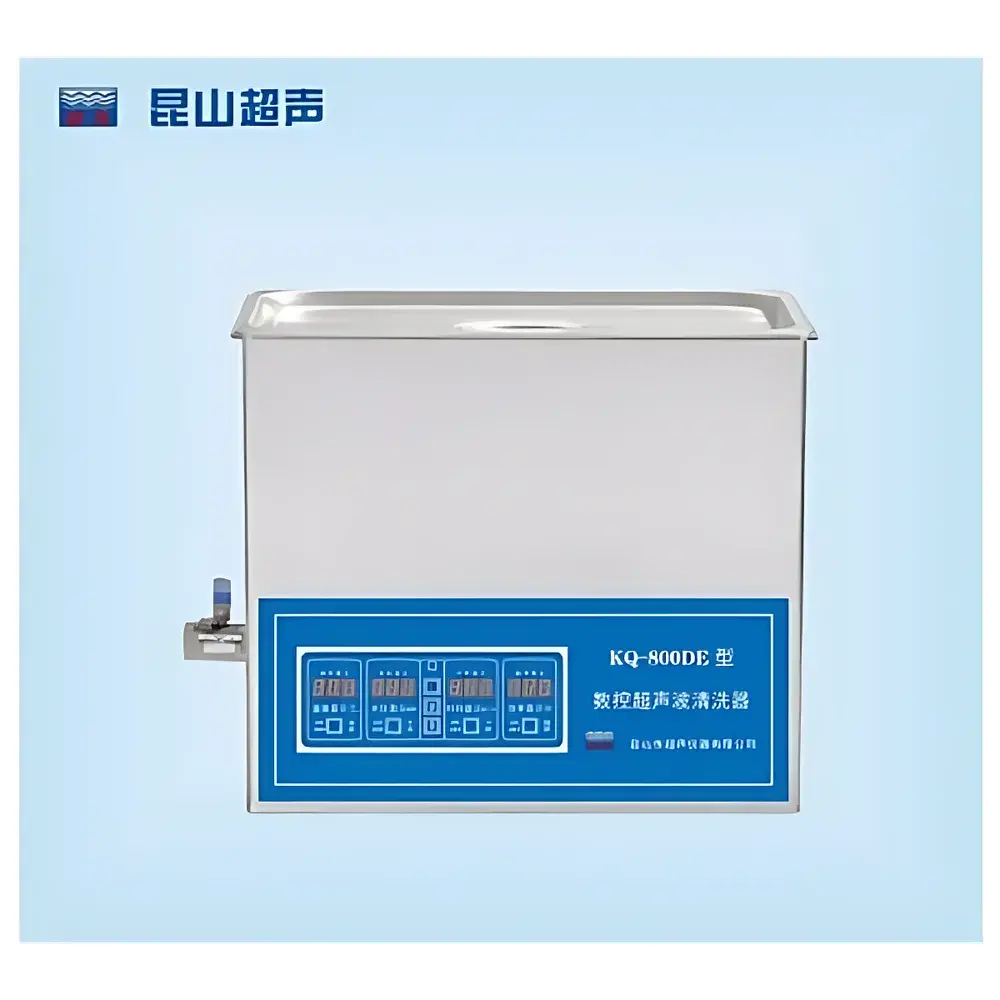
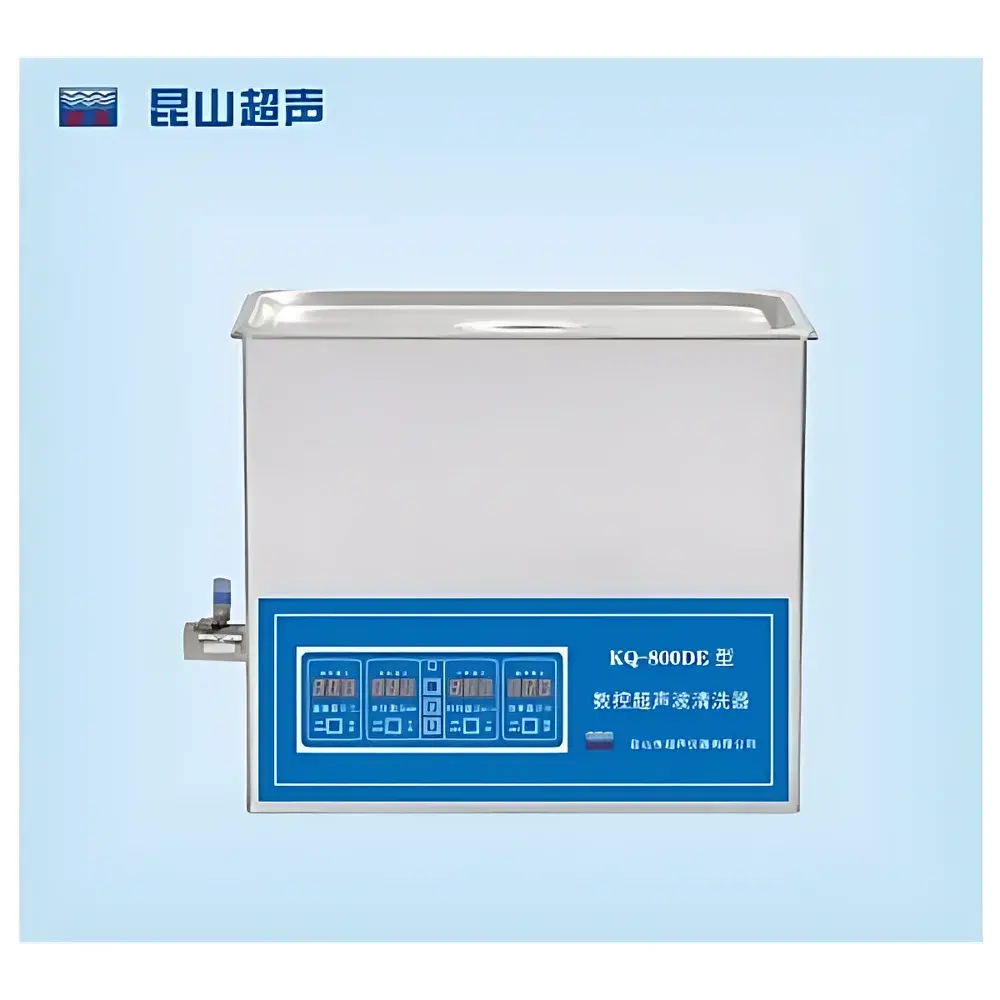
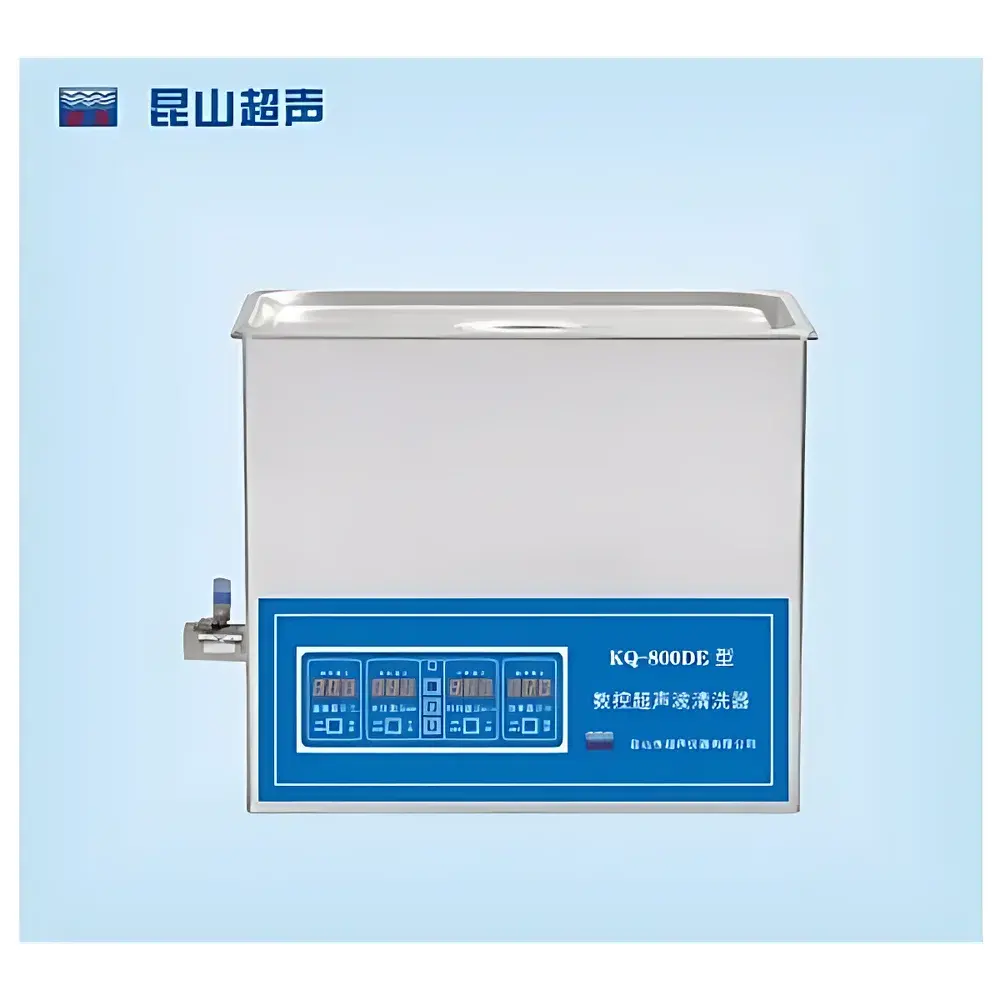
Shumei KQ-800DE Digital Ultrasonic Cleaner
| Brand | Shumei |
|---|---|
| Origin | Jiangsu, China |
| Model | KQ-800DE |
| Capacity | 30 L |
| Ultrasonic Frequency | 40 kHz |
| Ultrasonic Power | 800 W |
| Power Adjustment | Yes |
| Time Adjustment | Yes |
| Sound-Dampening Lid | Included |
| Manual Fill/Drain | Yes |
| Tank Material | 304 Stainless Steel |
| Protection Features | Over-Temperature, Over-Voltage, Over-Current, Low-Water-Level, No-Solution Detection |
| Display | Digital LED (Time, Power, Temperature, Water Level) |
Overview
The Shumei KQ-800DE Digital Ultrasonic Cleaner is a benchtop-capable, microprocessor-controlled cleaning system engineered for reproducible, high-efficiency removal of particulate, organic, and ionic contaminants from laboratory glassware, precision components, optical elements, and small-volume instrumentation parts. It operates on the principle of ultrasonic cavitation—generating controlled acoustic pressure waves at a fixed frequency of 40 kHz within an aqueous or compatible solvent bath. These waves induce transient microbubble formation and collapse (inertial cavitation), producing localized shear forces and microstreaming that dislodge adherent residues without mechanical abrasion. Designed for routine QC/QA labs, R&D facilities, and maintenance workshops, the KQ-800DE delivers consistent energy delivery across its 30-liter stainless steel tank—constructed entirely from ASTM A240 Type 304 stainless steel—to ensure corrosion resistance, structural integrity, and long-term compatibility with mild alkaline, acidic, or neutral cleaning formulations.
Key Features
- Microcontroller-based digital operation with real-time LED display showing elapsed time, set power level (10–100% of 800 W), and status indicators for thermal, electrical, and fluid-level safety interlocks
- Integrated multi-layer protection circuitry: automatic shutdown upon detection of over-temperature, over-voltage, over-current, low water level, or absence of cleaning solution
- Adjustable ultrasonic power output (stepless or discrete increments depending on firmware version) to optimize cleaning intensity for delicate vs. robust substrates
- Programmable cleaning duration (typically 1–30 minutes, configurable via front-panel keypad) with memory retention for frequently used protocols
- Sound-dampening lid reduces ambient noise by ≥15 dB(A) and minimizes solvent evaporation during operation
- Manual fill-and-drain interface—compatible with standard laboratory faucet connections and floor drain setups—enabling flexible integration into existing utility infrastructure
- Standard accessories include a perforated 304 stainless steel mesh basket and a rigid support tray for uniform part immersion and acoustic coupling
Sample Compatibility & Compliance
The KQ-800DE accommodates a broad range of sample geometries—including volumetric flasks, burettes, pipette tips, chromatography vials, semiconductor wafers (with appropriate fixturing), and small metal or ceramic components—provided they are acoustically stable and chemically inert in the selected cleaning medium. While not certified to ISO 13485 or FDA 21 CFR Part 11 out-of-the-box, its operational parameters and safety architecture align with general laboratory good practice (GLP) requirements for documented cleaning validation. Users performing regulated cleaning processes (e.g., pharmaceutical equipment prep per USP or ASTM D2603 for ultrasonic cleaning verification) may implement external logging and audit-trail procedures using third-party data acquisition systems.
Software & Data Management
The KQ-800DE operates via embedded firmware without external PC dependency. All operational parameters—including time, power level, and active safety flags—are displayed and retained in non-volatile memory. Though it lacks native USB/Ethernet connectivity or compliant electronic record functionality, its deterministic behavior supports manual SOP documentation and periodic calibration verification. For laboratories requiring 21 CFR Part 11-compliant audit trails, integration with validated Lab Information Management Systems (LIMS) or programmable logic controllers (PLCs) is feasible via dry-contact relay outputs (if equipped on optional control modules) or serial communication interfaces (subject to hardware revision).
Applications
- Routine decontamination of HPLC/GC autosampler vials, syringe filters, and column frits prior to reuse
- Removal of polishing compounds and oxide layers from optical lenses and mirrors in metrology labs
- Cleaning of surgical instruments and dental tools in research-focused biomedical facilities (non-sterile applications only)
- Preparation of electron microscopy grids and TEM sample holders to minimize carbon contamination
- Deposition residue removal from semiconductor mask blanks and photomask carriers
- Validation of cleaning efficacy in method development studies per ISO 14971 risk management frameworks
FAQ
Is the KQ-800DE suitable for cleaning heat-sensitive plastic components?
Yes—when operated without heating (as temperature control is not available) and at reduced power settings (≤40% nominal), it safely cleans polypropylene, PTFE, and polycarbonate parts without warping or surface degradation.
Can this unit be used with flammable solvents?
No. The KQ-800DE is designed exclusively for aqueous or water-miscible solutions. Use of alcohol-, acetone-, or chlorinated-solvent-based baths requires explosion-proof certified equipment and is strictly prohibited.
What is the expected service life of the transducers under continuous daily use?
With proper maintenance—including regular descaling, avoidance of dry operation, and adherence to recommended duty cycles (max 3 × 20-min sessions/day)—the piezoelectric transducers typically maintain ≥90% nominal output efficiency for 5+ years.
Does the unit include a heater or temperature regulation capability?
No. The KQ-800DE does not incorporate a heating element or temperature feedback loop. Ambient bath temperature rise during extended operation is limited to ≤5 °C above room temperature due to efficient electroacoustic conversion.
How is calibration verified for ultrasonic power output?
Power calibration follows ASTM E1574-22 (Standard Practice for Determining Ultrasonic Cleaner Performance Using Aluminum Foil Test). Shumei provides foil test kits and reference procedure documentation; third-party metrology labs may perform traceable power mapping upon request.



