
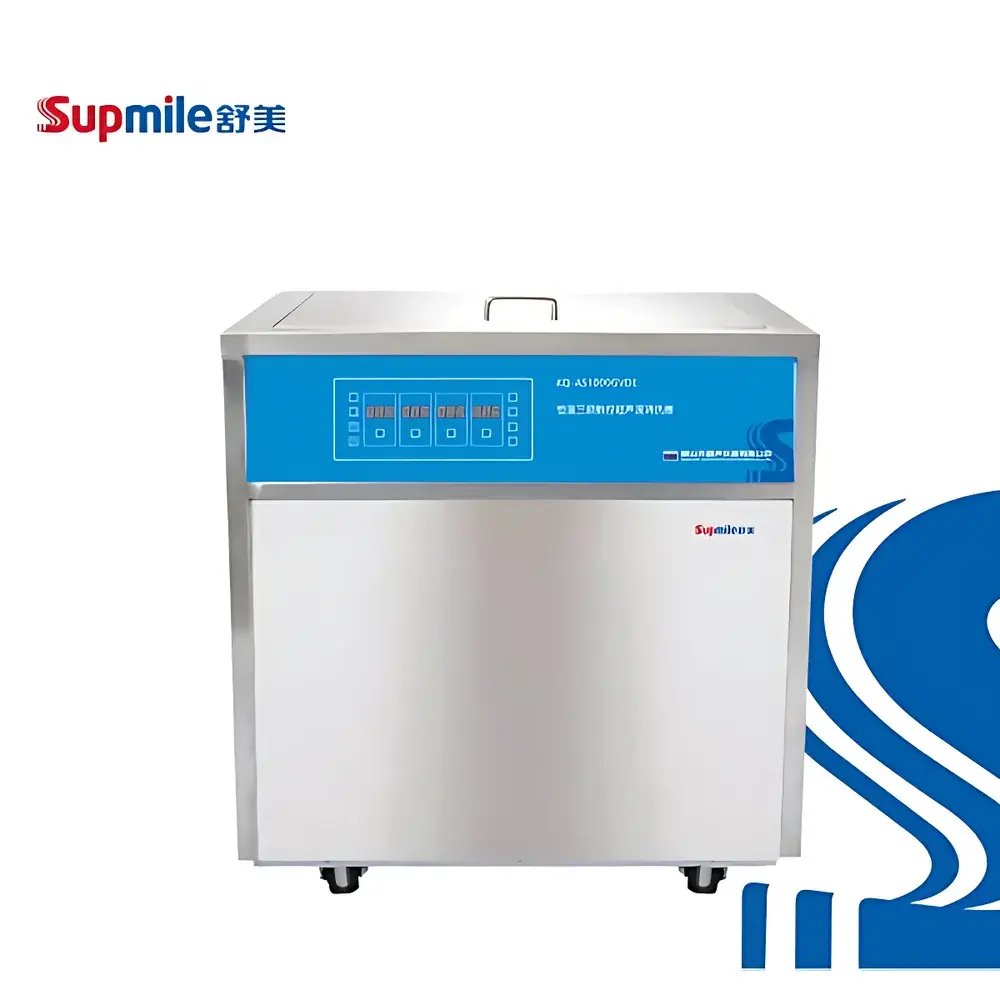
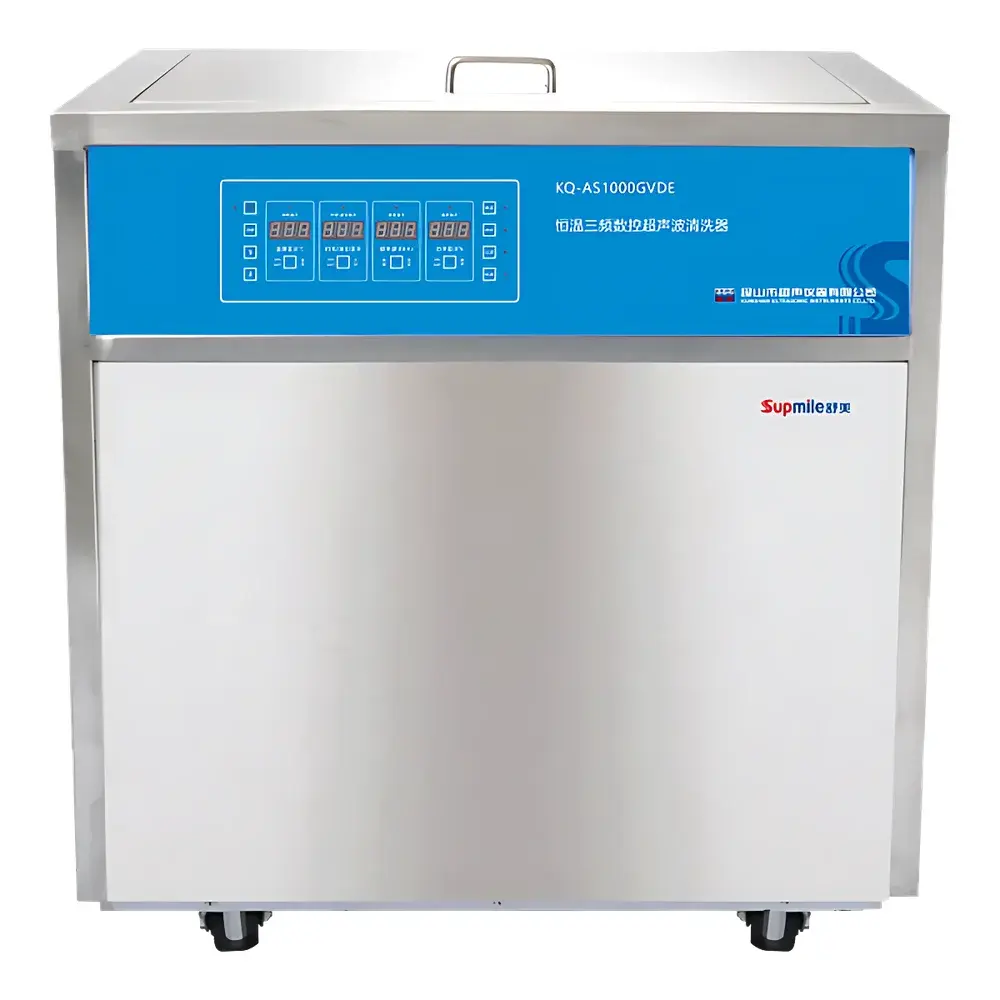
Shumei KQ-AS1000GVDE Triple-Frequency Programmable Temperature-Controlled Ultrasonic Cleaner
| Brand | Shumei |
|---|---|
| Origin | Jiangsu, China |
| Manufacturer Type | Direct Manufacturer |
| Instrument Type | General-Purpose Ultrasonic Cleaner |
| Tank Capacity | 72 L |
| Ultrasonic Frequencies | 45 / 80 / 100 kHz |
| Ultrasonic Power Output | 1000 W (Adjustable 40–100%) |
| Heating Power | 3000 W |
| Cooling Power | 1000 W |
| Temperature Control Range | 0–80 °C (±2 °C accuracy) |
| Timer Range | 1–480 min |
| Frequency Switching Interval | 0–999 s |
| Liquid Level Monitoring & Protection | Yes |
| Solution Filtration System | Integrated |
| Lid Operation | Motorized Noise-Reduction Cover |
| Drain/Inlet Control | Electrically Actuated |
| Power Supply | AC 220 V / 50 Hz or AC 380 V / 50 Hz |
| Internal Tank Dimensions | 600 × 300 × 400 mm |
| External Dimensions | 1390 × 770 × 880 mm |
| Construction Material | 304 Stainless Steel |
| Display | Digital LED with Real-Time Parameter Feedback |
Overview
The Shumei KQ-AS1000GVDE is a high-capacity, triple-frequency programmable ultrasonic cleaner engineered for precision cleaning of delicate and complex components in research laboratories, quality control environments, and industrial R&D facilities. It operates on the principle of cavitation-induced acoustic energy transfer—where controlled ultrasonic waves generate microscopic vacuum bubbles in liquid media that collapse violently upon contact with surfaces, dislodging particulate contaminants, organic residues, and thin-film deposits without mechanical abrasion. Its tri-band frequency capability (45 kHz, 80 kHz, and 100 kHz) enables selective optimization across diverse sample geometries and contaminant types: lower frequencies deliver higher cavitation intensity for robust particulate removal from machined parts; mid-range frequencies balance penetration and gentleness for glassware and optical components; while the 100 kHz mode offers fine-resolution cleaning for microfluidic devices, semiconductor wafers, and MEMS assemblies. The integrated Peltier-assisted cooling system (1000 W), combined with 3000 W heating capacity, ensures stable temperature maintenance within ±2 °C across the full 0–80 °C operating range—critical for temperature-sensitive solvents or enzymatic cleaning protocols.
Key Features
- Triple-frequency transducer array with independent digital control over 45 kHz, 80 kHz, and 100 kHz modes—each selectable via front-panel interface or software command
- Full digital microcontroller architecture with non-volatile memory for parameter recall: frequency selection, power level (40–100%), temperature setpoint, timer duration (1–480 min), and inter-frequency dwell time (0–999 s)
- Motorized noise-reduction lid with position-sensing feedback and automatic safety interlock—reduces ambient sound pressure to ≤65 dB(A) at 1 m distance
- Electrically actuated inlet and drain valves with flow monitoring, enabling automated fill-and-empty cycles compatible with centralized lab water systems
- Real-time liquid level sensing with low-level cutoff and visual/audible alarm—prevents dry-run operation and transducer damage
- Integrated stainless-steel filtration module (5 µm nominal rating) recirculates bath solution, extending solvent life and reducing particulate redeposition
- 304 stainless steel tank and housing structure conforming to ISO 9001 manufacturing standards; corrosion-resistant welds and electropolished interior surface finish
Sample Compatibility & Compliance
The KQ-AS1000GVDE accommodates a wide range of laboratory and industrial substrates—including borosilicate glassware, quartz cuvettes, metal calibration standards, ceramic substrates, polymer microplates, and silicon-based microdevices. Its large 72 L tank volume supports batch processing of up to 12 standard 1-L volumetric flasks or 48 × 15 mL centrifuge tubes simultaneously. All operational parameters are traceable and auditable via internal event logging, supporting GLP-compliant documentation requirements. While not certified to UL/CSA or CE for medical device reprocessing, the unit meets IEC 61000-6-3 (EMC emission limits) and IEC 61000-6-2 (immunity) standards. Temperature stability and timer repeatability have been validated per ASTM E2877-22 for laboratory equipment performance verification.
Software & Data Management
The embedded firmware supports RS-232 and optional Ethernet (TCP/IP) communication protocols for remote parameter configuration, real-time data streaming, and event-triggered logging. Optional Shumei CleanControl™ PC software provides GMP-aligned audit trail functionality—including user login authentication, change history tracking, electronic signature fields, and exportable CSV reports compliant with FDA 21 CFR Part 11 requirements. All temperature, power, and timing values are stored with timestamps and checksum validation to ensure data integrity across power cycles.
Applications
- Cleaning of HPLC columns, GC injectors, and mass spectrometry ion sources prior to calibration
- Preparation of electron microscopy grids and TEM sample holders requiring sub-micron particle-free surfaces
- Removal of photoresist residues and etch byproducts from photomasks and lithography tools
- Decontamination of reusable pipette tips, filter housings, and fluidic manifolds in regulated bioprocessing labs
- Surface activation of PDMS microchannels prior to plasma bonding or protein immobilization
- Validation of cleaning efficacy per USP <1051> and ISO 15883-5 for reusable laboratory instrumentation
FAQ
What is the maximum permissible load weight in the tank?
The tank is rated for continuous operation with up to 65 kg of immersed material, assuming uniform distribution and adequate solution coverage above all items.
Can this unit be integrated into a building management system (BMS)?
Yes—via Modbus RTU over RS-485 (optional module) or HTTP API over Ethernet, enabling status polling, fault alerts, and scheduled start/stop commands.
Is third-party calibration documentation available?
Shumei provides factory calibration certificates traceable to NIM (National Institute of Metrology, China); accredited third-party calibration (e.g., A2LA or UKAS) can be arranged upon request.
Does the unit support solvent compatibility verification for aggressive chemistries?
The 304 stainless steel construction is compatible with aqueous alkaline cleaners, isopropanol, ethanol, acetone, and mild chlorinated solvents; extended exposure to hydrochloric acid or sodium hypochlorite is not recommended.
How often does the filtration cartridge require replacement?
Under typical laboratory use (8 hrs/day, aqueous detergent), the 5 µm filter element should be replaced every 3–6 months—or when pressure differential exceeds 0.15 bar, as indicated by the onboard sensor.



