
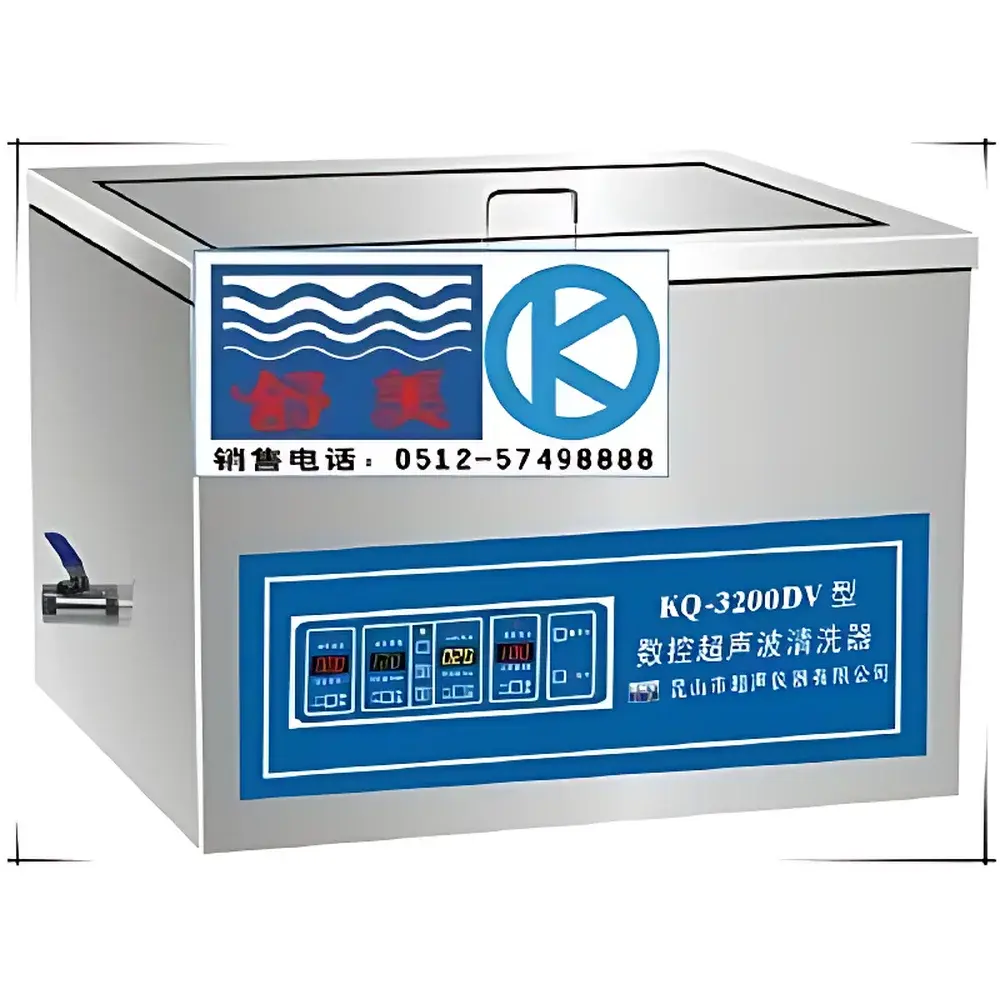
Shumei KQ3200DV Desktop Digital Ultrasonic Cleaner
| Brand | Shumei |
|---|---|
| Origin | Jiangsu, China |
| Manufacturer Type | Direct Manufacturer |
| Country of Origin | China |
| Model | KQ3200DV |
| Dimensions (W×D×H) | 410 × 260 × 380 mm |
| Inner Tank Dimensions | 300 × 150 × 180 mm |
| Tank Capacity | 8 L |
| Ultrasonic Frequency | 40 kHz |
| Ultrasonic Power Output | 150 W |
| Power Adjustment Range | 40–100% |
| Fill Level Range | 1–140 mm |
| Heating Power | 400 W |
| Temperature Control Range | 10–80 °C |
| Timer Range | 1–480 min |
| Cumulative Operating Time Counter | Up to 999,999 h |
| Heating Element | Immersed stainless-steel sheathed heater |
| Tank Material | 304 Stainless Steel |
| Lid | Sound-dampening stainless-steel lid with vapor recovery system |
| Drain & Auto-fill | Electrically controlled |
| Basket | Polypropylene mesh basket |
| Protection Functions | Over-temperature, over-current, low-level, dry-run, and voltage fluctuation detection |
Overview
The Shumei KQ3200DV Desktop Digital Ultrasonic Cleaner is an integrated benchtop system engineered for precision cleaning, degassing, emulsification, cell disruption, and solvent extraction in academic laboratories, quality control environments, and light industrial R&D settings. It operates on the principle of high-frequency ultrasonic cavitation—generating microscopic vacuum bubbles in liquid media that collapse violently upon reaching resonance, producing localized shockwaves and microstreaming forces capable of dislodging sub-micron particulates from complex geometries. With a fixed 40 kHz transducer frequency optimized for balanced penetration depth and cleaning intensity, the KQ3200DV delivers reproducible energy distribution across its 8-liter stainless-steel tank. Its fully digital control architecture enables precise coordination between ultrasonic output, thermal regulation, and fluid management—critical for applications requiring strict process traceability under GLP or ISO/IEC 17025-compliant workflows.
Key Features
- Integrated digital interface displaying real-time and setpoint values for ultrasonic duration, power level (%), water level (mm), bath temperature (°C), and cumulative operational hours (up to 999,999 h)
- Microcontroller-based firmware supporting programmable sequences: independent adjustment of ultrasonic power (40–100%), heating temperature (10–80 °C), and timer (1–480 min)
- Stainless-steel tank (304 grade) formed via deep-drawn stamping for structural integrity and corrosion resistance; compatible with aqueous, alcoholic, and mild alkaline cleaning solutions
- Sound-dampening hinged lid equipped with condensate recovery channel to minimize volatile organic compound (VOC) emissions during heated operation
- Electrically actuated fill-and-drain system with level-sensing feedback for repeatable solution volume control
- Comprehensive safety monitoring: dual thermal cutoffs, current-limiting circuitry, low-level shutoff, and dry-run prevention logic
- Detachable polypropylene mesh basket with ergonomic handle for safe handling of delicate components and optical parts
Sample Compatibility & Compliance
The KQ3200DV accommodates a broad range of sample types—including metal alloys, glassware, ceramic substrates, printed circuit boards, dental instruments, and biological tissue specimens—without mechanical abrasion or surface etching. Its 40 kHz frequency ensures effective removal of organic residues, fluxes, polishing compounds, and biofilms while preserving dimensional tolerances of precision-engineered parts. The unit complies with IEC 61000-6-3 (EMC emission limits) and IEC 61000-6-2 (immunity requirements). While not certified for medical device reprocessing per ISO 15883 or FDA 510(k), it meets general laboratory equipment safety standards under GB 4793.1–2007 (Chinese equivalent of IEC 61010-1). For regulated environments, audit-ready operation logs can be manually recorded; optional RS232 interface supports external data capture for SOP-driven documentation.
Software & Data Management
The KQ3200DV operates without proprietary software—the embedded controller stores all user-defined parameters and runtime events in non-volatile memory. Each session records start time, set temperature, applied power percentage, actual bath temperature, and elapsed cycle duration. The cumulative hour counter serves as a maintenance scheduling reference for transducer aging assessment and preventive service planning. Though no native PC connectivity is included, the RS232 port (optional accessory) enables integration into centralized lab asset tracking systems using ASCII command protocol. All displayed metrics meet NIST-traceable calibration expectations when validated against external thermometers and calibrated ultrasonic power meters per ASTM E1578–22 guidelines.
Applications
- Pre-analytical sample preparation: cleaning HPLC vials, GC autosampler trays, and electrode surfaces prior to electrochemical analysis
- Materials science: deburring micro-machined components, removing sintering aids from additive-manufactured metal parts
- Life sciences: lysing adherent mammalian cells in suspension, disaggregating protein aggregates in buffer solutions
- Electronics manufacturing: post-reflow cleaning of solder paste residues from PCB assemblies
- Pharmaceutical QC: cleaning stainless-steel filter housings and membrane holders used in sterile filtration validation studies
- Academic research: solvent-assisted extraction of plant metabolites, nanoparticle dispersion stabilization, and sonochemical synthesis initiation
FAQ
What is the recommended cleaning solution for aluminum parts?
Use neutral pH aqueous detergents with corrosion inhibitors; avoid chloride- or fluoride-based solvents to prevent pitting.
Can the unit operate continuously for extended periods?
Yes—thermal management and duty-cycle monitoring allow uninterrupted operation up to 480 minutes per cycle; however, periodic rest intervals are advised for transducer longevity.
Is the stainless-steel tank suitable for use with acetone or isopropanol?
Compatible with short-term immersion (<15 min) in IPA; acetone requires ventilation and is not recommended for heated cycles due to flash point limitations.
How is the ultrasonic power calibrated at the factory?
Transducer output is verified using calorimetric measurement per ASTM E1578, with power density normalized to tank volume and confirmed via radiometer-based acoustic field mapping.
Does the unit support GMP-compliant electronic recordkeeping?
Not natively—but external logging via RS232 enables integration with validated LIMS or ELN platforms meeting 21 CFR Part 11 requirements when paired with appropriate audit trail configuration.
Related Products



