
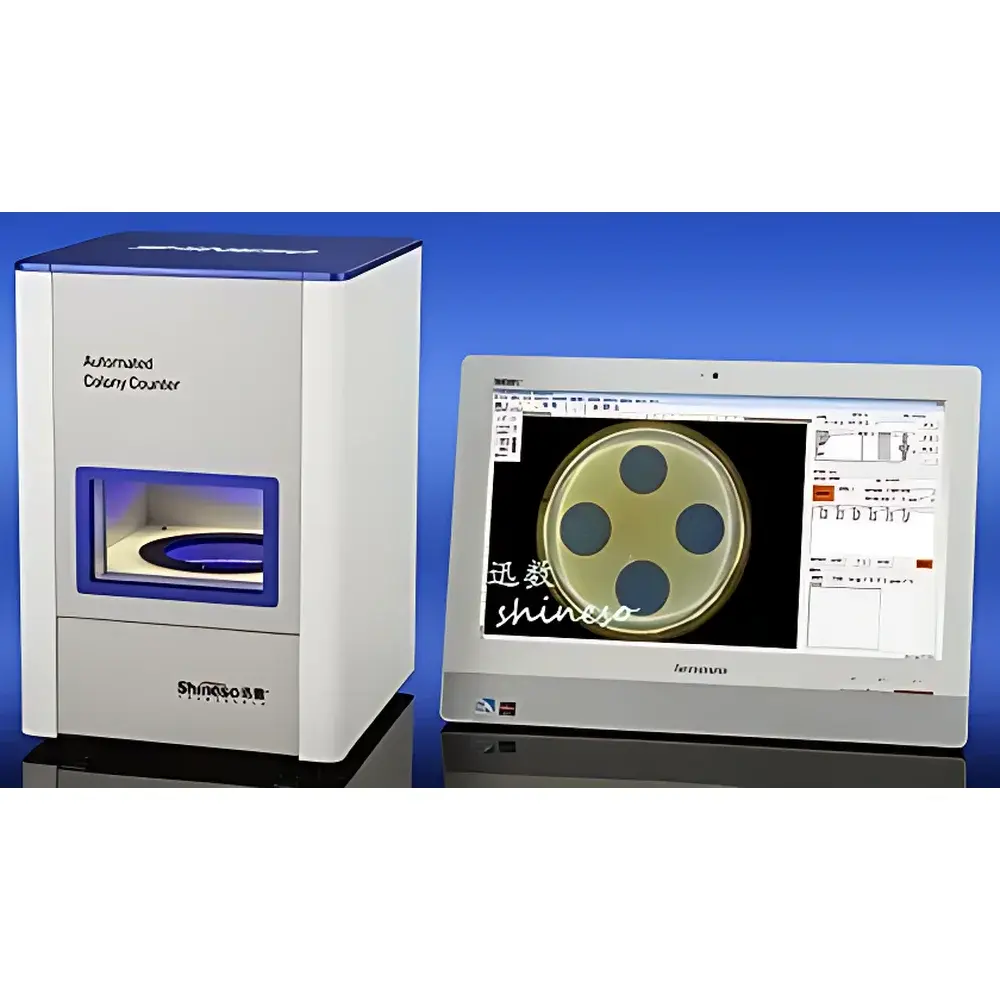
Shunso Z10 Zone of Inhibition (Antibiotic Potency) Measurement System
| Brand | Shunso |
|---|---|
| Origin | Zhejiang, China |
| Manufacturer Type | OEM Manufacturer |
| Region Category | Domestic (China) |
| Model | Shunso Z10 |
| Pricing | Upon Request |
Overview
The Shunso Z10 Zone of Inhibition (Antibiotic Potency) Measurement System is a regulatory-compliant, high-precision digital imaging platform engineered for quantitative analysis of antimicrobial activity in pharmaceutical and microbiological quality control laboratories. Based on standardized agar diffusion assays—including the Kirby-Bauer disk diffusion method, Oxford cup assay, agar well diffusion, and plug diffusion—the system captures, processes, and quantifies transparent inhibition zones formed around antimicrobial agents embedded in or applied to nutrient agar plates. Its core measurement principle relies on high-fidelity digital image acquisition coupled with algorithmic edge detection and geometric modeling of circular or near-circular zones against heterogeneous microbial lawns. Designed to meet the 2020 Chinese Pharmacopoeia (ChP) requirements and aligned with USP <51>, ISO 20776-1, and FDA 21 CFR Part 11 expectations for computerized systems, the Z10 delivers traceable, auditable, and reproducible potency data essential for QC release testing, stability studies, and strain susceptibility profiling.
Key Features
- Fully enclosed, light-tight aluminum alloy chassis (32 × 34 × 46 cm) eliminates ambient light interference and ensures optical integrity during image capture.
- Dual-mode illumination architecture: (1) Embedded diffuse fog-light LED array (96 LEDs, 3100–5800 K color temperature, 50–7000 lux adjustable) for uniform, low-glare surface illumination; (2) Dual-layer suspended dark-field backlighting for enhanced contrast between transparent inhibition zones and surrounding bacterial turbidity.
- UV sterilization module (254 nm) integrated into the sample chamber for routine decontamination between runs.
- Z10 Pro variant equipped with a 21-megapixel Sony 4/3″ color CMOS sensor and a 12-megapixel, large-format fixed-focus lens (f/2–f/16, 170 lp/mm resolution), delivering distortion-free, edge-to-edge sharpness critical for sub-pixel boundary localization.
- Intelligent illumination controller with recessed magnetic-touch panel: four independent lighting mode switches, dual-channel color temperature tuning, and three-channel stepless brightness adjustment.
- Integrated USB 3.0 interface for real-time image streaming and deterministic latency performance.
Sample Compatibility & Compliance
The Z10 supports standard Petri dishes (90 mm and 150 mm diameters), agar plates of variable thickness (3–8 mm), and diverse inoculation methods—paper disk, Oxford cup, agar well, plug, and spot inoculation. It accommodates both Gram-positive and Gram-negative test strains (e.g., Staphylococcus aureus ATCC 25923, Escherichia coli ATCC 25922) under CLSI- and EUCAST-recommended incubation conditions. All measurement workflows comply with ChP 2020 Volume IV (General Chapters 9201, 9202, 9203) for antibiotic potency determination via one-, two-, and three-dose parallel-line assays. The system’s architecture satisfies Annex 11 (EU GMP), WHO TRS 937, and PIC/S PI 011-3 requirements for electronic record integrity, including audit trail generation, role-based access control, and immutable data archiving.
Software & Data Management
The SZone™ multi-mode analysis software implements three complementary segmentation algorithms: (1) “Auto-Detect” for sharply defined, high-contrast zones; (2) “Circle-Fit Approximation” for irregular or fragmented zones; and (3) “Three-Point Manual Circle” for low-contrast or diffused boundaries. Antibiotic potency calculation modules support USP monograph-compliant single-dose assays and ChP 2020-compliant two- and three-dose parallel-line analyses—including slope-ratio, validity testing, and combined potency estimation across replicate plates. The system enforces a four-tier permission model (“System Administrator”, “Data Manager”, “Operator”, “Reviewer”) with strict separation of duties. All user actions—including image acquisition, parameter selection, zone measurement, report generation, and review approval—are timestamped, attributed, and immutably logged. Raw images, metadata, and intermediate calculation files are stored in a relational database with SHA-256 hashing; export options include PDF (with digital signature support) and Excel (with full audit trail metadata embedded).
Applications
The Z10 serves as a validated tool for: antibiotic potency release testing in API and finished dosage form manufacturing; antimicrobial susceptibility testing (AST) in clinical and industrial microbiology labs; high-throughput screening of novel antimicrobial compounds; quality assessment of disinfectants and preservatives; and validation of culture media performance per ISO 11133. Its calibrated measurement accuracy (repeatability ≤0.002 mm; inter-instrument variability ≤0.2%) enables use in GLP-compliant stability protocols and regulatory submissions requiring documented metrological traceability. The system also supports research applications such as efflux pump inhibitor evaluation, biofilm inhibition assays, and synergy testing (e.g., checkerboard + zone overlay).
FAQ
Does the Z10 meet FDA 21 CFR Part 11 requirements for electronic records and signatures?
Yes—the system implements role-based authentication, automated audit trails with tamper-evident logging, electronic signatures for review/approval, and secure archival of raw images and processed data in accordance with Part 11 Subpart B.
Can the Z10 be used for CLSI M02-A12 or EUCAST disk diffusion interpretive criteria?
Yes—measurement output (zone diameter in mm) is fully compatible with CLSI and EUCAST breakpoint tables; users may configure custom interpretation rules within the software.
Is calibration traceable to national standards?
The system supports user-defined calibration using NIST-traceable stage micrometers or certified reference plates; factory default calibration is verified against ISO 13528 reference materials.
What operating system and hardware configuration is required?
The bundled workstation runs Windows 10 Pro (64-bit), with Intel Core i3/i5 dual-core CPU, 4 GB RAM, 1 TB HDD, and 21.5″ Full HD display; optional upgrades to Windows 11 and SSD storage are available.
How is data backup and disaster recovery implemented?
The Data Manager role enables scheduled database backups, encrypted offsite export (AES-256), and versioned snapshot restoration; all backups retain full audit trail linkage to original measurement sessions.






