
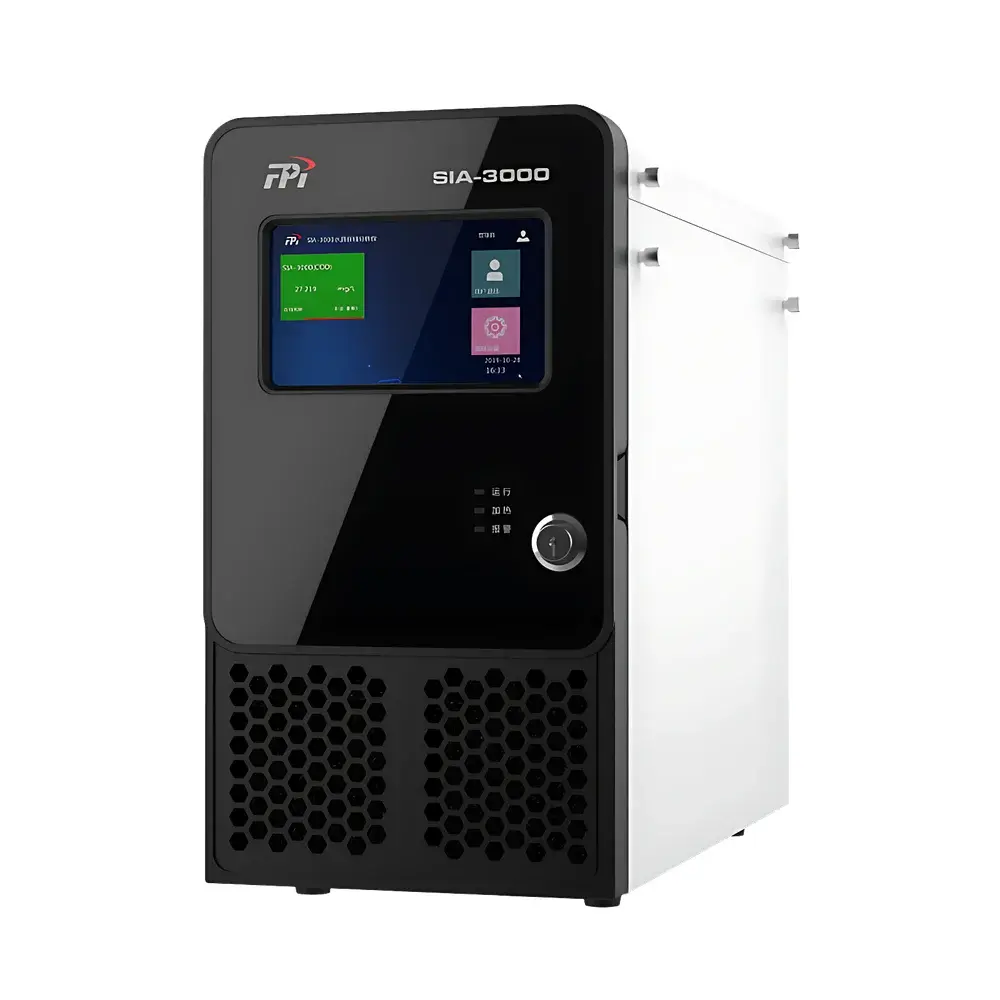
SIA-3000 Series Online Water Quality Analyzer by FPI (Hangzhou Fuluo Technology Co., Ltd.)
| Brand | FPI |
|---|---|
| Origin | Zhejiang, China |
| Manufacturer Type | OEM Manufacturer |
| Country of Origin | China |
| Model | SIA-3000 Series |
| Instrument Type | Online Water Quality Analyzer |
| Measured Parameters | Total Nitrogen (TN), Total Phosphorus (TP), Ammonia-Nitrogen (NH₃-N), Permanganate Index (CODₘₙ), Chemical Oxygen Demand (COD) |
| Regulatory Compliance | HJ 636, GB 11893, HJ 536, GB 11892, HJ 828 |
| Sample Matrix | Surface Water, Drinking Water, Municipal Wastewater, Industrial Process Water, Effluent from Pollution Sources |
| Measurement Modes | Continuous, Cyclic, Manual, Remote-Triggered |
| Calibration & Maintenance | Automated Cyclic Cleaning and Standard Calibration |
| Flow Architecture | Sequential Injection Analysis (SIA) |
Overview
The SIA-3000 Series Online Water Quality Analyzer is an industrial-grade, sequential injection analysis (SIA)-based platform engineered for unattended, long-term monitoring of critical water quality parameters in real time. Designed for deployment in fixed-site environmental monitoring stations, wastewater treatment plants, drinking water distribution networks, and industrial effluent discharge points, the system implements standardized wet-chemistry methodologies to quantify total nitrogen (TN), total phosphorus (TP), ammonia-nitrogen (NH₃-N), permanganate index (CODMn), and chemical oxygen demand (COD). Its analytical architecture adheres strictly to Chinese national and environmental protection standards—including HJ 636 (TN), GB 11893 (TP), HJ 536 (NH₃-N), GB 11892 (CODMn), and HJ 828 (COD)—ensuring regulatory traceability and methodological consistency with laboratory reference procedures. Unlike spectrophotometric or electrochemical spot sensors, the SIA-3000 performs full-sample digestion, reagent-controlled reaction kinetics, and photometric detection within a closed, pressure-regulated fluidic path—delivering laboratory-grade accuracy under field conditions.
Key Features
- Modular, compact design: Integrated chassis with <1.2 m³ footprint; weight <45 kg; optimized for wall-mounting, skid integration, or cabinet installation in constrained utility spaces.
- Sequential injection fluidics: Precision syringe-driven metering eliminates peristaltic pump wear, reduces carryover (<0.5%), and enables programmable reagent/sample volume control (10–500 µL range).
- Intelligent diagnostics: Real-time monitoring of tubing integrity, liquid level in reagent reservoirs, flow path pressure differentials, and photometric baseline drift—with configurable alarm thresholds and event logging.
- Adaptive measurement strategy: Auto-ranging capability across three programmable concentration spans per parameter (e.g., NH₃-N: 0.1–5 mg/L, 5–50 mg/L, 50–200 mg/L); automatic dilution and re-analysis triggered upon signal saturation.
- Multi-mode operation: Supports continuous sampling (12–60 min intervals), scheduled cyclic analysis (user-defined time windows), manual initiation via local HMI, and external command execution via Modbus TCP or OPC UA.
- Autonomous maintenance: Scheduled ultrasonic-assisted line flushing, air-gap isolation between sample and reagent streams, and on-board standard calibration using certified reference solutions at user-configurable frequencies (e.g., every 6/12/24 hours).
Sample Compatibility & Compliance
The SIA-3000 accommodates raw, filtered, or pre-sedimented aqueous matrices without pretreatment—provided suspended solids <20 mg/L and chloride concentration remains below 2,000 mg/L (to avoid interference in COD and TN digestion). It meets structural and operational requirements aligned with ISO 5667-16 (water quality sampling—analysis of treated wastewater), and its method validation documentation supports GLP-compliant data generation. While not certified to US EPA Methods (e.g., 351.2, 365.2), its adherence to HJ-series protocols ensures equivalency for regulatory reporting in China’s Ministry of Ecology and Environment (MEE) frameworks. All internal wetted materials—PFA tubing, quartz cuvettes, and ceramic syringe components—are chemically inert to strong oxidants (e.g., K₂S₂O₈, KMnO₄) and acidic digestants (H₂SO₄/H₃PO₄ mixtures), minimizing leaching and cross-contamination.
Software & Data Management
Embedded Linux-based firmware provides local web interface (HTTPS) for configuration, diagnostics, and live trend visualization. Raw absorbance values, temperature-compensated results, calibration coefficients, and system health logs are timestamped and stored onboard (16 GB eMMC, >12 months at 15-min interval). Data export supports CSV, XML, and Modbus RTU/TCP protocols for seamless integration into SCADA, LIMS, or cloud-based environmental dashboards. Audit trail functionality records all user actions (login/logout, method edits, calibration events) with immutable timestamps—supporting basic 21 CFR Part 11 compliance when deployed with external identity management and electronic signature workflows. Firmware updates are performed via secure SFTP or USB drive with SHA-256 signature verification.
Applications
- Surface and groundwater quality surveillance networks requiring multi-parameter compliance reporting (e.g., national surface water monitoring stations).
- Drinking water treatment plants performing source water early-warning detection of nutrient surges or organic loading shifts.
- Municipal wastewater facilities fulfilling discharge permit requirements for TN, TP, and COD at outfall points.
- Industrial parks implementing self-monitoring systems for process cooling water, boiler feedwater, and regulated effluent streams (e.g., textile, pharmaceutical, food processing sectors).
- Research platforms evaluating treatment efficiency of constructed wetlands, membrane bioreactors (MBRs), or advanced oxidation processes (AOPs).
FAQ
What sample pretreatment is required prior to analysis?
No filtration or centrifugation is needed for samples with turbidity <50 NTU and TSS <20 mg/L. Higher particulate loads require optional inline 5-µm filter modules (sold separately) to prevent flow path clogging.
Can the instrument operate unattended for extended periods?
Yes—designed for >30 days of continuous operation between routine maintenance cycles, assuming ambient temperature 5–40°C, stable power supply, and reagent replenishment per consumption tracking alerts.
Is remote firmware update supported over cellular or satellite links?
Firmware updates require authenticated HTTPS or SFTP connection; low-bandwidth cellular (LTE-M) is supported, though large binary transfers (>10 MB) are recommended over wired Ethernet for reliability.
How is calibration traceability maintained?
Certified reference standards (traceable to NIM, China) are used during factory calibration; end-users perform periodic verification using secondary standards with documented uncertainty budgets—fully recordable in the audit log.
Does the system support dual-stream analysis (e.g., influent and effluent simultaneously)?
Not natively—the SIA-3000 analyzes one sample stream at a time; however, multiplexed sampling via external 6-port selection valve (with TTL/Modbus control) enables alternating analysis of up to four independent sources.







